
Choosing Industrial Air Blow Guns for Safe, Low-Noise Parts Cleaning
Choosing Industrial Air Blow Guns for Safe, Low-Noise Parts Cleaning
Selecting industrial air blow guns for parts cleaning requires more than choosing the highest air output. Quality and safety teams must balance cleaning efficiency with noise exposure, air-consumption control, operator protection, and site-specific compliance requirements. The right blow gun design can remove chips, dust, and coolant residue while reducing workplace risk, protecting sensitive components, and supporting more consistent manufacturing operations.
That balance matters in machining cells, casting finishing areas, assembly lines, maintenance workshops, and fluid-power equipment production. Compressed air is readily available, responsive, and simple to direct. It is also easy to misuse. A conventional open pipe or a poorly chosen high-flow nozzle may create excessive noise, propel sharp chips into nearby work areas, consume more air than the task requires, or force contamination deeper into seals, bearings, connectors, and internal passages.
For quality personnel, the issue is whether cleaning actually supports inspection and downstream assembly. For safety managers, it is whether the method introduces avoidable exposure to noise, airborne debris, pressure-related injury, and poor ergonomic practices. Procurement teams need a selection process that looks beyond unit price and considers nozzle behavior, material compatibility, maintainability, and documentation from the supplier.
Start with the contamination, not the tool
“Parts cleaning” covers very different tasks. A CNC-machined aluminum housing may have fine chips trapped around drilled holes. A forged shaft may need loose scale removed before visual inspection. A valve body may contain residual abrasive media, while a hydraulic component may require cleanliness control that makes unrestricted air blowing unsuitable. Treating these applications as identical is one of the most common selection errors.
Before comparing industrial air blow guns, define what must be removed and where it is located. Loose dry dust is different from wet coolant residue. Large swarf on an external surface is different from particulate hidden in a blind hole, threaded port, or internal fluid passage. The part material also changes the decision: a robust casting can tolerate a different cleaning approach than a finished bearing race, coated pipe fitting, precision gear, or pneumatic valve component.
Compressed air is generally most appropriate when debris can be directed toward a controlled collection point and when blowing will not compromise the part or surrounding process. If material is hazardous, highly respirable, oily, or likely to be redistributed rather than removed, local extraction, vacuum collection, enclosed washing, or another cleaning method may be the safer starting point. An air gun should not become a substitute for process containment.
Airflow, pressure, and nozzle geometry are not interchangeable
A blow gun’s effectiveness is shaped by the interaction of supply pressure, available flow, nozzle geometry, working distance, and the operator’s angle of attack. High pressure alone does not guarantee better cleaning. In some situations, a concentrated jet simply scatters debris across the bench or drives coolant and particles into crevices. In others, an air-amplifying or multi-port nozzle may produce a broader, more useful cleaning pattern while drawing in surrounding air.
The practical question is not “Which gun has the strongest blast?” It is “What air pattern removes the required contamination at the lowest reasonable supply demand and with acceptable operator exposure?” This distinction is especially relevant where many stations share one compressed-air system. A tool that uses more air than necessary may contribute to pressure instability elsewhere in the plant, affecting pneumatic actuators, controls, and machine-tool functions.
Buyers should request operating information at the intended inlet pressure rather than relying on a general product description. Useful details include recommended pressure range, air consumption, nozzle outlet configuration, connection size, and whether the stated performance depends on a specific hose diameter. Long or undersized hoses, restrictive quick couplings, and poorly maintained filters can materially change the result at the nozzle.
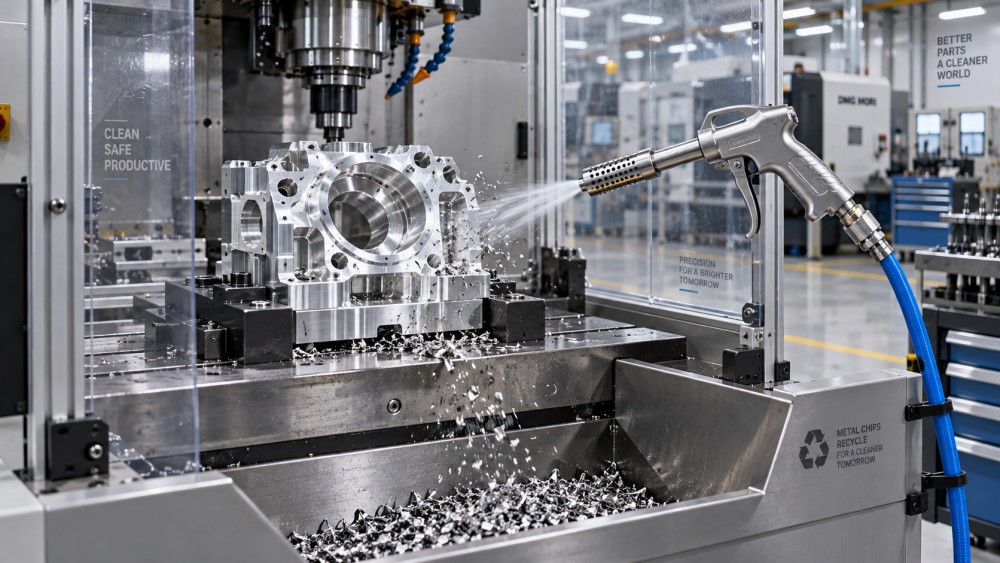
Nozzle shape should follow the work. A narrow straight nozzle can help reach recessed features but may concentrate debris and increase the chance of ricochet. A flat nozzle is often better for sweeping a broad surface. An extended lance can improve access to guarded areas or deep workpieces, although it adds leverage and may increase wrist strain if used continuously. Flexible extensions solve some access problems but should not be selected where they can contact rotating equipment, hot surfaces, or sharp edges.
Noise needs to be evaluated at the task level
Noise is often treated as an unavoidable side effect of compressed-air cleaning. It should be treated as a design variable. The sound level heard by an operator depends not only on the gun and nozzle, but also on supply pressure, blowing duration, the distance to the workpiece, reflected sound from machine enclosures or metal bins, and whether the jet strikes a sharp edge, cavity, or perforated component.
A nozzle described as low-noise may be a sensible option, but the claim should be assessed in the actual workstation. Catalog test conditions may not reproduce the acoustics of a machining enclosure, a large fabricated frame, or a confined maintenance area. Where air blowing is frequent, safety teams should consider the full exposure pattern: how many cycles occur per shift, how long each cycle lasts, who is nearby, and whether workers must communicate during the operation.
Reducing pressure to the lowest effective level can lower noise and air use at the same time, provided cleaning quality is verified. A regulated point-of-use supply makes this easier than relying on plant header pressure. It also prevents operators from informally increasing pressure to compensate for clogged nozzles, unsuitable hoses, or a cleaning method that was never matched to the part.
Safety features deserve the same attention as cleaning performance
Industrial air blow guns should be evaluated as handheld safety equipment, not merely as pneumatic accessories. The trigger should allow predictable control rather than an abrupt, difficult-to-modulate discharge. A comfortable grip and balanced body reduce the tendency to hold the tool in an unsafe direction when performing repetitive work. For oily environments, surface texture and glove compatibility matter as much as appearance.
Look closely at the nozzle’s behavior if the outlet is blocked against a surface. Safety-oriented nozzle designs may be intended to limit pressure buildup through side ports, bypass paths, or other engineered outlet arrangements. The supplier should be able to explain how the design performs under blockage and which workplace rules or recognized practices it is intended to address. Requirements vary by jurisdiction and application, so this should be confirmed against local safety obligations rather than assumed from a label alone.
Chip control is equally important. Blowing dry machining chips from a fixture may expose the operator’s hands, face, and eyes even when the nozzle itself is well designed. Guarding, a chip shield, a transparent enclosure, or a dedicated collection arrangement can be more effective than relying on personal protective equipment alone. Eye and face protection, hearing protection where required, and suitable workwear remain part of the operating system, but they do not correct an uncontrolled cleaning process.
Do not use air cleaning to hide a process problem
If operators spend a long time blowing every part, the underlying issue may be machining strategy, coolant management, chip evacuation, deburring, washer performance, or fixture design. This is particularly visible in precision machining, where chips repeatedly lodge in the same pockets, tapped holes, and intersecting passages. Changing to a more aggressive nozzle may improve speed temporarily while increasing noise and contamination transfer.
Quality teams should distinguish between a process that removes loose external debris and one that achieves a defined cleanliness condition. For hydraulic and pneumatic components, internal contamination can affect seals, valve response, and service life. Air used for final cleaning may itself need suitable filtration and dryness, depending on the component and customer requirement. In such cases, the specification should address the air supply as well as the hand tool.
Material choice and durability affect long-term control
The body and nozzle materials should match the environment. Metal blow guns can be appropriate in demanding industrial settings, but corrosion resistance, impact behavior, and electrical considerations may still need review. Composite or engineered polymer bodies can reduce weight and may be suitable for many assembly and inspection operations, yet they must withstand the actual coolant, solvent residue, temperature range, and risk of mechanical damage at the site.
A damaged nozzle changes both cleaning behavior and safety performance. Bent extensions, cracked bodies, worn trigger valves, leaking couplings, and blocked side ports should be treated as inspection findings rather than minor inconveniences. A simple preventive check can include trigger return, visible damage, connection security, leakage, nozzle cleanliness, and confirmation that the air pattern remains consistent. Replacement parts availability is worth discussing before a high-volume rollout.
A practical selection framework
A useful evaluation starts with representative parts and real working conditions. Test a small number of candidate configurations at the intended supply pressure, with the normal hose, fittings, guards, and collection arrangements in place. Review the result with the people who own quality, safety, maintenance, and production. The preferred option is often not the one with the highest immediate cleaning force; it is the one that repeatedly meets the cleaning requirement without creating an unacceptable operational burden.
Bring quality, safety, and pneumatic knowledge into one decision
Air blow gun selection sits at the intersection of manufacturing quality and fluid-power practice. The same compressed-air network that drives cylinders, valves, and automation equipment also shapes the performance of manual cleaning tools. Poorly controlled air use can affect energy demand and plant pressure stability; poor cleaning can affect dimensional inspection, assembly cleanliness, coating adhesion, and component reliability.
This is why equipment evaluations benefit from structured technical information rather than isolated product comparisons. Global Industrial Machining & Piping Equipment Network (IMPE) covers the wider industrial context around machining, hydraulic and pneumatic equipment, cast and forged components, piping systems, and mechanical assemblies. For decision-makers, the useful question is how a small hand tool fits into a larger process: the part’s material and tolerance, the air system’s condition, the inspection requirement, and the risks present at the workstation.
Before approving a model, document the intended task, inlet conditions, nozzle configuration, cleaning acceptance criteria, and any required safety controls. Then validate the setup on representative production work rather than on an empty bench. That approach gives quality and safety teams a defensible basis for choosing industrial air blow guns that clean effectively without treating noise, airborne debris, or compressed-air consumption as afterthoughts.
Related News
- Using Industrial Air Blow Guns to Clear Chips Without Spreading DebrisOct 15, 2026Fluid Power Control Strategist
- Ductile Iron Pipe Valves: Which AWWA Standards Apply to Water Main Projects?Oct 15, 2026Dr. Elias Vance
- Why Vacuum Suction Cups Lose Grip on MDF in Woodworking MachinesOct 15, 2026CNC Kinematics Architect
- Choosing a Variable Displacement Piston Pump Manufacturer: What to VerifyOct 15, 2026Fluid Power Control Strategist
- Parallel vs. Angular Pneumatic Grippers for Confined Assembly StationsOct 15, 2026Fluid Power Control Strategist
- Die Castings vs. Investment Castings: Which Costs Less at Your Production Volume?Oct 14, 2026Foundry Phase-Change Fellow