
Air Regulators in Paint Lines: Setting Stable Pressure to Reduce Finish Defects
In a paint line, unstable compressed-air pressure can create finish defects even when the coating, spray gun, and operator are otherwise suitable. Pressure that is too low may produce poor atomization, heavy particles, and uneven coverage. Pressure that is too high can increase overspray, dry spray, bounce-back, and coating consumption. Rapid fluctuations can make the same gun behave differently from one part of a shift to the next.
Air Regulators help control this variable, but installing a regulator alone does not guarantee a stable result. The regulator must be correctly selected, placed, adjusted, and checked while air is actually flowing through the spray equipment. For quality and safety teams, the practical objective is simple: maintain repeatable pressure at the point of use without restricting required airflow or allowing contamination into the coating process.
Why Air Pressure Changes the Finish
Compressed air performs two jobs in a conventional spray application. It carries the coating toward the workpiece and breaks the liquid into droplets at the air cap. The balance between air pressure, air volume, fluid delivery, nozzle condition, coating viscosity, and spray distance determines the shape and consistency of the spray pattern.
A pressure reading taken while the trigger is released may look acceptable, while pressure falls significantly when the gun is spraying. That difference is one of the most common reasons a line appears correctly adjusted at startup but develops defects during production. The supply system may have enough static pressure but insufficient flow capacity, a restrictive filter, a small hose, an undersized regulator, or a partially closed valve.
Typical pressure-related symptoms include:
- Low or unstable pressure: poor atomization, coarse droplets, an uneven fan pattern, heavy wet spots, and possible runs or sags.
- Excessive pressure: overspray, dry or rough texture, reduced transfer efficiency, increased airborne coating, and faster booth filter loading.
- Pressure fluctuation: inconsistent gloss, color variation, patchy coverage, and defects that appear intermittently rather than on every part.
- Pressure decay during a shift: differences between the first and last parts, often caused by compressor demand, receiver capacity, leaks, moisture, or filter loading.
Pressure is therefore a process-control variable, not merely a number to set on the wall-mounted air line. The correct setting is the one that supports the spray equipment and coating specification under real operating conditions.
Where the Regulator Should Be Installed
Regulator location affects how meaningful the pressure reading is. A central regulator may control the general branch pressure, but it cannot always compensate for pressure loss through long pipe runs, flexible hoses, quick couplings, filters, valves, or multiple users sharing the same branch.
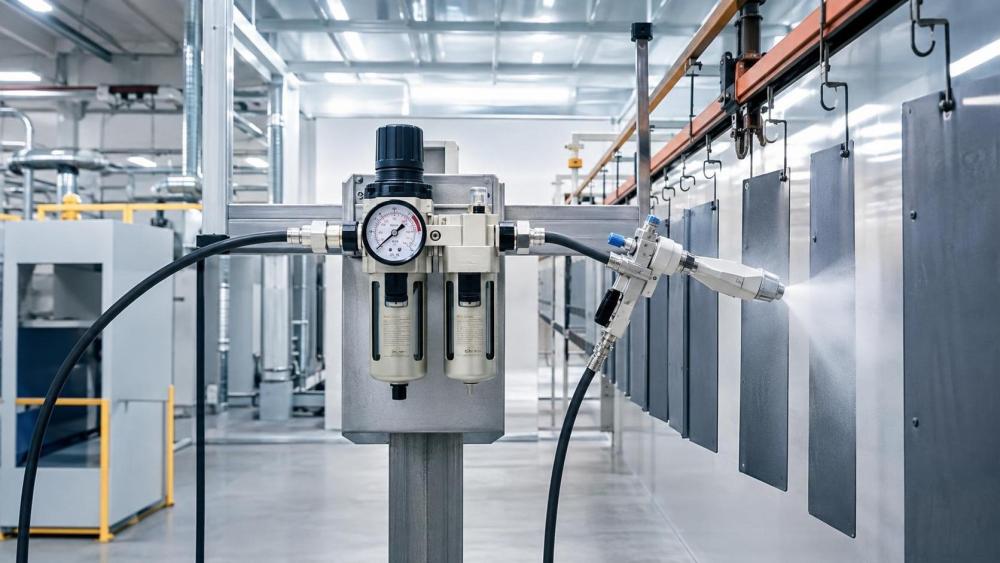
For a spray station, the final point-of-use regulator should be installed as close to the spray equipment as practical. A common arrangement is:
Compressed-air supply → shutoff valve → filter or water separator → regulator with gauge → flexible hose → spray gun or automatic applicator.
The filter and regulator may be part of a combined air-preparation unit, provided the assembly is sized for the required flow. The gauge should be visible to the operator and positioned where it can be checked without reaching into a hazardous area or interrupting the workpiece path.
Some systems benefit from separate regulators for atomizing air, fan air, and other pneumatic functions. Automatic paint equipment may also require different pressure circuits for valves, cylinders, triggering systems, or electrostatic equipment. Combining all functions under one regulator can create unwanted interactions: a short demand from a pneumatic actuator may cause the atomizing pressure at the gun to dip.
When several guns operate from the same branch, each station should be evaluated individually. A shared regulator can be suitable for a stable, correctly sized distribution line, but the final operating pressure still needs to be verified at each point of use.
How to Set Pressure Under Real Conditions
The adjustment procedure should begin with the coating manufacturer’s application instructions and the spray equipment supplier’s operating range. Those documents establish the acceptable starting point. The regulator should then be adjusted while the gun is spraying, not only while it is idle.
A practical setup sequence is:
- Confirm that the air line is clean, dry, and free from oil or liquid water that could reach the coating.
- Check the spray gun, air cap, nozzle, fluid needle, and seals for wear, damage, or blockage.
- Open the regulator gradually and set an initial pressure within the equipment recommendation.
- Trigger the gun in the same way it is used during production and observe the gauge while air flows.
- Spray a test panel or a representative part at the intended travel speed, distance, overlap, and coating flow.
- Adjust pressure only after checking fluid viscosity, nozzle size, fluid pressure, and fan control.
- Record the final operating setting and the conditions under which it was established.
The setting should be judged by the resulting spray pattern and finish, not by the highest possible atomization. More air does not automatically produce a better surface. Excessive air can dry droplets before they reach the part, increase overspray, disturb the wet film, and carry coating outside the target area.
For quality control, it is useful to distinguish between the regulator setting and the pressure actually available at the gun. If the regulator gauge is upstream of a long hose or restrictive coupling, the displayed value may not represent the pressure at the air cap. A temporary test gauge, an approved inline gauge, or a documented pressure check at the point of use can help identify this difference during commissioning and troubleshooting.
Selection Factors That Affect Stability
The regulator’s pressure range should match the required operating range. A device designed for a very broad range may offer less useful adjustment resolution near the low end of a paint application. Conversely, a regulator with an unsuitable upper rating may create a safety or equipment-compatibility problem.
Flow capacity is equally important. The regulator should handle the maximum air demand of the gun or automated applicator without excessive pressure drop. The selection should consider simultaneous users, pulsed demand, fan-air requirements, and future changes to the line. Port size alone is not a reliable indication of flow performance; the manufacturer’s flow and pressure-drop data are more useful.
Other selection points include:
In a paint environment, the regulator should not be considered separately from air preparation. A pressure regulator cannot remove moisture, oil, or solid particles. If contamination is present, the system may require appropriate filtration, separation, drainage, and possibly drying equipment. The exact arrangement depends on the compressor, piping material, climate, coating process, and required surface quality.
Common Causes of “Regulator Problems”
When the finish changes, operators often adjust the regulator first. That may correct the symptom temporarily while leaving the underlying issue untouched. A structured check can prevent unnecessary pressure changes.
Pressure falls only when spraying
This usually points to a flow restriction or insufficient supply capacity. Check the hose inside diameter, coupling type, clogged filter element, partially closed isolation valve, regulator flow rating, and compressor or receiver performance. Compare the idle gauge reading with the reading during continuous spraying.
The gauge moves constantly
Gauge movement may result from pulsed demand, a regulator that is too small, unstable upstream pressure, or a gauge installed where it is exposed to vibration. A pulsation-sensitive installation may require a suitable gauge, improved line layout, or separate circuits for different pneumatic functions.
The pressure setting drifts
Drift can be associated with regulator wear, contamination, damaged seals, vibration, temperature changes, or an adjustment knob that is not secured against unintended movement. A regulator that cannot hold a repeatable setting should be removed from production service for inspection rather than repeatedly readjusted.
The finish remains defective after pressure adjustment
Pressure is only one part of atomization. Inspect the air cap and nozzle, verify the coating’s viscosity and temperature, check fluid delivery, confirm gun distance and angle, and look for booth airflow disturbances. Runs may result from excessive fluid delivery or slow gun movement, while orange peel may also be caused by unsuitable viscosity, poor flash conditions, or droplets drying too quickly.
Quality and Safety Checks for Production
A stable paint line needs a repeatable verification method. The frequency can be based on process risk, production volume, coating sensitivity, and the consequences of a defect. At minimum, pressure should be checked during startup, after maintenance, after filter replacement, and whenever the finish changes without an obvious material or operator-related cause.
Useful records include the regulator identification, set pressure, pressure under flow, spray gun or applicator used, coating batch or formulation, test-panel result, and any corrective action. The purpose is not to create paperwork for its own sake. These records help distinguish a process change from equipment wear and provide evidence when a defect appears only under certain operating conditions.
Safety personnel should also verify that the regulator, gauge, hose, fittings, and downstream equipment are rated for the system conditions. Adjustment and maintenance should follow the site’s isolation and depressurization procedures. A regulator should never be used to compensate for an incorrectly rated hose, damaged fitting, blocked relief path, or unsafe supply pressure.
Paint-line air may also carry combustible vapors or create hazardous spray exposure, depending on the coating and booth arrangement. Electrical, ventilation, grounding, and equipment requirements must be handled under the applicable site procedures and local regulations. Pressure control supports safe operation, but it does not replace booth controls, personal protective equipment, or hazardous-area requirements.
A Better Decision Before Replacing Components
Replacing a regulator is justified when the unit cannot maintain pressure, has damaged seals or threads, shows unreliable gauge behavior, is contaminated beyond practical cleaning, or is undersized for the actual air demand. It is less likely to solve the problem when the real cause is a restricted hose, wet compressed air, an overloaded compressor, incorrect fluid delivery, or a worn spray gun.
Before selecting a replacement, document the operating pressure while spraying, peak and simultaneous air demand, connection size, air quality requirements, upstream pressure variation, ambient conditions, and the maintenance access available at the station. The selected assembly should then be validated with a representative coating and production pattern, rather than accepted solely because the gauge reaches the desired number.
For quality and safety teams, the most useful standard is repeatability. A paint line is under control when operators can achieve the same pressure under flow, the same spray pattern, and the same finish across normal shifts and equipment changes. Air Regulators are an important part of that control, but their value depends on the complete air path, accurate measurement, appropriate maintenance, and disciplined process settings.
Related News
- How to Assess a Rigid Coupling Supplier for Bore Accuracy and Traceable QualityOct 08, 2026Tribology & Kinematics Expert
- Titanium Alloys Compared: Balancing Strength, Corrosion Resistance, and MachinabilityOct 08, 2026CNC Kinematics Architect
- Where Ductile Iron Dismantling Joints Reduce Alignment Risk in Water PipelinesOct 08, 2026Pipeline Metallurgy Scientist
- Selecting a Precision Bearing Sleeve: Fits, Runout, and Material ChoicesOct 08, 2026Tribology & Kinematics Expert
- Face Milling Cutters: How Insert Geometry Affects Finish on Steel and AluminumOct 08, 2026CNC Kinematics Architect
- Single-Acting Cylinders for Clamping: Stroke, Force, and Return Spring ConsiderationsOct 07, 2026Fluid Power Control Strategist