
Air Blow Gun Price Guide: Comparing Material, Nozzle Type, and Air Use
Quoted air blow gun prices can look similar while the tools perform very differently in service. A low initial figure may apply to a short, general-purpose model with a basic molded nozzle, while a higher quotation may include a metal body, threaded extension, regulated flow design, or a nozzle intended for confined work. The relevant comparison is the delivered specification: body material, valve construction, inlet thread, nozzle geometry, operating pressure range, air consumption, packaging, and replacement-part availability.
In compressed-air systems, the tool itself is only one part of the expense. Every trigger pull draws from compressor capacity, treatment equipment, distribution piping, and the electrical energy needed to maintain pressure. A blow gun that removes chips quickly but consumes excessive air during frequent cleaning can create a larger operating burden than its unit price suggests. Conversely, restricting flow too aggressively can lengthen cleaning time or leave contamination on machined parts, fixtures, and work surfaces.
Read a Quotation Beyond the Unit Price
An air blow gun price should be compared on an equal technical basis. Ask whether the quoted item includes the nozzle, air fitting, hose connection, hanging hook, protective guard, and retail or industrial packaging. A catalog image may show an assembly with an extension tube, but the quotation may cover only the gun body. Differences in thread standard also matter. A tool supplied with one thread form may require an adapter before it can connect to an existing hose or quick coupling, adding both cost and possible leakage points.
Quantity affects price, but so does the production method. Die-cast or forged metal bodies generally require more material control and machining than simple molded bodies. A threaded brass valve seat, replaceable seal, precision-drilled nozzle, or plated extension tube can raise the quoted amount because these features add operations and inspection points. For a basic bench-cleaning task, such features may not be necessary. For repeated use near coolant, welding residue, abrasive dust, or rough handling, they can be relevant to service life.
Request a clear line description rather than accepting broad labels such as “metal blow gun” or “high-flow nozzle.” Useful quotation fields include body alloy or polymer grade, trigger material, inlet size, nozzle material, nozzle length, maximum stated working pressure, stated air consumption at a specified pressure, net weight, and carton quantity. If an air fitting is included, its material and thread should be identified separately.
Material Changes Both Durability and Application Fit
Plastic-bodied models are commonly used where low weight and moderate-duty cleaning are sufficient. Reinforced engineering polymers may resist many workshop chemicals and can reduce the chance of surface damage when the tool contacts a finished component. Their limitations depend on the resin, wall thickness, trigger pivot design, and exposure to heat or solvents. A vague description of “plastic” does not establish impact resistance or chemical compatibility.
Aluminum bodies offer a practical middle ground for many industrial assemblies. They are light, can be cast or machined with a defined thread form, and may receive an anodized, painted, or plated surface treatment. Surface treatment should be considered in wet or corrosive environments because scratches around the inlet, trigger pin, and nozzle threads can become points of deterioration. A cast aluminum body also needs sound wall thickness around threaded connections; overtightening a fitting can damage weak threads.
Steel construction usually provides greater resistance to impact and thread damage, although it adds weight. Coated carbon steel may be suitable for dry indoor service, while stainless steel can be selected where washdown, humidity, or corrosive process conditions justify it. Stainless grades are not interchangeable: corrosion resistance, hardness, and machinability vary by grade and finish. When stainless is specified, the requirement should identify the relevant grade rather than relying on appearance.
Brass is frequently used for valve components, threaded inserts, and nozzles because it machines cleanly and resists corrosion in ordinary compressed-air service. It is softer than steel, so a thin brass extension can bend if used as a lever or struck against a fixture. Material selection should follow the working environment rather than an assumption that the heaviest tool is automatically the best value.
Nozzle Geometry Determines Where the Air Goes
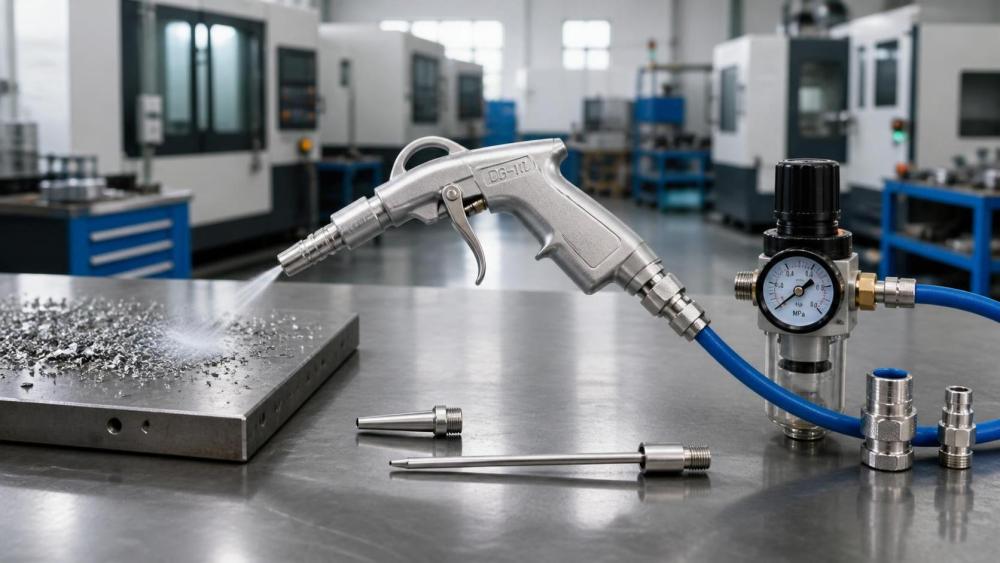
The nozzle is often the most consequential difference between two apparently similar tools. A short tapered nozzle gives a concentrated stream for close-range dust removal and chip clearing. It is easy to maneuver, but its direct jet may disturb loose debris over a wide area when used on open benches. A longer rigid extension reaches behind guards, into machine enclosures, or along fabrication joints. The extension length should be matched to the clearance actually available; an unnecessarily long tube can flex and is easier to damage in daily handling.
Rubber-tipped nozzles are useful where contact with a finished surface is possible. They can reduce scratching and may seal briefly against an opening for clearing a passage, although creating a seal can concentrate pressure in a confined space. Metal tips retain shape better in abrasive environments and are generally easier to clean, but they require more care around coated, painted, or precision-finished surfaces.
Safety-style nozzles are designed to limit pressure buildup when the outlet is blocked or held against a surface. Their internal passages, side ports, or shielded geometry may alter the sound, cleaning pattern, and perceived force compared with an unrestricted straight nozzle. The exact behavior depends on the nozzle design and supply pressure. A quotation should state the nozzle type and intended operating condition instead of using a generic safety claim without supporting technical information.
Flat fan nozzles distribute air across a broader strip and can suit drying, light dust removal, or clearing chips from a wide surface. They are less suitable where a narrow passage needs a focused jet. Multi-hole nozzles can spread flow and reduce localized blast intensity, but their small openings are more sensitive to contamination from untreated compressed air. For machining cells, the selected nozzle should be tested around actual fixtures, chuck jaws, tool holders, and guarding rather than evaluated only in open air.
Air Consumption Is an Operating-Cost Specification
Air use is normally expressed as a flow rate at a stated inlet pressure. That pressure condition is essential. A flow figure without its test pressure cannot be compared reliably with another figure. The supply pressure at the point of use can also differ from compressor discharge pressure because filters, regulators, undersized hose, quick couplings, and long pipe runs create pressure loss.
A large-orifice nozzle may feel powerful because it releases a high volume of air. Yet the required cleaning task may only need a controlled stream for several seconds. Where blow-off is repeated across many workstations, flow demand can influence compressor cycling, pressure stability for pneumatic actuators, and the size of filters and distribution lines. A lower-flow design may be preferable when it removes the required debris within an acceptable time at normal line pressure.
Air quality affects this comparison. Water, rust scale, compressor oil carryover, and pipe debris can partially obstruct a small orifice, change the spray pattern, and cause a trigger valve to leak. A filtered and drained line preserves repeatable output, while a contaminated line can make a sound nozzle appear inadequate. If parts must remain free from oil or moisture, the upstream air-treatment arrangement should be defined as part of the process requirement, not treated as an unrelated utility issue.
Trigger design also changes consumption in practice. A smooth progressive trigger allows short, controlled bursts. A stiff trigger or abrupt on-off action tends to encourage longer blasts. Spring return, pivot pin retention, valve-seat quality, and seal material influence both control feel and the chance of leakage during storage. A tool that hisses after release consumes air even when no cleaning is taking place.
Pressure Rating Requires Context
Do not assume that a stated maximum pressure is the preferred working pressure. The selected pressure should match the hose, coupling, regulator, fittings, and local operating procedure. The complete assembly is limited by its weakest rated component. A robust metal gun connected to a damaged lightweight hose does not create a robust system.
Higher pressure may improve removal of dry chips from a rough casting or machine table, but it can also propel particles farther and create rebound from hard surfaces. Sensitive assemblies may require lower regulated pressure, a wider nozzle, shielding, or an alternative cleaning method. Directing compressed air into bearings, seals, electrical connectors, skin, clothing, or sealed cavities can create damage or safety hazards. The application should define what is being removed, where it can travel, and whether the item being cleaned can tolerate the jet.
When the tool is installed at a fixed station, placing the regulator close to the work area makes the set pressure easier to control. Pressure adjustment at a distant compressor room does not account for downstream loss and encourages informal changes at the point of use. A locked or protected regulator setting may be appropriate where consistent air force is needed for a repeatable task.
Common Comparison Errors
- Comparing a body-only quotation with a complete assembly that includes an extension nozzle and coupling.
- Using maximum pressure as a substitute for flow information, even though nozzle orifice size strongly affects actual air demand.
- Selecting a long tube from a product photo without confirming that it clears guards, doors, fixtures, and nearby moving equipment.
- Ignoring inlet-thread compatibility until installation, then adding adapters that reduce clearance or introduce leaks.
- Assuming a metal exterior proves internal valve quality; the seat, seals, spring, trigger pivot, and machining of threaded joints still need attention.
- Evaluating only the purchase amount while omitting hose replacement, coupling changes, compressed-air use, downtime from leaks, and discarded damaged tools.
Specification Language That Reduces Ambiguity
A concise purchase description can prevent many avoidable substitutions. State the required body material or acceptable alternatives, inlet thread standard, nozzle form and length, intended operating pressure, maximum allowed air consumption if relevant, and whether a quick coupling is included. Add requirements for marking, packaging protection, and any needed documentation for material or inspection only when those items are genuinely necessary. Broad requests for “industrial quality” leave too much room for interpretation.
Before release, confirm a sample or technical drawing against the intended hose and regulator. Inspect thread engagement, trigger return, leakage at normal working pressure, nozzle alignment, and the stability of the hanging or storage feature. For a batch delivery, a simple incoming inspection can verify that nozzle style, quantity, fittings, and packaging match the order. A small mismatch repeated across multiple stations becomes expensive to correct after distribution.
Maintenance is usually straightforward: keep the inlet clean before connection, drain upstream filters, inspect the nozzle for blockage or bending, and replace damaged seals or couplings before they leak continuously. Avoid using the nozzle as a scraper, pry bar, or alignment tool. Store extensions where they cannot be crushed under heavier equipment. These routine controls preserve the assumptions used when the original price comparison was made.
The most defensible selection is the one that states the required cleaning result and then matches material, nozzle type, pressure, and air use to that result. A transparent specification makes quoted differences easier to explain and reduces the risk of paying for features that do not serve the actual work.
Related News
- How to Assess a Rigid Coupling Supplier for Bore Accuracy and Traceable QualityOct 08, 2026Tribology & Kinematics Expert
- Titanium Alloys Compared: Balancing Strength, Corrosion Resistance, and MachinabilityOct 08, 2026CNC Kinematics Architect
- Where Ductile Iron Dismantling Joints Reduce Alignment Risk in Water PipelinesOct 08, 2026Pipeline Metallurgy Scientist
- Selecting a Precision Bearing Sleeve: Fits, Runout, and Material ChoicesOct 08, 2026Tribology & Kinematics Expert
- Face Milling Cutters: How Insert Geometry Affects Finish on Steel and AluminumOct 08, 2026CNC Kinematics Architect
- Single-Acting Cylinders for Clamping: Stroke, Force, and Return Spring ConsiderationsOct 07, 2026Fluid Power Control Strategist