
Why Microglass Return-Line Filters Clog Early—and How to Extend Element Life
Early plugging of a return-line element should be treated as evidence from the hydraulic circuit, not simply as a consumable-parts problem. A microglass medium can capture fine particles efficiently, including debris that may pass through a coarser cellulose element. That performance can expose contamination, fluid degradation, or sizing errors that were previously hidden. Replacing the element without identifying the loading mechanism often leads to the same alarm, bypass event, or restricted return flow after a short interval.
The first distinction is whether the element is genuinely full of retained solids or whether its pressure drop is rising for another reason. Fine silt, wear metals, elastomer fragments, paint flakes, oxidized oil products, water-related deposits, and air-generated varnish can all produce different loading patterns. A collapsed pleat pack, distorted end cap, loose media seam, or blocked indicator passage points toward a different failure path than an evenly loaded filter surface.
Read the restriction signal in context
A return filter works under changing flow conditions. Cylinder retraction, accumulator discharge, multiple actuator movements, cold start, and rapid directional-valve shifts can produce short-duration return surges well above the nominal pump flow. If the filter housing or element was selected only from average flow, a normal machine cycle may repeatedly drive excessive differential pressure across the media. The restriction indicator may then trigger during transient peaks, even when the element has little accumulated contamination.
Confirm when the indicator changes state. An indication that appears only on cold mornings and clears once the reservoir warms suggests high viscosity or inadequate flow capacity. An indication that develops progressively at normal operating temperature is more consistent with particle loading, oxidation products, or a deteriorating component upstream. A permanently actuated indicator after element replacement can indicate a damaged indicator, blocked sensing port, incorrect element height, or an element that is not sealing correctly in the housing.
Differential-pressure readings are most useful when recorded with the same fluid temperature, machine condition, and actuator cycle. Comparing a cold reading after startup with a warm reading taken during idle can create a false diagnosis. Where a visual or electrical indicator is installed, inspect its set point and mounting arrangement before assuming that the element has reached its usable dirt-holding limit.
Contamination often enters after the filter
Return filtration protects the reservoir from contamination generated in working components, but it cannot correct every source. Worn cylinder rod seals can draw dirt and moisture into mobile equipment. Breathers with damaged caps, saturated desiccant, poor gasket contact, or an unsuitable filtration rating allow airborne contamination to enter the tank. Reservoir access covers, sight glasses, filler necks, and inspection ports are frequent leakage paths when sealing surfaces are scratched or hardware is left loose.
Maintenance work can introduce a high initial particle load. Opening hose ends without caps, reusing wiped fittings, installing a cylinder that was not internally cleaned, or topping up from an unfiltered container may send debris directly into the circuit. Newly fabricated pipework and manifolds deserve particular attention: weld spatter, scale, machining chips, abrasive residue, and thread sealant fragments can circulate for many cycles before reaching the return element. A filter that plugs shortly after such work may be doing exactly what it was installed to do.
Look beyond the main reservoir. Charge pumps, case drains, gearboxes with shared oil, auxiliary cooling loops, and offline transfer connections can each introduce or redistribute contaminants. A return element has limited ability to control particles produced on the pressure side before those particles pass through sensitive pumps, valves, and bearings. If wear is accelerating upstream, the filter may become the visible symptom rather than the initiating defect.
The debris pattern narrows the search
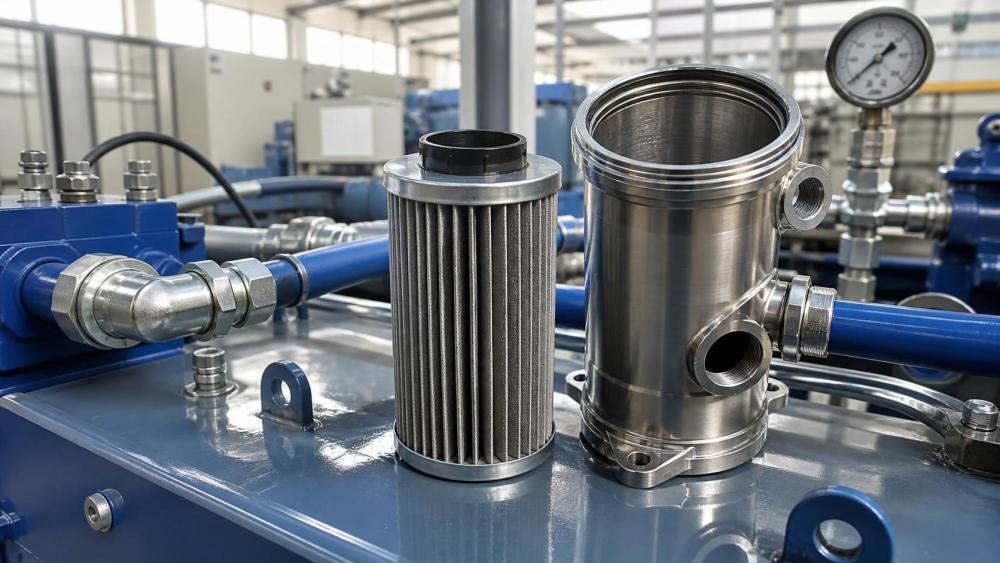
When an element is removed, preserve enough evidence to examine it. Note the installation date, service hours if available, operating complaint, fluid temperature, and condition of the indicator. Cut the element open with a dedicated filter cutter rather than a saw that adds metallic debris. Separate outer-surface contamination from material captured within the pleat pack.
Bright ferrous particles may indicate wear in a gear pump, piston pump, motor, bearing, or steel-lined actuator. Nonferrous flakes can come from bronze wear plates, aluminum housings, brass components, or certain coatings. Long black strips may be degraded seals, hose liner material, or rubber fragments from a coupling. A sticky brown or dark film can be associated with oxidation and varnish, while a pale gelatinous deposit may point to water contamination or incompatible fluid chemistry. These observations do not establish a source by themselves, but they determine which components merit closer inspection.
Fine, uniform gray loading commonly has a different cause from a few large flakes. The first may follow dirty make-up oil, inadequate breathers, prolonged wear, or incomplete flushing. The second can arise from a discrete failure, internal coating release, damaged hose, or recent repair activity. Sending a representative fluid sample for particle count, water assessment, viscosity, and condition testing is more useful when the sample is taken from a live, turbulent line or a designated sampling point, not from settled fluid at the tank bottom.
Fluid condition changes filter behavior
Viscosity has a direct effect on pressure drop. The same element passes warm fluid more easily than cold fluid, so a system that is acceptable in a heated workshop may show restriction in outdoor service or after a long shutdown. Use the fluid grade and temperature range specified for the circuit. Substituting a heavier oil, mixing grades, or using an unapproved fluid can raise return-line restriction even though the filter is clean.
Water affects both the fluid and the media-loading process. Free water can promote corrosion, reduce lubricity, and support sludge formation. Dissolved water may become free water as temperature changes. Air entrainment creates foam and can accelerate oxidation, while severe aeration may cause erratic indicator behavior and damage pump inlet conditions. Investigate low reservoir level, suction leaks, return pipes terminating above the fluid level, loose fittings, and damaged seals where aeration accompanies rapid element plugging.
Compatibility matters when fluid type changes. Some additives, seal materials, paints, and hose compounds react poorly with a new fluid chemistry. The result may be soft deposits, swollen elastomer particles, or released internal coatings. Before converting to a different oil type, confirm compatibility across seals, hoses, filter materials, tank coatings, and flushing fluid. A compatible element is not a substitute for confirming the whole circuit.
Element rating is only one part of sizing
A finer rating can improve cleanliness control, but it also needs adequate media area and flow capacity. Selecting an element solely by micron rating overlooks collapse rating, permitted differential pressure, bypass setting, seal material, temperature range, and expected cyclic flow. A fine microglass element installed in an undersized housing may have excellent efficiency and poor service life because its available area is insufficient for the actual return flow and contamination load.
Return flow should be calculated from the maximum simultaneous discharge condition, including differential cylinder areas. A rod-side cylinder volume can return fluid faster than pump delivery during extension or retraction, depending on circuit geometry. Regenerative functions, accumulators, and parallel actuators further complicate the estimate. The line size, elbow count, cooler restriction, and downstream tank connection should also be reviewed because high backpressure can add to the filter's differential-pressure burden.
Do not assume that an element of similar dimensions is interchangeable. End-cap geometry, bypass-valve location, center-tube strength, gasket compression, and media construction vary by design. An element that appears to fit can bypass internally, obstruct the flow path, fail to seat, or operate with an incorrect indicator relationship. Record the complete housing and element identification, including revision details where they exist, before ordering replacements.
Bypass events need attention, not reassurance
A bypass valve prevents excessive restriction from damaging the element or impairing return flow, but it allows unfiltered oil to return to the reservoir while open. In a circuit containing proportional valves, servo components, close-clearance pumps, or heavily loaded bearings, repeated bypass operation can distribute damaging contamination. A bypass valve that is stuck open, held open by debris, or set incorrectly can make the oil appear to circulate normally while cleanliness deteriorates.
Inspect the bypass assembly when service history shows frequent indicator events but removed elements do not appear heavily loaded. Confirm the valve moves freely, spring components are intact, and no packaging fragment or failed element material is lodged in the seat. Also verify that the housing's bypass arrangement matches the intended application. Some circuits require different protection priorities than a general return-line installation.
Installation details can shorten life immediately
Elements should remain sealed in clean packaging until installation. Before opening the housing, clean its exterior and the surrounding area. Drain or isolate the circuit according to the machine procedure, then inspect the bowl, cover, spring, standpipe, and sealing surfaces. A retained old gasket, twisted O-ring, damaged center post, or incorrect spring can prevent proper seating and cause abnormal flow paths.
Lubricate seals only with a fluid compatible with the system, install them without stretching or rolling, and tighten the housing to its specified condition. Over-tightening can damage threads, deform a cover, or crush a seal; under-tightening can admit air or leak under return pulses. After startup, inspect for leakage during actual actuator movement rather than only at idle.
Replacement-element storage also matters. Keep cartons dry, covered, and away from grinding dust, welding debris, direct sunlight, and extreme heat. Damaged packaging can permit contamination to settle on the media before the element reaches the housing. During transport between workshops or job sites, protect the element from impact that could deform the center tube or crack end-cap bonds.
Correct the system condition before shortening the interval
Reducing the replacement interval may be appropriate during cleanup after a known repair, component failure, or fluid conversion. It is not a durable response when the same type of contamination returns repeatedly. Establish a short monitoring period after corrective work, then compare differential pressure, fluid condition, and debris findings with the prior event. The trend is more informative than a single element change.
Where contamination generation cannot be eliminated quickly, an offline filtration loop may reduce reservoir contamination without adding restriction to the main return line. Its flow rate, media rating, duty cycle, and sampling arrangement should suit the reservoir volume and fluid condition. Offline filtration will not repair a failing pump, leaking rod seal, or damaged cooler, but it can support cleanup while the underlying fault is addressed.
Element life becomes more predictable when the return filter is treated as part of the hydraulic system rather than as an isolated service item. Match the housing and media to real flow and temperature, preserve evidence from plugged elements, control entry points during maintenance, and investigate changes in debris rather than merely resetting the indicator. That approach reduces avoidable bypass operation and keeps the reservoir from becoming a repeated source of contamination.
Related News
- How to Assess a Rigid Coupling Supplier for Bore Accuracy and Traceable QualityOct 08, 2026Tribology & Kinematics Expert
- Titanium Alloys Compared: Balancing Strength, Corrosion Resistance, and MachinabilityOct 08, 2026CNC Kinematics Architect
- Where Ductile Iron Dismantling Joints Reduce Alignment Risk in Water PipelinesOct 08, 2026Pipeline Metallurgy Scientist
- Selecting a Precision Bearing Sleeve: Fits, Runout, and Material ChoicesOct 08, 2026Tribology & Kinematics Expert
- Face Milling Cutters: How Insert Geometry Affects Finish on Steel and AluminumOct 08, 2026CNC Kinematics Architect
- Single-Acting Cylinders for Clamping: Stroke, Force, and Return Spring ConsiderationsOct 07, 2026Fluid Power Control Strategist