
Why Diaphragm Hydraulic Accumulators Lose Precharge and How to Prevent Downtime
Why Diaphragm Hydraulic Accumulators Lose Precharge and How to Prevent Downtime
Diaphragm hydraulic accumulators are often quiet, overlooked components—until a machine begins hesitating at the worst possible time. A press may lose its fast-response capability, a mobile machine may develop pressure spikes, or an emergency circuit may no longer have enough stored energy to complete a safe movement. In many of these cases, the root cause is not the pump or valve bank. It is lost gas precharge.
For after-sales maintenance personnel, diagnosing precharge loss in diaphragm hydraulic accumulators requires more than connecting a charging kit and adding nitrogen. A low reading can result from genuine gas loss, but it can also be caused by temperature changes, an incorrect test method, a damaged diaphragm, or a hydraulic circuit that was not fully depressurized before inspection. The right diagnosis matters because repeatedly recharging a failed accumulator may hide a developing problem and create another unplanned shutdown later.
This guide explains what precharge does, why it disappears, how to inspect an accumulator safely, and how maintenance teams can build practical prevention routines around real operating conditions.
What Precharge Actually Does in a Diaphragm Accumulator
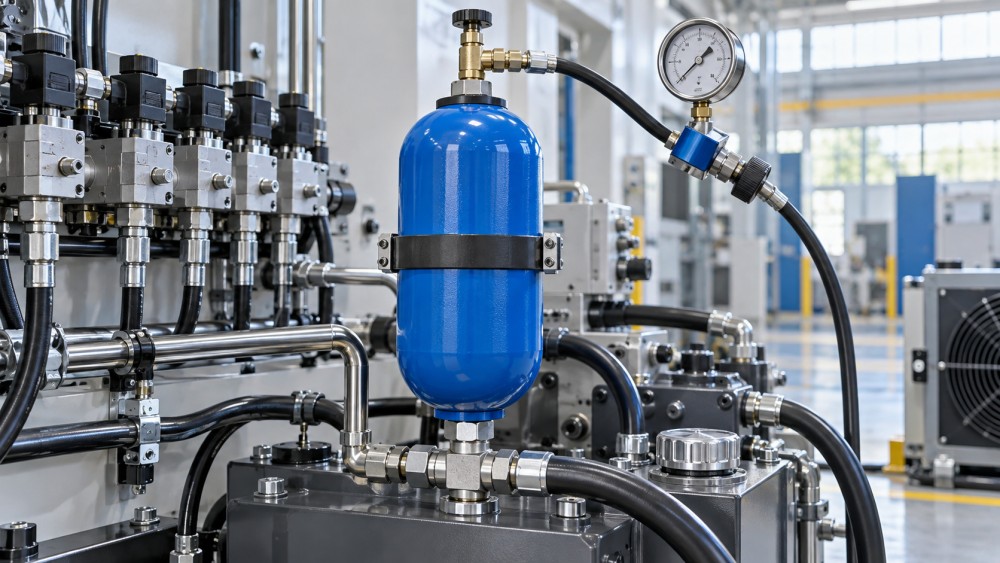
A diaphragm accumulator separates hydraulic fluid from a compressed gas charge, normally dry nitrogen. The flexible diaphragm moves as hydraulic fluid enters and leaves the shell. When system pressure rises, fluid compresses the gas and stores energy. When pressure falls, the gas expands and pushes fluid back into the circuit.
That stored energy can serve several purposes: absorbing pressure pulsation from pumps, damping hydraulic shock, compensating for leakage or thermal expansion, supplying a short burst of flow during peak demand, or supporting an emergency function if pump flow is lost.
Precharge pressure is the nitrogen pressure inside the accumulator before hydraulic oil enters it. If this pressure is too low, the diaphragm can overextend or repeatedly strike the fluid port area. The accumulator may accept more oil volume than intended, but it will not behave as designed and diaphragm life may be shortened. If precharge is too high, the unit may accept very little oil at normal system pressure, leaving little usable energy reserve.
In other words, an accumulator can still look physically intact while contributing almost nothing to machine performance. That is why a pressure instability problem should not be dismissed simply because there is no visible external oil leak.
The First Question: Is It True Precharge Loss?
Before assuming that nitrogen has escaped, maintenance teams should consider the operating context. Gas pressure changes with temperature. An accumulator checked in a cold workshop may show a lower pressure than it had when the machine was operating at elevated oil and ambient temperatures. Conversely, a unit checked soon after a hot production cycle can appear overcharged.
The comparison should therefore be made at a known and reasonably stable temperature, using the manufacturer’s specified reference conditions. A gradual difference caused by seasonal temperature is not the same as repeated pressure decline under similar conditions.
Another common mistake is measuring pressure while hydraulic pressure remains trapped on the fluid side. A diaphragm accumulator must be isolated from the system and the hydraulic side safely relieved according to the machine procedure before its true gas precharge can be checked. If residual oil pressure is still acting on the diaphragm, the reading may be misleading. It can also make servicing unsafe.
A useful maintenance record includes the accumulator identification, installation point, target precharge, measured pressure, ambient temperature, date, operating hours, and any observed symptoms. One isolated reading tells little. A trend recorded over several inspections tells a much clearer story.
Where the Nitrogen Goes: Common Causes of Precharge Loss
Normal permeation through the diaphragm material
No elastomer diaphragm is a perfect barrier forever. Over a long service period, a small amount of gas can diffuse through the diaphragm material. The actual rate depends on diaphragm compound, gas type, temperature, pressure, duty cycle, and fluid compatibility. This is one reason periodic inspection is part of normal accumulator maintenance, even when no obvious fault is present.
Slow, predictable loss over an extended period may be manageable through planned recharge intervals. A sudden or accelerating loss is different; it should trigger a closer investigation.
A leaking gas valve or damaged valve core
The gas charging valve is one of the most frequent leakage points. Dirt on the sealing surface, a loose cap, a worn valve core, damaged threads, or improper use of a charging connector can allow nitrogen to escape. In harsh environments, corrosion around the valve assembly can compound the problem.
The protective cap is not just a dust cover. On many designs, it also provides a secondary seal. Leaving it off after service invites contamination and increases the chance that a minor valve leak becomes an ongoing loss of precharge.
Diaphragm rupture or fatigue damage
A ruptured diaphragm is a more serious failure. It may occur after excessive cycling, severe pressure surges, incorrect precharge, fluid incompatibility, age-related elastomer degradation, or operation outside the permitted temperature range. Once the diaphragm fails, hydraulic oil can enter the gas side, and the accumulator will no longer separate fluid from nitrogen as intended.
Signs may include rapid loss of precharge, oil found at the gas valve during servicing, erratic pressure behavior, or an accumulator that appears unable to store or release useful fluid volume. Depending on the design, a failed diaphragm may require complete accumulator replacement rather than a field repair.
Damage at the fluid port or diaphragm seat
Low precharge is not merely a performance issue; it can be the beginning of mechanical damage. When the gas charge is insufficient, the diaphragm can be driven deeply into the fluid port during discharge. Repeated contact, especially in fast-cycling circuits, may cut, pinch, or fatigue the diaphragm. Contamination, damaged port geometry, or incorrect installation can make this problem worse.
Systems with high-frequency pump pulsation, rapid directional-valve shifts, or aggressive load changes deserve particular attention. The accumulator may be cycling far more often than the maintenance schedule assumes.
Incorrect charging practices
Many precharge problems begin during service rather than operation. Charging with compressed air or oxygen is dangerous and unacceptable in hydraulic accumulators; oxygen or air can create a serious combustion risk in the presence of oil. Only clean, dry nitrogen should be used, with approved charging equipment and a regulated supply.
Other service errors include charging too quickly, using an inaccurate gauge, failing to account for temperature stabilization, damaging the valve during connector installation, or setting precharge based on a remembered value rather than the equipment documentation. A technician may leave believing the accumulator has been restored, while the actual setting remains unsuitable for the circuit.
Symptoms That Point to a Weak or Empty Accumulator
Loss of precharge does not always produce a single clear alarm. It often shows up as a change in machine behavior. Maintenance staff may notice pump noise increasing, pressure gauges fluctuating more sharply, or pressure relief valves opening more frequently. On mobile equipment, boom or steering response may become less smooth. In industrial presses or clamping systems, cycle consistency can deteriorate during peak flow demand.
For emergency backup circuits, the warning signs can be more subtle and more important. A stored-energy function may still move an actuator when the system is warm and lightly loaded, yet fail during a cold start or a full-load stop condition. Testing only under convenient conditions can create false confidence.
Look for patterns rather than isolated symptoms:
- Pressure ripple or shock that was previously controlled;
- Longer pump run time or more frequent pump cycling;
- Slower actuator response during short, high-flow events;
- Reduced emergency or backup stroke capability;
- Repeated need to add nitrogen between planned service intervals;
- Oil traces around the gas valve or evidence of gas-side contamination;
- Noticeable performance changes after temperature, load, or cycle-rate increases.
These symptoms do not prove that the accumulator is at fault. A worn pump, blocked filter, malfunctioning relief valve, or internal cylinder leakage can produce similar complaints. Still, checking accumulator precharge early is usually a sensible diagnostic step because it is a known influence on pressure stability and stored energy.
A Safe Field Inspection Sequence
Accumulator work must follow the machine manufacturer’s lockout, depressurization, and safety requirements. Stored hydraulic and gas energy can cause serious injury if handled casually. The following sequence is a practical framework, not a substitute for the accumulator supplier’s service instructions.
- Confirm the accumulator’s duty. Identify whether it is used for pulsation damping, emergency energy, leakage compensation, thermal expansion, or peak flow support. The intended duty affects the correct precharge range.
- Review the specified value. Use the machine drawing, hydraulic schematic, service manual, or accumulator data sheet. Do not assume that nearby accumulators have the same setting.
- Isolate and relieve the hydraulic side. Shut down the system, lock out energy sources, and discharge trapped hydraulic pressure according to approved procedures.
- Allow temperatures to stabilize where practical. Record ambient conditions and avoid comparing a cold measurement with a hot commissioning record without adjustment.
- Inspect externally before connecting tools. Check the shell, mounting clamp, fluid port, gas valve, protective cap, corrosion condition, labels, and signs of impact or overheating.
- Use a suitable nitrogen charging and test assembly. The equipment should be rated for the pressure involved and fitted correctly to avoid valve damage or leakage.
- Measure, record, and assess the result. Compare the pressure with the specified target and previous trend data. If the reading is low, determine whether the loss is gradual, sudden, or associated with visible evidence of failure.
- Recharge only after the cause is considered. If a unit repeatedly loses charge, investigate the valve and diaphragm rather than treating nitrogen as a routine consumable.
Precharge Is Not a Universal Percentage
A frequently repeated rule says that precharge should be set to a fixed percentage of system pressure. This can be a useful starting concept, but it is not a universal field setting. The correct relationship depends on the accumulator application, minimum and maximum working pressures, required usable fluid volume, temperature range, response speed, and supplier limits.
For example, a pulsation damper may use a different precharge strategy from an accumulator intended to provide emergency actuator movement. A unit set for thermal expansion control may have yet another requirement. Setting all diaphragm hydraulic accumulators to one familiar percentage can leave some circuits underperforming and others vulnerable to damage.
When the design information is incomplete, the safest route is to consult the equipment manufacturer, hydraulic schematic, or accumulator supplier with the operating pressure range and intended function. Guesswork is particularly risky on safety-related circuits.
Preventing Repeat Downtime in Real Maintenance Conditions
The most effective preventive measure is not simply “check precharge more often.” It is to make accumulator condition visible before a machine loses function. Add each accumulator to the asset register, including part number, volume, pressure rating, diaphragm material where known, location, purpose, specified precharge, and service history. Large systems often contain multiple accumulators that look similar but serve very different roles.
Inspection intervals should reflect the duty cycle and consequences of failure. A lightly used thermal compensator does not need the same attention as an accumulator on a high-cycle press, mining machine, injection molding system, or emergency shutdown circuit. After any major hydraulic repair, system overpressure event, extended storage period, or unexplained pressure-control complaint, precharge verification should be considered.
Mounting and environment also matter. Excessive vibration can loosen connections and stress valve assemblies. Heat accelerates elastomer aging. Chemical exposure can attack seals and diaphragm materials. Poorly supported pipework may transmit shock directly into the accumulator connection. In these cases, the problem is not solved by adding nitrogen; the installation condition must be corrected.
Fluid cleanliness deserves equal attention. Contaminated oil can damage valves and pumps, but it can also contribute to abnormal pressure events that overwork an accumulator. Review filter condition, relief-valve performance, pressure spikes, and actual operating temperatures when precharge loss becomes recurrent.
When Recharging Is Reasonable—and When Replacement Is the Better Decision
Recharging is appropriate when pressure loss is gradual, the accumulator passes inspection, the gas valve seals correctly, and service records indicate normal long-term permeation. After recharge, document the stabilized pressure and schedule a follow-up check to confirm that the value remains stable.
Replacement or specialist evaluation is more appropriate when the unit loses pressure quickly, has a damaged shell or valve, shows signs of oil on the gas side, has been exposed to fire or severe impact, or cannot meet its required stored-energy function. Do not continue operating a questionable accumulator in a critical emergency circuit simply because it can temporarily be brought back to pressure.
For maintenance teams, the practical goal is not merely to restore a number on a gauge. It is to restore predictable hydraulic behavior. A correctly selected, properly charged, and routinely inspected diaphragm accumulator reduces pressure shock, supports stable cycle performance, and gives operators one less hidden failure waiting in the system.
When diaphragm hydraulic accumulators are treated as active energy-storage components rather than sealed maintenance-free vessels, precharge loss becomes easier to detect, easier to diagnose, and far less likely to turn into unexpected downtime.
Related News
- How to Assess a Rigid Coupling Supplier for Bore Accuracy and Traceable QualityOct 08, 2026Tribology & Kinematics Expert
- Titanium Alloys Compared: Balancing Strength, Corrosion Resistance, and MachinabilityOct 08, 2026CNC Kinematics Architect
- Where Ductile Iron Dismantling Joints Reduce Alignment Risk in Water PipelinesOct 08, 2026Pipeline Metallurgy Scientist
- Selecting a Precision Bearing Sleeve: Fits, Runout, and Material ChoicesOct 08, 2026Tribology & Kinematics Expert
- Face Milling Cutters: How Insert Geometry Affects Finish on Steel and AluminumOct 08, 2026CNC Kinematics Architect
- Single-Acting Cylinders for Clamping: Stroke, Force, and Return Spring ConsiderationsOct 07, 2026Fluid Power Control Strategist