
Which Pump Housing Material Withstands Chlorinated Water?
Which Pump Housing Material Withstands Chlorinated Water?
What pump housing material handles chlorinated water without degrading? There is no responsible one-word answer. A housing that performs reliably in treated municipal drinking water may corrode prematurely in a warm industrial recirculation loop, a sodium-hypochlorite dosing skid, or a pool system with poor chemical control. “Chlorinated water” can mean low residual disinfectant in a distribution network, intermittent chlorination during commissioning, concentrated chemical contact near an injection point, or water carrying chlorides from its source. Those are materially different duties.
For most project teams, the real objective is not simply finding a corrosion-resistant metal. It is selecting a pump casing, coating, seal arrangement, and manufacturing quality level that can tolerate the actual liquid, pressure, temperature, maintenance practice, and expected service life. Ductile iron with an appropriate protective system, stainless steel, selected bronze alloys, and engineered thermoplastics can all be credible choices. The correct option depends on where the pump sits in the process and what it will see when operation is not ideal.
Chlorine Is Only Part of the Corrosion Picture
Free chlorine is an oxidizing disinfectant. It can challenge metallic materials, particularly where deposits, stagnant pockets, damaged coatings, elevated temperatures, or crevices are present. Yet the corrosion risk is also shaped by chloride content, pH, dissolved oxygen, conductivity, suspended solids, and whether the system experiences frequent starts and stops. A water sample described simply as “chlorinated” does not provide enough information for a material decision.
This distinction is especially important around chemical injection. A main transfer pump may move bulk water with a modest disinfectant residual, while a nearby booster or recirculation pump may occasionally encounter locally concentrated hypochlorite solution before full mixing occurs. The second duty is far more severe. Cleaning procedures matter as well: a pump that normally handles neutral water can be exposed to aggressive chemicals during flushing, shock treatment, or maintenance.
Engineers should also separate chlorine from chlorides. Chloride ions are often associated with pitting and crevice corrosion in stainless steels. A site can have low disinfectant residual but high chloride content from groundwater, seawater influence, regeneration processes, or industrial contamination. Conversely, water with controlled chloride levels may still be challenging if a strong oxidizing disinfectant is introduced at elevated temperature.
The Practical Material Options
The material comparison below is best treated as a screening tool, not a substitute for chemical compatibility review. Housing geometry, coating continuity, pump duty, and the manufacturer’s documented limits all remain relevant.
Coated ductile iron: still a sound choice in many water systems
Ductile iron remains widely used for large and medium water-handling equipment because it combines strength, castability, vibration resistance, and practical cost. For normal treated-water duties, a ductile iron pump housing with a suitable internal lining or coating can provide a durable, serviceable solution. It also fits naturally with ductile iron piping networks, flanged connections, and municipal maintenance practices.
The weakness is not the base metal alone; it is the dependence on surface protection. Bare or poorly protected iron can corrode in chlorinated water, and localized coating failure can create a small defect with disproportionately serious consequences. Edges, bolt holes, gasket faces, impeller clearances, and areas affected by cavitation deserve attention. A coating specification should identify the intended fluid exposure and application method rather than merely state that the casing is “painted.”
For municipal EPC work, it is worth asking how the casting is prepared before coating, how coating thickness and continuity are inspected, what repairs are permitted, and how machined surfaces are protected during storage and installation. These questions often reveal more about expected lifecycle performance than a generic material label.
Stainless steel: useful, but not a blanket answer
Stainless steel is frequently chosen when buyers want a clean wetted surface and better general corrosion resistance than coated cast iron. It can be appropriate for potable-water equipment, process skids, vertical multistage pumps, and packaged pumping systems. However, stainless steel’s protective passive film can be compromised under unfavorable chloride and oxidizing conditions, especially in crevices or stagnant zones.
The familiar choice between 304 and 316 should not be reduced to a price comparison. Grade selection should consider water chemistry, temperature, surface finish, weld quality, cleaning chemicals, and the possibility of deposits. The higher alloy content of 316 can improve resistance in some chloride-bearing environments, but it is not a universal solution for every chlorinated service. More demanding conditions may require a different alloy family, a nonmetallic wetted end, or a redesigned process arrangement.
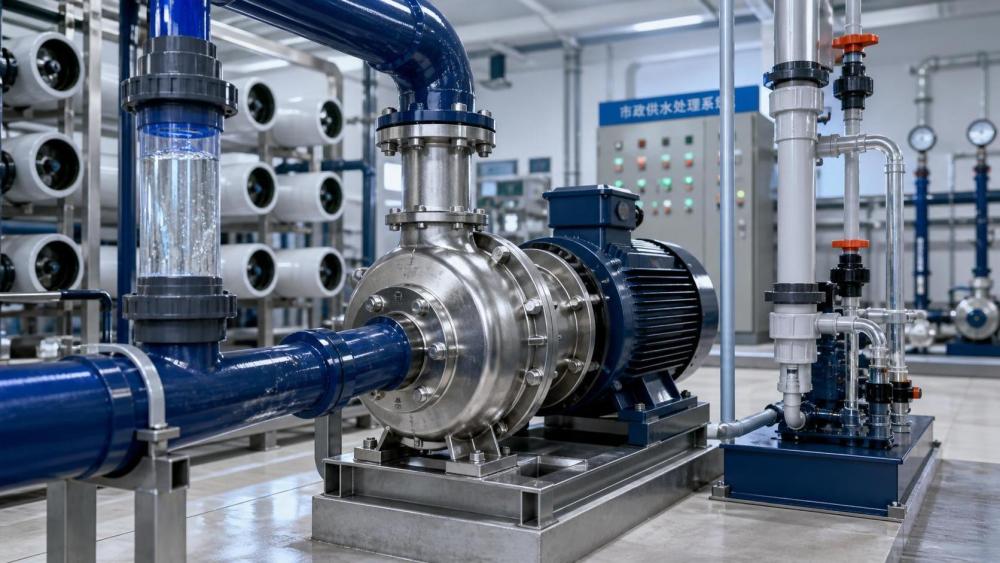
Bronze, Plastics, and Composites Have Distinct Roles
Bronze pump housings have a long history in water service. They are valued for casting quality, machinability, and corrosion performance in selected applications. But “bronze” covers a broad group of copper-based alloys, and their behavior can vary. Procurement documents should identify the required alloy rather than relying on a broad trade description. This is particularly important where water chemistry, chlorine treatment, or stagnant operation may promote selective attack in unsuitable copper alloys.
Engineered thermoplastics, including materials commonly used for chemical pumps, are often attractive for hypochlorite dosing and other corrosive applications because they do not rust and are not vulnerable to the same electrochemical mechanisms as metals. They can be an excellent route when chemical resistance is the governing requirement. Their limits are mechanical rather than imaginary: pressure rating, temperature capability, creep, flange loading, impact resistance, and support design all require review. A plastic housing that is chemically compatible but overstressed by pipework is not a reliable solution.
Composite or lined pump designs can bridge the gap between structural strength and chemical resistance. They may be considered where a metallic pressure boundary is needed but the process fluid demands a more resistant internal surface. In these designs, buyers should examine lining attachment, edge termination, inspection access, repair procedures, and the consequences of a lining breach.
The Housing Cannot Be Specified in Isolation
A corrosion-resistant casing will not prevent failure if the impeller, wear rings, shaft sleeve, fasteners, mechanical seal faces, elastomers, or flush piping are incompatible. Pump failures in chlorinated service are often system failures. An apparently sound housing may be paired with elastomers that harden, a seal arrangement that allows crystallizing chemical to accumulate, or metallic fasteners that create a corrosion weak point.
Cavitation adds another complication. It can remove coatings, damage passive surfaces, and accelerate localized attack. If a pump is expected to operate near its hydraulic limits, material selection cannot compensate for inadequate suction conditions. Likewise, dead legs and extended idle periods should be discussed early, because stagnant chlorinated liquid behaves differently from continuously refreshed flow.
For fabricated or cast housings, manufacturing quality also matters. Casting porosity, poorly controlled wall thickness, unmachined crevices, rough internal surfaces, weld defects, and dimensional variation at sealing faces can all shorten service life. IMPE’s coverage of industrial casting, machining, fluid handling, and piping systems is useful here because the question crosses disciplines: metallurgy, manufacturing process, corrosion control, hydraulics, and installation practice all meet at the pump.
A Better Way to Define the Duty Before Buying
Before comparing quotations, prepare a concise fluid-and-duty statement. It should state whether the pump handles treated bulk water, diluted solution, or chemical concentrate; whether chlorine is free chlorine, hypochlorite, chlorine dioxide, or another disinfectant; and whether concentration can vary during start-up, cleaning, or upset conditions. Include the expected temperature range, pressure, flow regime, solids content, pH where available, and the presence of chloride-bearing water.
Then ask the supplier to identify every wetted material, not just the housing. The response should distinguish base material from coating or lining, identify seal elastomers and metallic components, and explain any limitations connected to temperature, chemical concentration, or intermittent exposure. If potable-water compliance, local utility specifications, or project standards apply, these requirements should be defined at the start rather than added after the pump design is fixed.
For a custom cast housing, request the practical records that support repeatability: material traceability, dimensional inspection where it affects fit and sealing, coating inspection records when coated, and agreed acceptance criteria for casting quality. For a machined stainless housing, surface condition and weld treatment may be as important as nominal grade. These are not administrative details; they affect whether the material performs as intended in service.
The Most Defensible Choice Is Usually a Matched System
For ordinary chlorinated municipal water, coated ductile iron often remains a practical and economical pump housing solution when the coating system and operating conditions are properly controlled. Stainless steel may be justified where corrosion risk, cleanliness, compact design, or project specifications demand it, but grade selection should follow actual chemistry rather than assumption. Bronze can suit particular water-service designs, while thermoplastics and composites are often more logical for chemical dosing or higher chemical exposure.
The key question is therefore not simply, “Which material withstands chlorine?” It is: “What material system will remain reliable at this concentration, temperature, pressure, flow pattern, and maintenance condition?” Municipal owners, OEMs, contractors, and procurement teams should confirm that answer against project water data, pump manufacturer guidance, and the complete wetted-material schedule before release. That disciplined review is usually less costly than discovering incompatibility after the pump is installed.
Related News
- How to Assess a Rigid Coupling Supplier for Bore Accuracy and Traceable QualityOct 08, 2026Tribology & Kinematics Expert
- Titanium Alloys Compared: Balancing Strength, Corrosion Resistance, and MachinabilityOct 08, 2026CNC Kinematics Architect
- Where Ductile Iron Dismantling Joints Reduce Alignment Risk in Water PipelinesOct 08, 2026Pipeline Metallurgy Scientist
- Selecting a Precision Bearing Sleeve: Fits, Runout, and Material ChoicesOct 08, 2026Tribology & Kinematics Expert
- Face Milling Cutters: How Insert Geometry Affects Finish on Steel and AluminumOct 08, 2026CNC Kinematics Architect
- Single-Acting Cylinders for Clamping: Stroke, Force, and Return Spring ConsiderationsOct 07, 2026Fluid Power Control Strategist