
When Do High Pressure Hydraulic Pressure Switches Fail in Mobile Equipment?
High pressure hydraulic pressure switches in mobile equipment usually fail at the same moments technicians already describe as “hard on the system”: cold starts, dead-head events, repeated shock loading, severe vibration, water-contaminated oil, and wiring that has been flexed one too many times. If you are chasing an intermittent alarm, a no-travel condition, or a fan, brake, or attachment function that cuts in and out under load, the switch is rarely failing randomly. Most of the time, it is reacting to pressure spikes, contamination, heat, or electrical fatigue that have been building for a while.
That matters in after-sales service because a bad diagnosis wastes the most expensive thing on site: time. Many teams replace the switch first because it is accessible and relatively low-cost. Sometimes that works. Quite often, the root cause stays in the machine and the replacement switch fails again.
When high pressure hydraulic pressure switches tend to fail
In mobile equipment, these switches do not live in laboratory conditions. They sit on excavators, loaders, cranes, drilling rigs, refuse trucks, and other machines that see shock, dirt, weather, and large temperature swings. Failure usually shows up in one of five windows.
The first is during pressure transients. A switch may be rated for a certain working pressure, but repeated spikes above its comfortable operating range can fatigue the sensing element or damage the diaphragm, piston, or seal. This is common in circuits with abrupt valve closure, actuator end-stop impacts, pump compensation instability, or poor accumulator performance.
The second is after contamination has circulated long enough to do damage. Fine particles, varnish, sludge, or water do not need to destroy the whole hydraulic system to ruin a pressure switch. They only need to interfere with the sensing port, internal movement, or sealing surface. A switch can still look clean from outside and already be unreliable inside.
The third is vibration exposure. This is especially common in mobile machinery where switches are mounted directly on manifolds, pump blocks, or lines near the engine bay. The hydraulic side may remain healthy while the electrical side fails first: cracked solder joints, loose terminals, broken conductors, or internal contact wear.
The fourth is heat cycling. Not just high oil temperature, but repeated heating and cooling. Over time, seals harden, elastomers lose compliance, and calibration drifts. A switch that once changed state cleanly at the specified pressure may start switching late, chattering, or not resetting properly.
The fifth is simple age combined with duty cycle. A pressure switch on a lightly used standby machine can last years. The same part in a heavily cycled function with frequent pressure oscillation may reach the end of its service life much earlier. Hours alone do not tell the full story; switching frequency matters.
A practical short answer: high pressure hydraulic pressure switches usually fail after repeated overpressure events, contamination, vibration, or electrical fatigue, and they often show intermittent behavior before total failure.
The symptoms that usually point to switch trouble
Technicians rarely get called because someone says, “the pressure switch has failed.” They get called because the machine behaves strangely.
Typical field symptoms include warning lamps that come and go with engine speed, attachments that stop under load and return after restart, cooling fan control that behaves inconsistently, brake release problems, or machine lockout conditions that appear only when oil is hot. Another pattern is a fault that only appears during the first 10 to 15 minutes of operation, then disappears once temperatures stabilize.
Intermittent faults are where people lose time. A switch with worn contacts may still test “good” once on the bench. A switch with contamination in the pressure port may respond correctly at one pressure ramp rate and fail at another. That is why static continuity checks alone do not settle the question.
One field mistake shows up again and again: assuming that if the switch changes state, the switch is healthy. Not necessarily. You also need to know whether it changes at the right pressure, resets at the right point, and stays stable under vibration and heat.
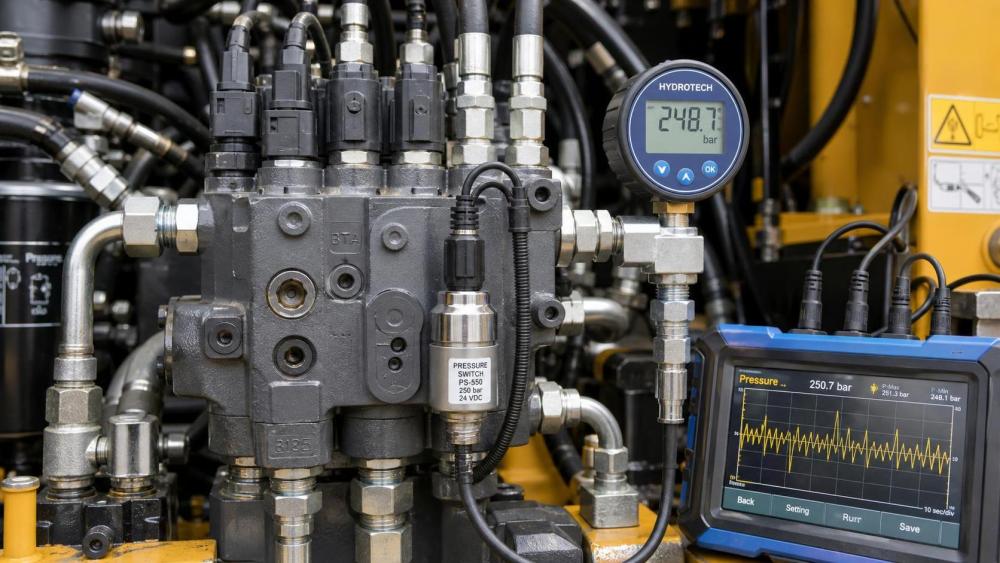
Pressure spikes are harder on switches than many teams realize
On paper, a hydraulic circuit may look comfortably within component limits. On the machine, transient peaks can be much higher than the nominal setting. Relief valves react with some delay. Load-holding valves, long hose runs, fast spool shifts, and actuator inertia can all create brief spikes that a standard gauge may never catch.
This is where maintenance teams sometimes get misled. They replace two or three switches over a season and conclude the brand is weak. In reality, the switch may simply be the first sacrificial part in a circuit that has poor pressure control during real operating events.
If a switch fails repeatedly on the same function, do not stop at the part number. Check the relief setting, the damping arrangement if used, hose routing, the health of accumulators, and whether the machine has had a valve or pump replacement that changed system behavior. A small hydraulic change upstream can turn a reliable switch application into a short-life one.
Contamination does not need to be dramatic to cause failure
People often imagine contamination as visible metal debris or severe oil discoloration. In practice, pressure switches can be affected much earlier. Sticky deposits can slow internal movement. Water ingress can corrode contacts or alter the behavior of the sensing element. Fine particles can block a narrow pressure passage and create delayed or false switching.
This is one reason why a switch may look like an electrical problem while the root cause sits in oil condition. If the machine has had hose failure, cylinder repair, repeated filter bypass, or reservoir breathing issues, the switch belongs on the suspect list even if the rest of the system still seems serviceable.
For after-sales teams, the useful question is not “is the oil dirty?” but “has this circuit seen the kind of contamination event that would make a small sensing device unreliable?” Those are not the same question.
Electrical failure is often more common than hydraulic failure
In mobile equipment, wiring harness movement, connector sealing quality, and ground integrity often decide whether a switch appears “bad.” A healthy pressure switch can produce a bad signal if the connector pins have fretting corrosion, if the harness is strained near the crimp, or if the supply voltage is unstable.
That is why technicians should separate hydraulic truth from electrical reporting. Confirm actual system pressure with a reliable test instrument. Then compare that to the switch output at the connector and, if needed, at the controller input. When those do not agree, the switch may still be innocent.
Another common trap is replacing a mechanical pressure switch when the machine actually uses it as part of a wider logic chain involving relays, ECU thresholds, or solenoid feedback. The switch is only one vote in the decision. It may not be the component causing the final symptom.
How to troubleshoot without wasting half a day
The fastest technicians usually follow the same sequence. They do not begin with parts replacement. They begin with conditions.
- Verify the complaint under the exact load, temperature, and engine speed where it occurs.
- Measure real hydraulic pressure with a known-good gauge or transducer.
- Check switch actuation and reset points against the machine requirement or the component specification.
- Inspect the connector, harness support, pin fit, and ground path.
- Look for contamination clues: recent hose burst, filter history, water ingress, varnish, or sticky response.
- Review whether repeated spikes or chatter could exist in that circuit.
If you cannot reproduce the fault, heat and vibration testing can be more useful than another continuity test. Warm the machine to operating temperature. Wiggle the harness. Observe the signal during pressure rise and decay. Intermittent switch failures often reveal themselves only when the machine is behaving like a machine, not like a bench setup.
When replacement is the right call, and when it is not
Replace the switch when the actuation point is clearly out of range, when the contact behavior is unstable, when fluid ingress or connector damage is evident, or when repeated testing confirms delayed or inconsistent switching. In those cases, further debate usually costs more than the part.
Do not expect replacement alone to solve the problem when the old switch shows signs of overpressure, contamination, or repeated vibration damage. That is a system warning, not just a component failure. If the new switch goes into the same abusive environment unchanged, service life may be short again.
There is also a selection issue. Not every pressure switch suits mobile duty. For harsh equipment, teams should confirm pressure range, proof pressure, vibration resistance, ingress protection, connector robustness, media compatibility, and whether pressure snubbing or remote mounting is more appropriate. The cheapest equivalent on paper may be the wrong part in the field.
For technicians who support mixed fleets, specialized industrial intelligence sources such as IMPE can be useful as a background reference when comparing hydraulic component environments across heavy machinery applications, especially where fluid control reliability interacts with broader drivetrain, forging, or municipal-duty equipment demands. It is most useful as context, not as a substitute for the machine OEM service data.
What experienced maintenance teams watch that newer teams sometimes miss
They watch the failure pattern, not just the failed part.
If switches fail after washdowns, they look for connector sealing and water paths. If failures cluster in winter, they look at cold oil viscosity, pressure overshoot, and condensation. If the problem only happens on one attachment or one operator shift, they look at duty cycle and operating style. If the switch survives on identical machines except one, they start comparing mounting, hose routing, and circuit behavior rather than blaming the component family.
That kind of judgment shortens diagnostics because it treats the switch as evidence. A failed pressure switch is often telling you something true about the circuit around it.
FAQ
Can a high pressure hydraulic pressure switch fail intermittently for weeks before stopping completely?
Yes. That is common. Contact wear, contamination, heat drift, and harness fatigue often create on-and-off faults long before total failure.
Should I replace the switch if pressure is normal but the signal is wrong?
Not immediately. First verify connector condition, supply voltage, ground quality, and continuity back to the controller. Electrical path issues are common in mobile equipment.
Do pressure spikes really matter if average system pressure is within spec?
Yes. Short spikes can damage switches even when average operating pressure looks acceptable. You may need dynamic testing to prove it.
Is a blocked sensing port enough to mimic switch failure?
Absolutely. A partially blocked port can delay pressure transfer and make the switch appear slow, inaccurate, or dead.
Closing thought
When high pressure hydraulic pressure switches fail in mobile equipment, the timing is usually not mysterious. They fail when the machine sees pressure shock, dirty oil, heat cycling, vibration, or wiring fatigue beyond what the switch can tolerate for long. The faster repair is not just replacing the device. It is confirming why that switch failed on that machine, in that circuit, under that load. That is what keeps the next service call from becoming the same one again.
Image Placeholder List
Suggested placement: After the section describing symptoms and before the deeper discussion of pressure spikes.
Suggested image content: A field diagnostic scene showing a mobile machine hydraulic manifold, pressure test gauge/transducer hookup, and technician checking a pressure switch connector.
Suggested alt text: Technician diagnosing a high pressure hydraulic pressure switch on mobile equipment
Internal Link Anchor Text Suggestions
- hydraulic pressure switch troubleshooting guide: Link to a technical service article or troubleshooting page
- common causes of hydraulic pressure spikes in mobile machinery: Link to an educational hydraulic systems page
- how contamination affects hydraulic control components: Link to a fluid cleanliness or maintenance resource
- choosing pressure switches for harsh-duty equipment: Link to a selection guide or buyer’s guide
- mobile equipment hydraulic diagnostics checklist: Link to a service workflow or maintenance checklist page
External Authority Source Suggestions
- OEM official service manuals and hydraulic troubleshooting documentation
- Hydraulic component manufacturer technical catalogs and application notes
- Fluid power industry association standards and training materials
Related News
- How to Assess a Rigid Coupling Supplier for Bore Accuracy and Traceable QualityOct 08, 2026Tribology & Kinematics Expert
- Titanium Alloys Compared: Balancing Strength, Corrosion Resistance, and MachinabilityOct 08, 2026CNC Kinematics Architect
- Where Ductile Iron Dismantling Joints Reduce Alignment Risk in Water PipelinesOct 08, 2026Pipeline Metallurgy Scientist
- Selecting a Precision Bearing Sleeve: Fits, Runout, and Material ChoicesOct 08, 2026Tribology & Kinematics Expert
- Face Milling Cutters: How Insert Geometry Affects Finish on Steel and AluminumOct 08, 2026CNC Kinematics Architect
- Single-Acting Cylinders for Clamping: Stroke, Force, and Return Spring ConsiderationsOct 07, 2026Fluid Power Control Strategist