
When Do Custom Hydraulic Reservoirs Deliver Lower Downtime Than Standard Tanks?
In a hydraulic system, the reservoir is often treated as a simple fabricated box: large enough to hold oil, fitted with a breather, perhaps a level gauge, and selected from a standard catalog. That assumption can be expensive. When a press stops because fluid overheats, a mobile machine loses pump life from aeration, or a compact power unit becomes difficult to service, the tank is no longer a passive component. It becomes part of the downtime problem.
Custom hydraulic reservoirs deliver lower downtime than standard tanks when the operating environment exposes a mismatch between generic tank geometry and the actual needs of the hydraulic circuit. Severe heat, contamination exposure, rapid duty cycles, limited installation space, difficult maintenance access, and unusual return-flow behavior are common triggers. For procurement leaders, the decision is not whether a custom tank looks more sophisticated. It is whether its added engineering and fabrication cost prevents enough production interruption, fluid replacement, component damage, and service labor to justify the investment.
The most useful comparison is therefore not “standard versus custom.” It is “acceptable initial cost versus controllable lifecycle risk.”
The downtime question begins with the duty cycle, not tank volume
A standard reservoir can be a sensible choice for a stable, well-understood hydraulic power unit. If the equipment operates at moderate pressure, has predictable daily runtime, adequate cooling, clean indoor conditions, and easy service access, a proven catalog tank may meet the requirement without introducing unnecessary engineering work.
Problems appear when the same standard tank is used in a system with more demanding behavior than its original design assumptions. Consider an industrial press that cycles intensely for long shifts, a mining attachment working in dirty ambient conditions, or a compact machine tool with a hydraulic unit installed inside a crowded enclosure. In those applications, tank capacity alone does not determine performance. The location of return ports, the size of the deaeration zone, the separation between suction and return flow, the ability to reject heat, and the placement of filters all affect the health of the fluid and the components relying on it.
A reservoir that nominally holds enough oil may still circulate hot, aerated, or contaminated fluid back to the pump. The machine may continue running for a time, but warning signs usually follow: unstable actuator motion, noise, rising operating temperature, clogged filters, leaking seals, shortened pump life, and unplanned maintenance windows.
For decision-makers, the practical question is: Does the current or proposed tank allow the oil enough time and the right conditions to cool, release entrained air, settle contaminants, and reach the pump without turbulence? If the answer is uncertain, a custom design deserves evaluation.
Where standard tanks most often create avoidable risk
Standard tanks are designed around common dimensions and broadly applicable port arrangements. Their limitations are not necessarily defects; they are the consequence of serving many applications with one layout. Downtime risk increases when that layout conflicts with the machine’s real installation or process requirements.
Heat load exceeds the available cooling path
Hydraulic inefficiency becomes heat. Pumps, valves, throttling losses, long hose runs, and continuous high-pressure operation all contribute to thermal load. A standard tank may offer insufficient surface area, poor airflow around its walls, or no practical provision for an integrated heat exchanger. Once fluid temperature remains elevated, oil viscosity can move outside the preferred operating range. Lubrication films become less reliable, seal materials age faster, and pump wear accelerates.
A custom reservoir can be shaped around the available cooling opportunities: a larger exposed surface, a layout that permits airflow, dedicated cooler connections, or mounting provisions that simplify installation of cooling equipment. This does not eliminate the need to calculate heat balance. It does, however, prevent the common mistake of installing a cooler after overheating has already become a production issue.
Return flow disturbs the suction zone
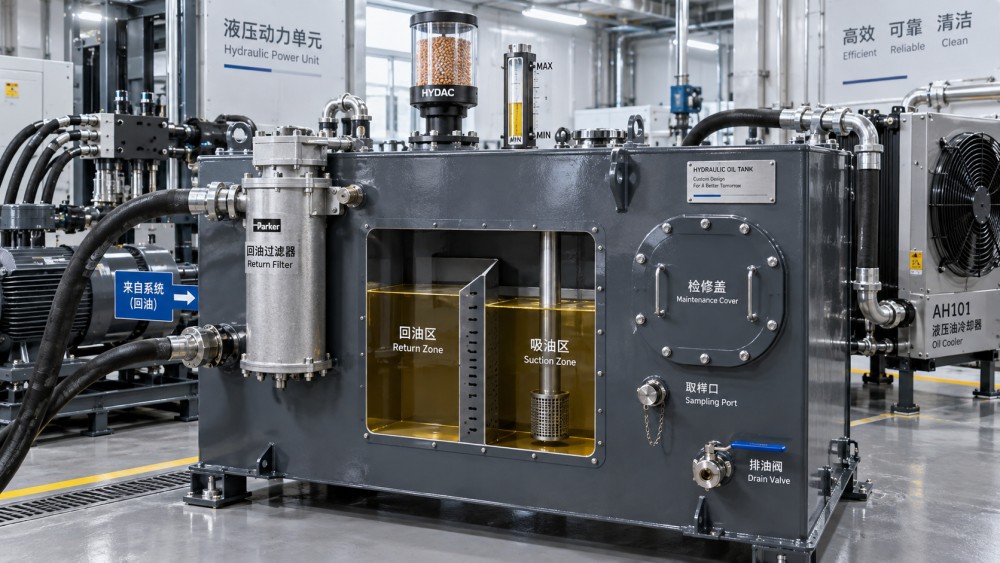
Oil returning from cylinders, motors, and valves may carry air, heat, and fine contamination. If that return flow enters too close to the pump suction connection, the pump can receive oil before it has had time to calm and deaerate. Internal baffles, diffuser arrangements, port orientation, and adequate travel distance are important here. A tank with a convenient but poorly located return port can contribute to cavitation-like symptoms, excessive noise, erratic control response, and premature pump failure.
Custom hydraulic reservoirs are especially valuable when the hydraulic circuit has multiple return lines, high return velocity, or a return stream that changes significantly during different machine modes. The reservoir can be designed so that return oil enters a controlled zone, travels through the tank as intended, and reaches the suction area in a more stable condition.
Contamination control is difficult in the field
In construction, quarrying, agriculture, recycling, marine work, and outdoor infrastructure maintenance, contamination is not an occasional concern. Dust, moisture, washdown exposure, and inconsistent service conditions are part of normal operation. A generic tank may have a basic breather and drain point, yet still make clean filling, sampling, filtration, and inspection harder than necessary.
A custom design can include dedicated filling and filtration connections, desiccant breather mounting, properly located sample ports, cleanout access, magnetic plugs, inspection covers, and drain geometry that supports more complete fluid removal. These features sound minor during initial procurement. They matter when technicians must diagnose oil condition quickly rather than drain a tank awkwardly, open improvised access points, or work around obstructing machine structures.
Machine packaging leaves no room for good maintenance
Many equipment builders face a familiar conflict: the reservoir must fit within a tight frame, yet filters, gauges, breathers, level switches, and hose connections still need to be reachable. Choosing a standard tank can reduce purchasing effort but may force service components into inaccessible positions. A ten-minute filter change can become an hour-long task involving guard removal, hose handling, or partial disassembly.
Downtime is not only the time required to repair a fault. It also includes the time needed to safely reach the fault. A custom reservoir can place routine service items on the accessible side of the machine, provide lifting points, accommodate removable covers, and avoid interference with electrical cabinets, drive systems, or structural members. In fleets and production lines, better serviceability can have a measurable effect on maintenance planning.
A custom tank is justified when it solves a defined failure mechanism
“Custom” should not mean adding features without purpose. It should mean engineering the reservoir around documented operating conditions and known risks. The strongest business case normally emerges when the buyer can connect a reservoir feature to a specific downtime mechanism.
The table also highlights an important procurement principle: a reservoir should be specified as part of the fluid-conditioning system, not simply purchased as a storage vessel.
How to compare the real cost of a standard tank and a custom hydraulic reservoir
The purchase price of a standard tank is easy to identify. The cost of unsuitable reservoir performance is usually dispersed across maintenance budgets, lost output, replacement parts, and operator disruption. That makes the custom option look harder to justify than it may actually be.
A more useful lifecycle review begins with the expected consequences of an interruption. What does one hour of lost production cost? How often does the equipment require fluid service? Are failed pumps or valves stocked locally, or do they create a long lead-time exposure? Does access require a planned shutdown, specialist labor, or safety isolation? Is the machine one of several redundant assets, or is it a bottleneck in a production or municipal service process?
For an OEM, the calculation also includes warranty exposure and field-service reputation. A reservoir that is inexpensive to fabricate but difficult to maintain can increase the cost of supporting installed equipment for years. For an EPC contractor or utility team, the concern may be different: whether the selected unit can be inspected, cleaned, and repaired without disrupting an already constrained site schedule.
There is no universal rule that a custom unit always pays back. If an asset is low duty, noncritical, easy to access, and supported by short replacement lead times, standardization may be the better commercial choice. But where an hour of stoppage has material operational consequences, reservoir design deserves the same scrutiny given to pumps, valves, filtration, and controls.
Specifications that should be settled before requesting quotations
Suppliers can fabricate a tank to a drawing, but the drawing must reflect hydraulic behavior as well as physical dimensions. Procurement teams should involve the hydraulic designer, maintenance lead, and machine packaging engineer before issuing an RFQ. A well-prepared request reduces redesign cycles and makes quotations more comparable.
- Fluid and temperature range: Identify the hydraulic fluid type, expected operating temperature, ambient conditions, and any requirements for compatibility with coatings, seals, or cleaning procedures.
- Flow profile: Provide normal and peak return flow, pump suction requirements, duty cycle, and whether several circuits return to the same reservoir.
- Pressure and venting conditions: Clarify whether the reservoir is vented, lightly pressurized, exposed to vacuum risk, or subject to transport vibration and machine motion.
- Filtration and cleanliness plan: State the target cleanliness approach and required locations for return filters, offline filtration, filler breathers, sample ports, and magnetic collection features.
- Installation envelope: Include available dimensions, mounting interfaces, service clearance, lifting needs, connection orientation, and nearby heat sources.
- Material and fabrication expectations: Consider carbon steel, stainless steel, aluminum, or other materials based on environment, weight, corrosion exposure, weld requirements, and applicable project standards.
- Inspection and documentation: Define leak testing, coating requirements, weld documentation where relevant, dimensional inspection, cleaning standards, and transport protection.
One overlooked detail is internal cleanliness after fabrication. Weld scale, grinding residue, loose paint, or improperly cleaned fabrication debris can undermine the contamination-control strategy from the first day of operation. Buyers should ask how the reservoir is cleaned, protected, capped, and packaged before shipment—not only how it is built.
Do not confuse a larger tank with a better reservoir
Increasing capacity may help with heat dissipation and residence time, but it is not a complete answer. A larger tank with poor internal flow control can still send aerated oil toward the suction line. It may also occupy valuable machine space, slow warm-up in cold conditions, add unnecessary fluid cost, and complicate handling.
Likewise, adding baffles without considering return velocity, port direction, and actual flow paths can create a false sense of security. Effective reservoir engineering balances volume, geometry, cooling, deaeration, sediment management, access, and structural integrity. The aim is not the largest fabricated vessel; it is the most suitable reservoir for the equipment’s operating profile.
A practical decision rule for buyers
A standard tank remains appropriate when the system is conventional, thermal conditions are controlled, maintenance access is straightforward, and the cost of interruption is low. It is also attractive when an established tank design has already been proven on the same equipment configuration.
A custom hydraulic reservoir should move to the shortlist when one or more of the following are true: overheating has occurred or is predicted; pump inlet stability is a concern; the machine operates in contaminated or wet environments; multiple circuits create complex return flow; the installation space is restrictive; planned service access is poor; or a failure would interrupt a high-value process.
The strongest procurement decision is based on evidence rather than preference. Review operating temperatures, oil analysis records, filter-change history, pump and valve failures, service labor time, available space, and the economic impact of downtime. Those inputs turn the reservoir from a generic line item into an engineered reliability decision.
For industrial buyers evaluating hydraulic power units, heavy machinery, fluid-control packages, or replacement assemblies, the reservoir should be discussed early with the component supplier and system designer. A well-matched custom tank will not compensate for every hydraulic design problem. Yet when fluid conditioning, maintenance access, and installation constraints are the sources of recurring disruption, it can remove a quiet but persistent cause of downtime before it reaches the production floor.
Related News
- Using Industrial Air Blow Guns to Clear Chips Without Spreading DebrisOct 15, 2026Fluid Power Control Strategist
- Ductile Iron Pipe Valves: Which AWWA Standards Apply to Water Main Projects?Oct 15, 2026Dr. Elias Vance
- Why Vacuum Suction Cups Lose Grip on MDF in Woodworking MachinesOct 15, 2026CNC Kinematics Architect
- Choosing a Variable Displacement Piston Pump Manufacturer: What to VerifyOct 15, 2026Fluid Power Control Strategist
- Parallel vs. Angular Pneumatic Grippers for Confined Assembly StationsOct 15, 2026Fluid Power Control Strategist
- Die Castings vs. Investment Castings: Which Costs Less at Your Production Volume?Oct 14, 2026Foundry Phase-Change Fellow