
What Maintenance Schedule Extends Mechanical Seal Life in Pump Stations?
Mechanical seal life is a station-reliability issue, not a seal-only issue
Mechanical seals are often discussed as consumable pump parts, but in a water pumping station they are better treated as indicators of broader operating conditions. A seal may fail because its faces have worn, but the wear usually reflects another issue: dry running, poor alignment, bearing movement, cavitation, solids exposure, pressure instability, incorrect flush conditions, or repeated operation far from the pump's preferred range.
That distinction matters for water utilities, municipal EPC contractors, industrial plant operators, and maintenance teams. Replacing a failed seal quickly restores service, but repeated replacement without correcting the underlying condition can turn a manageable maintenance item into a recurring outage source. The useful question is therefore not simply how often a seal should be changed. It is: what maintenance schedule identifies the operating conditions that shorten seal life before leakage becomes a failure event?
There is no single interval that applies to every pumping station. A clean-water booster station with duty/standby pumps, stable suction conditions, and continuous monitoring can use a relatively light inspection program. A wastewater lift station, raw-water intake, slurry-adjacent process station, or intermittently operated emergency pump needs a more intensive approach. The maintenance schedule should be based on consequence of failure, fluid quality, duty cycle, pump design, seal arrangement, and the station's ability to detect deterioration early.
The most effective schedule combines operating checks with planned physical inspection
A common mistake is to make seal maintenance calendar-based only. Calendar intervals are useful for organizing labor and shutdowns, but they do not capture real operating stress. A pump running continuously under stable conditions may accumulate far more meaningful exposure in one month than a standby unit does in a year. Conversely, an emergency pump can suffer damage during a short test if it starts against an improper valve position, loses prime, or runs without adequate cooling.
For most water pumping stations, the strongest program has four layers: operator observation each shift or day, condition checks weekly or monthly, predictive measurement at planned intervals, and intrusive inspection during scheduled outages. These layers work together. Operators identify changes in leakage, noise, temperature, and flow behavior. Maintenance technicians verify the mechanical causes. Reliability staff use trends to decide whether intervention should be brought forward.
The intervals in this table are starting points, not mandatory universal values. A critical high-capacity pump serving a treatment plant or flood-control station may justify continuous vibration and temperature monitoring, with a monthly engineering review. A small low-consequence booster pump may need daily operator observation and a more limited quarterly inspection. The important point is that the program should escalate with risk rather than applying the same task list to every pump.
Daily and weekly checks: catch the conditions that destroy seals quickly
Short-interval checks are not intended to dismantle equipment. Their value lies in identifying sudden deviations before they damage seal faces or related components. Mechanical seals depend on a very thin lubricating fluid film between lapped faces. Loss of that film, excessive heat, or shaft instability can cause damage much faster than a conventional periodic replacement schedule can prevent.
Operators should record whether leakage has changed in amount, color, location, or timing. A small, stable amount of visible leakage may be acceptable for some seal arrangements, depending on the pump design and service. A sudden increase, intermittent spray, crystallized deposits, cloudy leakage, or fluid emerging from an unexpected location requires investigation. It may indicate face damage, a failed secondary seal, blocked drain paths, excessive pressure, or a worn sleeve.
Basic operating data should be reviewed alongside leakage. Suction pressure, discharge pressure, flow, motor current, and run time can reveal why a seal is being stressed. For example, low suction pressure and fluctuating discharge conditions may point to cavitation or air entrainment. High motor current may signal hydraulic overload, mechanical binding, or an operating point outside the pump curve. A seal failure report that contains only the seal model and replacement date is rarely enough to prevent recurrence.
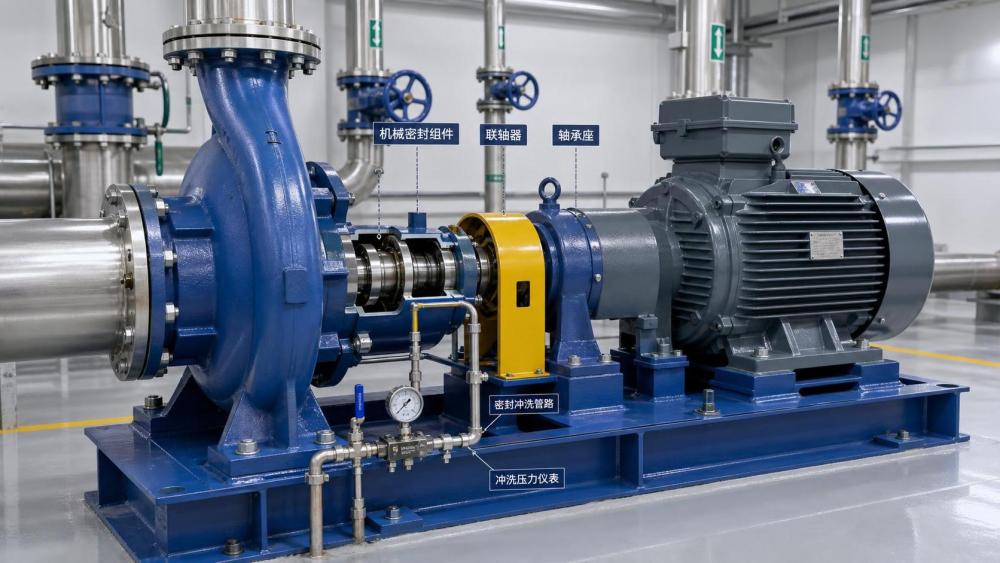
Weekly checks should also include the seal support environment. On pumps using flush, quench, cooling, or barrier-fluid arrangements, confirm that supply valves are open, filters are not blocked, pressure relationships are correct for the selected plan, and fluid level is within the equipment manufacturer's specified range. In utility stations, these supporting lines can be overlooked because they are small compared with suction and discharge piping. Yet a blocked flush line can have a larger effect on seal life than a minor change in the seal material itself.
Monthly inspection: compare what the pump is doing with what it was designed to do
Monthly maintenance is a practical point to move from observation to comparison. The team should compare current operating data with commissioning records, recent maintenance history, and the pump curve where available. A pump may continue delivering water while operating in a damaging zone. Low-flow recirculation, repeated throttling, excessive cycling, running too far right on the curve, or frequent starts can all create thermal and mechanical stress that reaches the seal through the shaft, bearings, and seal chamber.
At this stage, coupling alignment deserves attention. Alignment is sometimes checked only when a pump is installed or after a major overhaul. That is insufficient for stations where temperature changes, pipe movement, foundation settlement, or maintenance work can alter the machine position. Misalignment increases radial and axial shaft movement, accelerates bearing deterioration, and makes stable seal-face contact harder to maintain.
A useful monthly task is to inspect for soft-foot symptoms, loose base bolts, damaged grout, pipe strain, and coupling insert wear. Laser alignment tools provide better repeatability than straightedge methods, particularly for critical units, but the tool does not remove the need to address the source of movement. Aligning a machine while connected piping is applying significant force may produce a good reading during the task and a poor result when the system returns to service.
Lubrication checks belong in the same monthly review. The seal itself may be product-lubricated, but bearing condition is closely connected to seal life. Incorrect oil level, degraded grease, water contamination, incompatible lubricant, or excessive relubrication can cause bearing heat and shaft movement. Those symptoms are then often misdiagnosed as a seal-quality problem.
Quarterly condition monitoring: the dividing line between preventive and predictive maintenance
For critical pumps, quarterly analysis should include formal vibration trending and review of bearing temperatures, motor current, operating hours, starts, and hydraulic performance. Stations with online sensors can collect this information continuously, but continuous data is only useful when someone reviews the trend and defines action thresholds. A rising vibration value that remains below an alarm setpoint may still be meaningful if it has changed sharply from the pump's normal baseline.
Vibration analysis is especially valuable because it can distinguish likely causes that look similar from the outside. High vibration can arise from imbalance, misalignment, loose structure, bearing damage, hydraulic instability, cavitation, or pipe-induced forces. The corrective action differs in each case. Replacing the mechanical seal without understanding the vibration mechanism can produce another premature failure and conceal the station's more serious reliability risk.
Thermography and ultrasound may also be useful in larger stations, particularly where access is difficult or equipment is continuously operated. These methods should be chosen for a clear maintenance question, not adopted because they are available. For example, thermography can help identify abnormal bearing or motor heat; it is less direct as a method for determining seal-face condition. The inspection program should link each measurement to an expected decision.
Annual shutdown work: inspect the full failure chain
An annual planned outage is often the right time to inspect seals directly, but it should not be treated as an automatic seal replacement event. Replacing seals solely because the calendar says one year has passed can waste usable components and introduce installation errors. On the other hand, extending intervals merely because a seal has not visibly leaked can be risky where the pump is critical and internal wear cannot be detected externally.
The better approach is condition-informed inspection. When the pump is opened, examine seal faces for scoring, heat checking, uneven wear, chips, deposits, and signs of dry running. Inspect elastomers for swelling, hardening, cracking, or chemical attack. Check the shaft sleeve or shaft surface for wear in the secondary sealing area, and confirm that the seal chamber is clean and consistent with the required configuration.
Bearings, shaft runout, axial movement, impeller condition, wear rings, and internal corrosion should be assessed at the same time. These components form a failure chain. Excessive shaft runout or end play can prevent a new seal from operating correctly from its first hours in service. A worn impeller or blocked recirculation path can shift the hydraulic operating point and recreate the thermal conditions that damaged the previous seal.
For wastewater and solids-bearing applications, annual inspection may be too infrequent. Rags, fibrous material, grit, scaling, and chemical deposits can alter pump performance quickly. In such stations, periodic cleaning, suction-side review, and earlier inspection after a known blockage or abnormal operating event may be more important than adherence to a fixed annual overhaul date.
Different station types need different maintenance intensity
Clean-water transfer and booster stations generally benefit from a condition-based schedule. Their fluids are relatively benign, and well-designed systems can maintain long seal service life when suction conditions are stable and pumps operate near their intended range. The maintenance focus should be on alignment, bearing health, pressure stability, and avoiding dry starts after outages or maintenance.
Raw-water stations require more attention to debris, abrasive particles, seasonal water-quality changes, and intake conditions. A maintenance plan should include inspection of strainers or screening equipment, monitoring for sediment-related performance changes, and review of flush arrangements. Mechanical seal materials that perform well in clean water may not provide the same life where fine abrasives are present.
Wastewater lift stations need the most cautious approach. The issue is not only solids. Variable inflow, air entrainment, gas exposure, intermittent duty, clogging, and frequent starts can all affect seal performance. Dual mechanical seals, suitable barrier or buffer systems, and leakage detection may be justified for critical submersible or dry-pit applications, but these features add maintenance obligations. A more complex seal system is not automatically more reliable if the station cannot maintain its support fluid, sensors, and associated piping.
High-consequence stations, including those supporting treatment processes, fire protection, flood management, or major transmission lines, should use redundancy and criticality-based maintenance. The correct interval is shaped by what happens if one pump fails, whether a standby unit can carry the load, the time needed to obtain parts, and whether maintenance can be performed without interrupting service.
What maintenance programs commonly get wrong
The first misconception is that visible leakage alone defines seal health. Some failures occur with little external leakage, especially where leakage is captured, evaporates, or is routed away. Trending temperature, vibration, pressure, and power consumption provides a more complete view.
The second is that a premium seal design will compensate for poor pump conditions. Better materials, improved face geometry, or a more robust cartridge seal may increase tolerance to difficult service, but no seal selection can permanently correct dry running, severe cavitation, misalignment, or a damaged shaft sleeve. Procurement teams should evaluate seal design together with the pump's hydraulic duty, shaft condition, seal chamber dimensions, fluid characteristics, and maintenance capability.
The third is over-lubrication or indiscriminate lubrication. Bearings need the correct lubricant, quantity, and interval. Excess grease can raise bearing temperature and cause churning; contaminated oil can shorten bearing life. Neither condition is isolated from the seal system.
The fourth is treating every failure as identical. Maintenance records should classify failure mode where possible: face wear, thermal damage, elastomer degradation, spring or hardware damage, sleeve wear, installation error, contamination, bearing movement, or process upset. This level of detail supports better decisions about spares, design changes, operating procedures, and supplier discussions.
Building a schedule that supports procurement and lifecycle decisions
For B2B buyers and project teams, the maintenance schedule should be considered before equipment is purchased or handed over. A pump package should provide accessible seal information, recommended inspection intervals, seal arrangement details, compatible materials, flush-plan documentation where relevant, coupling alignment requirements, bearing lubrication instructions, and a clear list of normal operating limits. The quality of this documentation often matters more over the asset life than a small difference in initial component price.
During supplier evaluation, ask whether the pump and seal configuration is proven for the actual water quality, pressure, temperature, solids profile, and duty pattern. Confirm spare-part lead times, interchangeability, sleeve availability, repair capability, and the availability of dimensional drawings. For municipal and EPC projects, it is also prudent to clarify responsibility at commissioning: incorrect rotation, unvented casings, closed valves, or inadequate priming can damage seals before routine operations have even begun.
The schedule that extends mechanical seal life is therefore a disciplined, risk-based program rather than a single number of weeks or months. Daily operating awareness prevents sudden damage from being ignored. Monthly mechanical checks protect alignment and bearing stability. Quarterly trending exposes deterioration before it becomes an outage. Planned shutdowns allow the team to inspect the full pump system and act on evidence. When those tasks are connected to operating data and failure records, seal maintenance becomes a practical tool for protecting water-service reliability rather than a repetitive replacement exercise.
Related News
- Using Industrial Air Blow Guns to Clear Chips Without Spreading DebrisOct 15, 2026Fluid Power Control Strategist
- Ductile Iron Pipe Valves: Which AWWA Standards Apply to Water Main Projects?Oct 15, 2026Dr. Elias Vance
- Why Vacuum Suction Cups Lose Grip on MDF in Woodworking MachinesOct 15, 2026CNC Kinematics Architect
- Choosing a Variable Displacement Piston Pump Manufacturer: What to VerifyOct 15, 2026Fluid Power Control Strategist
- Parallel vs. Angular Pneumatic Grippers for Confined Assembly StationsOct 15, 2026Fluid Power Control Strategist
- Die Castings vs. Investment Castings: Which Costs Less at Your Production Volume?Oct 14, 2026Foundry Phase-Change Fellow