
Is a Hydraulic Vane Pump Better Than a Gear Pump for Constant Pressure?
Is a Hydraulic Vane Pump Better Than a Gear Pump for Constant Pressure?
Is a hydraulic vane pump better than a gear pump for constant pressure water systems? Sometimes—but that question contains an important technical trap. Standard hydraulic vane pumps and hydraulic gear pumps are generally designed to circulate hydraulic oil, not untreated water. Their internal clearances, lubrication requirements, seal materials, and wear surfaces depend heavily on the fluid being pumped. A pump that performs well in an oil-based hydraulic power unit may fail quickly if it is simply connected to a water line.
For a true constant-pressure water system, the better comparison is usually between water-rated pump designs: centrifugal booster pumps, multistage pumps, rotary positive-displacement pumps designed for water service, or purpose-built pressure-booster packages with variable-speed control. Still, the vane-versus-gear question matters in industrial equipment because many water systems are indirectly controlled by hydraulic circuits, and some specialized pumps are engineered for compatible low-lubricity fluids. The right answer depends on whether “constant pressure” refers to hydraulic oil pressure inside machinery or water pressure delivered to a process, pipe network, wash station, or utility system.
In most hydraulic oil applications, a vane pump is often the stronger choice when smooth pressure behavior, lower pulsation, and reduced operating noise are priorities. A gear pump is usually the more robust and economical choice when the circuit is simple, the fluid is clean enough, and modest pressure ripple is acceptable. Neither option automatically creates stable outlet pressure on its own. Pressure stability comes from the whole system: pump selection, drive speed, pressure-control valve behavior, accumulator sizing, line layout, load variation, fluid condition, and control strategy.
Why pump type alone does not guarantee constant pressure
A fixed-displacement pump delivers a volume of fluid per revolution. If the motor speed remains constant, the pump continues trying to move approximately the same flow. System pressure then rises or falls according to resistance in the circuit. When a valve closes, an actuator reaches the end of travel, or downstream demand drops, pressure can rise quickly unless the system has an appropriate relief valve, unloading arrangement, proportional control, or variable-speed drive.
This is why a gear pump can be perfectly reliable in a hydraulic press or lubrication package yet still produce pressure fluctuations in a poorly controlled circuit. The same is true of a vane pump. A well-designed pressure-compensated vane pump may hold a target pressure more smoothly than a basic fixed gear pump, but the advantage comes largely from its control architecture, not merely from the fact that it uses vanes.
For water distribution, this distinction is even more important. A water booster system must respond to changing demand from valves, branches, elevation changes, storage tanks, or process equipment. In practice, a pressure transducer, controller, and variable-frequency drive are frequently more influential than the pumping principle itself. A properly selected multistage centrifugal pump with speed control will often provide better constant-pressure water service than trying to adapt a conventional hydraulic pump.
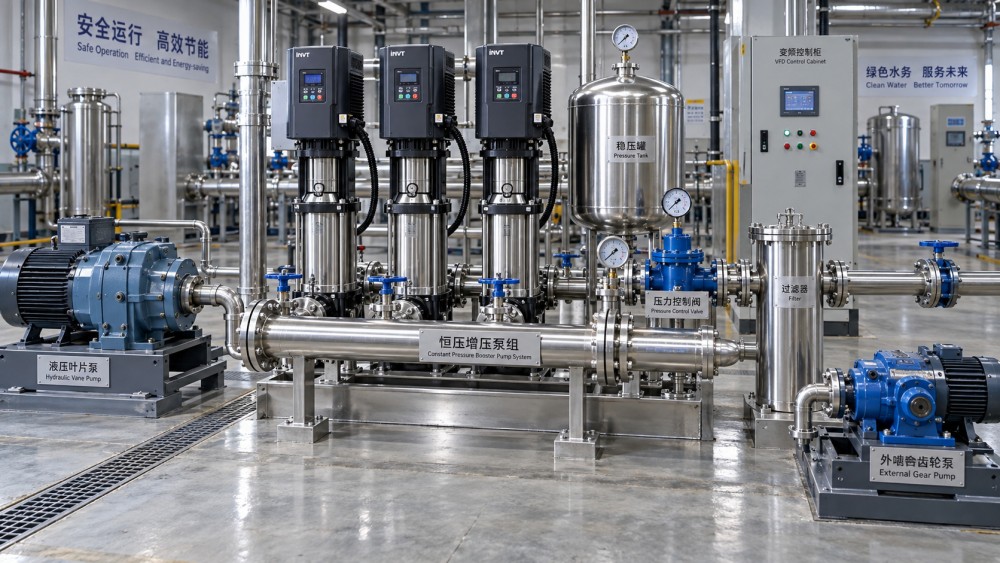
Vane pumps: smoother operation, but more demanding conditions
A hydraulic vane pump uses vanes that slide in and out of a rotor as it turns inside a cam ring. The changing chamber volume draws in and discharges fluid. In many industrial hydraulic units, this design is valued for relatively smooth flow delivery and lower noise compared with a basic external gear pump. Those characteristics can be useful where pressure fluctuations affect motion quality, such as machine tools, forming equipment, material-handling systems, and certain industrial automation circuits.
For constant hydraulic pressure, a vane pump is particularly attractive when paired with pressure compensation. Once the circuit reaches the set pressure, the compensating mechanism can reduce pump displacement or otherwise limit unnecessary flow. This can reduce heat generation compared with a fixed-displacement pump that constantly sends excess flow across a relief valve. In continuous-duty equipment, excessive bypass flow is not a minor issue; it converts input power into heat, stresses the oil, and makes cooling requirements more demanding.
The trade-off is sensitivity. Vane pumps depend on closely controlled internal surfaces and predictable lubrication. Contaminated oil can scratch the cam ring, damage vane tips, or interfere with the movement of the vanes. Incorrect viscosity can also affect volumetric efficiency and wear. A vane pump is not necessarily fragile, but it expects the rest of the system to be well managed: correct filtration, a clean reservoir, proper suction conditions, and compatible fluid.
That sensitivity is the main reason standard hydraulic vane pumps should not be casually treated as water pumps. Water has much lower lubricity than hydraulic oil and can introduce corrosion, scale, suspended solids, or chemical incompatibility. Unless the manufacturer specifically approves the pump for water or a defined water-based fluid, using it for water service is a high-risk decision.
Gear pumps: practical, economical, and often misunderstood
External gear pumps use two meshing gears to transfer fluid from the inlet to the outlet. They are common because they are compact, straightforward, widely available, and generally cost-effective. In mobile machinery, agricultural equipment, auxiliary hydraulic circuits, lubrication systems, and simple power units, a gear pump is often the sensible choice. It is not an inferior pump by default; it is a pump with a different operating profile.
Compared with many vane pump arrangements, a gear pump may generate more flow ripple and audible noise. In a circuit supplying a hydraulic cylinder, this can show up as less refined motion or pressure pulsation, especially if the piping is rigid, the pump speed is high, or the load changes abruptly. Some systems tolerate this without difficulty. Others, particularly those involving precise positioning, sensitive pressure regulation, or noise limits, do not.
A gear pump is also normally fixed displacement. If a system needs constant pressure while flow demand changes, the designer must provide a control method. That may be a relief valve for basic protection, an unloading valve for intermittent demand, a proportional valve for more responsive control, or variable motor speed where appropriate. Choosing a fixed gear pump and then allowing excess flow to continuously pass through a relief valve is a common low-first-cost solution, but it can become expensive in electricity, cooling, and maintenance when the unit runs for long periods.
For actual water handling, gear pumps do exist in water-compatible materials and configurations, especially in specialized transfer, dosing, and process duties. But they must be selected as water-service gear pumps, not as standard hydraulic gear pumps. Shaft seals, housing materials, gear clearances, corrosion resistance, solids tolerance, and permissible temperature all need review. Clean water, wastewater, chlorinated water, abrasive slurry, and chemically treated process water should never be assumed to impose the same conditions.
A practical comparison for hydraulic constant-pressure circuits
The table is useful only as a starting point. A quiet vane pump installed with undersized suction piping, aerated oil, and an unstable relief valve will not deliver stable pressure. Likewise, a gear pump connected to a correctly sized accumulator and a well-tuned control system may perform acceptably in an application where a more expensive pump offers little real benefit.
For constant-pressure water systems, start with the fluid and duty cycle
When evaluating whether a hydraulic vane pump is better than a gear pump for constant pressure water systems, the first question should be: is the pump actually intended to move water? If the answer is no, stop the comparison and identify a water-rated pumping solution. This is especially relevant in municipal infrastructure, irrigation, washdown, fire protection, industrial cooling, and process-water projects, where pump reliability is tied to pipe material, valves, filtration, water chemistry, operating hours, and maintenance access.
A constant-pressure booster package for clean water commonly uses one or more centrifugal pumps, often multistage, controlled by variable speed. The controller reads pressure at a meaningful point in the system and adjusts pump speed as demand changes. For larger pipe networks, system designers also need to consider pressure losses through fittings and valves, pipe diameter, elevation, transient events, and the possibility of water hammer. A pump can be correctly sized at the skid but still fail to maintain usable pressure at the remote outlet if the network design is poor.
Positive-displacement pumps may be appropriate when flow must be metered, viscosity is higher than water, or a process requires predictable displacement. However, they need dependable overpressure protection because they do not safely tolerate a blocked discharge in the same way a centrifugal pump can. In that setting, relief-valve location and return routing are practical safety decisions, not just drawing notes.
Questions to settle before selecting either pump
Procurement teams sometimes receive a pressure requirement and a nominal flow requirement, then ask suppliers to quote “a vane pump or gear pump.” That is too little information for a dependable selection. The more useful questions are these:
- What is the actual fluid: hydraulic oil, clean water, treated water, water-glycol fluid, or another process liquid?
- Is the required pressure at the pump discharge, a control manifold, or the farthest point of use?
- Will demand be steady, intermittent, or highly variable during operation?
- What pressure ripple can the downstream equipment tolerate?
- What are the suction conditions, including tank level, inlet piping, filtration, and risk of air entrainment?
- Will the equipment run continuously, cycle briefly, or remain at standby pressure for long periods?
- What evidence is needed from the supplier: material details, performance curves, test documentation, maintenance guidance, and spare-part availability?
These questions connect pump selection to the rest of the industrial system. In the same way that ductile iron pipe selection requires attention to pressure class, lining, joints, soil conditions, and installation method, fluid-power equipment must be reviewed as an assembly. Pump housing quality, shaft alignment, coupling selection, hose routing, seals, pressure valves, reservoir design, and filtration all influence service life.
The better choice depends on what “better” means
Choose a hydraulic vane pump when the system uses compatible hydraulic fluid and benefits from smoother flow, quieter operation, and potentially more efficient pressure-compensated control. It is often a good fit for industrial machinery where pressure stability affects quality, motion, or operator comfort and where maintenance practices can support clean fluid conditions.
Choose a hydraulic gear pump when the circuit is straightforward, ruggedness and cost discipline matter, and the system can manage normal pulsation through appropriate valves, piping, and control components. It remains a sound option for many mobile and industrial applications.
For a genuine constant-pressure water system, do not assume either standard hydraulic design is appropriate. Specify the fluid, pressure range, flow profile, control method, water quality, materials, and service conditions first. That approach avoids a surprisingly common and costly mistake: selecting a pump based on its name or general reputation while overlooking whether it was designed for the liquid and duty it will actually see.
Related News
- Using Industrial Air Blow Guns to Clear Chips Without Spreading DebrisOct 15, 2026Fluid Power Control Strategist
- Ductile Iron Pipe Valves: Which AWWA Standards Apply to Water Main Projects?Oct 15, 2026Dr. Elias Vance
- Why Vacuum Suction Cups Lose Grip on MDF in Woodworking MachinesOct 15, 2026CNC Kinematics Architect
- Choosing a Variable Displacement Piston Pump Manufacturer: What to VerifyOct 15, 2026Fluid Power Control Strategist
- Parallel vs. Angular Pneumatic Grippers for Confined Assembly StationsOct 15, 2026Fluid Power Control Strategist
- Die Castings vs. Investment Castings: Which Costs Less at Your Production Volume?Oct 14, 2026Foundry Phase-Change Fellow