
Hydraulic Seal Kit Price: What Drives Cost Across Cylinder Repair Applications?
For a procurement team, hydraulic seal kit price matters less as a standalone number than as an indicator of what is included, what operating conditions the kit can tolerate, and how much repair risk it removes. Two kits that appear to fit the same cylinder can differ sharply in service life, installation outcome, and the likelihood of an early repeat repair.
The lowest-priced kit can be appropriate for a lightly loaded, standard cylinder with verified dimensions and clean hydraulic fluid. It becomes a weak buying decision when the cylinder operates under high pressure, temperature swings, contaminated oil, side loading, or frequent cycling. In those conditions, the cost of reopening a machine often outweighs the initial saving on seals.
Why prices vary even for apparently similar kits
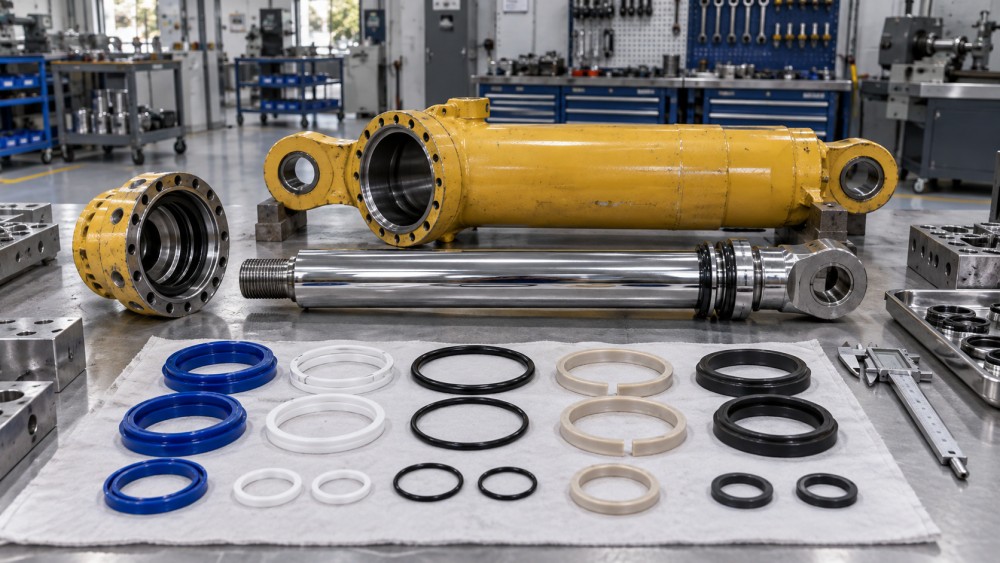
A hydraulic cylinder seal kit is a set of components designed around a particular cylinder configuration. It may include rod seals, piston seals, wiper seals, wear rings, O-rings, backup rings, static seals, and sometimes guide elements. A quotation that simply lists a “seal kit” without identifying these contents does not provide a reliable basis for comparison.
Material selection is one of the largest price drivers. Nitrile rubber is common for many mineral-oil hydraulic systems and is often the economical baseline. Polyurethane is frequently selected where abrasion resistance and dynamic sealing performance are important. Fluoroelastomer materials may be specified for elevated temperatures or more demanding fluid compatibility requirements. PTFE-based sealing elements can be used in demanding motion, pressure, or friction-control applications, often alongside energizers or backup components.
These materials are not interchangeable simply because they share a nominal size. A lower-cost elastomer may fit the groove but harden, swell, extrude, or wear prematurely when exposed to unsuitable fluid, excessive heat, or pressure spikes. Buyers should therefore compare the quoted material designation and operating envelope, rather than treating “rubber seal” as one commodity category.
Cylinder size also affects cost, but not in a purely linear way. Larger bore and rod diameters require more material, yet complexity can add more cost than diameter alone. A compact, high-pressure cylinder with tightly controlled grooves, specialized piston sealing, and multiple guide rings may require a more expensive kit than a larger, lower-duty cylinder. Telescopic cylinders, multi-stage cylinders, and cylinders with uncommon gland arrangements usually carry further identification and stocking challenges.
Brand-specific and OEM-reference kits can also command a premium. Part of that premium may reflect documentation, traceable material control, or confidence that the kit matches a known cylinder build. Part may also reflect distribution structure and availability. An aftermarket alternative can be commercially sound, but only after confirming the actual seal profile, dimensions, material, and component count. Matching an equipment model name alone is not always enough, particularly where cylinder designs have changed during a machine's production life.
Application conditions determine whether a cheaper kit is actually cheaper
Procurement decisions should begin with the cylinder's duty, not with the supplier's catalog grouping. Construction equipment, mining machinery, industrial presses, material-handling equipment, agricultural implements, and factory automation may all use hydraulic cylinders, but their sealing demands are materially different.
For outdoor mobile equipment, rod wipers and contamination resistance deserve close attention. Dust, abrasive particles, moisture, and damaged chrome surfaces can quickly compromise a rod seal. A kit priced below comparable alternatives may omit a robust wiper design, use a less suitable material, or provide only a basic static-seal set. The result can be oil leakage that is blamed on the replacement kit even though the rod surface or gland condition was never addressed.
In high-pressure cylinders, backup rings and anti-extrusion performance matter. Pressure peaks can force softer sealing elements into clearance gaps, especially when components are worn or temperatures rise. A quoted kit should identify whether backup rings are included and whether the proposed seal arrangement suits the expected pressure range and clearance condition. Buying a standard O-ring set for a cylinder that requires a supported dynamic seal package creates a false economy.
Temperature and fluid type require equal attention. Standard mineral hydraulic oil, water-glycol fluids, biodegradable fluids, synthetic fluids, and process-specific media can interact differently with sealing compounds. Heat adds another layer of risk by changing elastomer hardness and accelerating aging. A buyer does not need to become a materials specialist, but the supplier should be able to state the proposed seal materials and confirm their compatibility with the operating fluid and temperature range.
Duty cycle is often overlooked. A cylinder used occasionally for positioning may tolerate a cost-focused replacement approach. A cylinder operating continuously in a press, production line, lifting system, or high-utilization mobile machine has a much higher cost of unplanned downtime. In that case, the appropriate comparison is not kit price against kit price. It is installed repair cost, expected service interval, labor exposure, equipment availability, and the risk of secondary damage from leakage or contamination.
Compare quotations by repair scope, not by line-item price
Seal-kit quotations become difficult to evaluate when suppliers use different descriptions. One quote may cover piston and gland seals only. Another may include wear rings, rod wiper, static seals, and backup rings. A third may include individual parts that are dimensionally plausible but do not reproduce the original sealing arrangement.
A practical comparison sheet should request the following information for every offer:
- Cylinder manufacturer, model reference, or verified cylinder drawing reference
- Bore diameter, rod diameter, stroke, gland details, and piston arrangement where available
- Complete component list, including quantities and seal profiles
- Material designation for dynamic, static, and wiper elements
- Fluid compatibility and stated temperature suitability
- Pressure duty and whether anti-extrusion components are included
- Whether wear rings, guide rings, and backup rings are included or quoted separately
- Packaging, kit identification, lot traceability requirements, and lead time
This level of detail also exposes quotation gaps early. If one supplier cannot identify the seal profiles or material while another provides a complete breakdown, the apparent price advantage may be based on a different repair scope rather than better purchasing efficiency.
The cylinder condition can change the value of any seal kit
A seal kit does not restore damaged metal surfaces. Before purchasing, maintenance and engineering teams should determine whether the rod is scored, pitted, bent, or suffering from degraded chrome plating. The cylinder barrel should be checked for scoring, corrosion, and dimensional wear. Gland grooves, piston grooves, bearings, and retaining features also need inspection.
These checks matter to procurement because a premium kit can fail quickly in a worn cylinder, while a lower-cost kit may perform acceptably in a cylinder that has been properly inspected and reconditioned. The purchase decision should therefore distinguish between a routine reseal, a repair requiring rod or barrel work, and a cylinder that is economically better replaced or professionally rebuilt.
Contamination control belongs in the same review. If hydraulic oil contains abrasive debris, if filters are bypassed, or if assembly practices introduce dirt into the cylinder, changing seals alone may not solve the problem. Repeated seal-kit orders for the same equipment position can signal a system issue involving filtration, misalignment, pressure setting, side load, or a damaged mating surface. Ordering more of the same kit without investigating that pattern can increase spend without improving uptime.
How buyers can set a defensible purchase basis
For standard repair work, establish a verified cross-reference and define the minimum kit contents for each cylinder family. This allows purchasing to consolidate routine demand while avoiding uncontrolled substitutions. For critical equipment, build the specification around operating conditions: fluid, pressure, temperature, contamination exposure, cycle frequency, and downtime consequence.
It is also useful to separate stock decisions from emergency decisions. Common cylinder kits may justify controlled inventory when equipment downtime is expensive and cylinder identification is stable. Uncommon kits may be better sourced against a verified sample, drawing, or disassembled component set. Emergency buying tends to favor whatever is locally available; pre-approved technical data reduces that exposure.
When reviewing hydraulic seal kit price, the most useful question is: what repair outcome is this quote designed to support? A complete answer links the kit to a specific cylinder, a defined material set, the actual duty conditions, and the inspection work needed before installation. That basis gives procurement teams a clearer way to control both purchase cost and the far larger cost of an unsuccessful repair.
Related News
- How to Assess a Rigid Coupling Supplier for Bore Accuracy and Traceable QualityOct 08, 2026Tribology & Kinematics Expert
- Titanium Alloys Compared: Balancing Strength, Corrosion Resistance, and MachinabilityOct 08, 2026CNC Kinematics Architect
- Where Ductile Iron Dismantling Joints Reduce Alignment Risk in Water PipelinesOct 08, 2026Pipeline Metallurgy Scientist
- Selecting a Precision Bearing Sleeve: Fits, Runout, and Material ChoicesOct 08, 2026Tribology & Kinematics Expert
- Face Milling Cutters: How Insert Geometry Affects Finish on Steel and AluminumOct 08, 2026CNC Kinematics Architect
- Single-Acting Cylinders for Clamping: Stroke, Force, and Return Spring ConsiderationsOct 07, 2026Fluid Power Control Strategist