
Hydraulic Pump Prices: Comparing Quotes for the Same Pressure and Flow
Two hydraulic pump quotes can show the same pressure and flow while covering substantially different equipment. One may specify continuous operation at the required load; another may list maximum pressure alongside flow measured under lighter conditions. Before comparing hydraulic pump prices, establish whether each offer will deliver the required performance under the same operating conditions.
A useful comparison has three layers: technical suitability, total installed cost, and operating cost over the expected service period. A lower purchase price can be good value when the pump fits a straightforward application. Paying more makes sense when the additional cost buys a capability the system will actually use, such as variable flow control, better efficiency at frequent operating points, or faster access to replacement parts.
Check whether pressure and flow describe the same operating point
The first question is whether the quoted pump can deliver the required flow at the required pressure, speed, fluid viscosity, and temperature. Catalog headline figures do not always describe one simultaneous operating condition.
A pump’s theoretical flow depends on displacement and rotational speed. Actual outlet flow is lower because some fluid leaks internally, and that leakage changes with operating conditions and wear. Two pumps with equal displacement can therefore deliver different usable flow at working pressure.
Pressure ratings also need interpretation. Continuous, intermittent, and peak ratings describe different operating allowances. A peak rating does not establish suitability for sustained loading, and intermittent operation must stay within the manufacturer’s stated limits for duration and repetition.
Ask for a performance curve or test information covering the intended operating point. The useful evidence connects delivered flow, pressure, speed, and input power. A general catalog sheet that lists each maximum separately leaves too much room for an unequal comparison.
For a replacement, include the existing pump’s full identification code and the machine’s operating requirements. A partial model number can omit a control option, shaft arrangement, or seal specification that changes compatibility.
Compare pump design against the work it must perform
Gear, vane, and piston pumps can overlap in pressure and flow capability, but their suitability depends on the application. A price difference between designs should be assessed against the operating cycle, noise requirements, control needs, and maintenance conditions.
A fixed-displacement gear pump can be a sensible choice for equipment needing relatively steady flow and straightforward controls. Its simpler arrangement may keep acquisition and service costs manageable. However, if the system regularly needs much less flow than the pump supplies, the circuit must handle that excess through an appropriate unloading or control arrangement.
Vane pumps may suit industrial applications where smooth delivery and noise characteristics matter. Their value still depends on the specific model’s pressure capability, fluid requirements, and service provisions. The pump category alone does not establish better performance.
A variable-displacement piston pump may justify a higher price when demand changes frequently. Suitable controls can adjust output to system requirements and reduce losses associated with unnecessary flow. That benefit depends on the hydraulic circuit and duty cycle; a machine operating at a steady load may gain less from the added complexity.
Control specifications deserve their own comparison. Pressure compensation, load sensing, and electronic displacement control provide different functions. Even two load-sensing pumps can have different adjustment ranges, response characteristics, and interface requirements. Include the full control designation in the quotation comparison.
For an existing machine, changing pump design may also require engineering work. Valve behavior, cooling capacity, drive characteristics, and control logic can all affect whether the alternative performs properly. Treat those changes as part of the proposal’s cost.
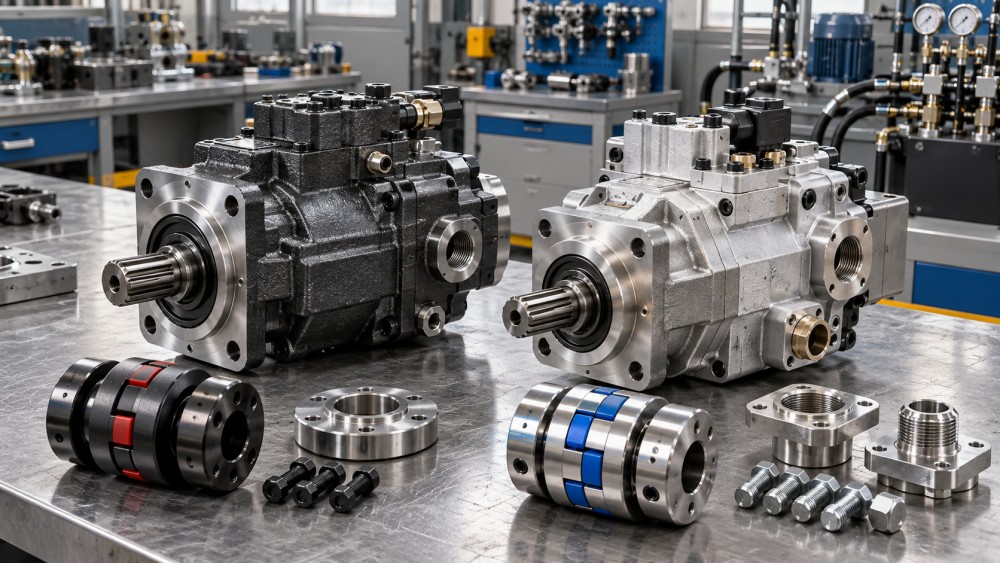
Turn each quotation into a comparable installed cost
Quotes often differ because their supply boundaries differ. A bare pump, a pump with a control assembly, and a complete motor-pump unit should not sit in the same price column without adjustments.
Request an itemized scope and identify everything required to put the equipment into service. Depending on the installation, this can include a coupling, bell housing, mounting bracket, flange adapters, case drain piping, sensors, electrical connectors, or commissioning support.
Physical interchangeability needs more than matching bolt holes. Check shaft dimensions, spline or key details, rotation direction, port sizes and positions, and available installation space. A replacement that requires hose rerouting or a new coupling may still be worthwhile, but those costs belong in the comparison.
Inlet conditions are particularly easy to miss. A pump may meet the required outlet specification yet be unsuitable for the existing suction arrangement. Available inlet pressure, fluid viscosity during startup, line restrictions, and permitted shaft speed affect reliable operation. A lower-priced replacement loses its advantage if it requires substantial changes to the reservoir or inlet piping.
Use the same commercial basis for every offer:
- Equipment scope: Pump, controls, accessories, documentation, and specified testing.
- Delivery basis: Freight, insurance where applicable, packaging, import charges, and the named delivery location.
- Installation: Mechanical adaptations, piping changes, electrical work, flushing, and commissioning.
- Initial support: Recommended spares, setup assistance, and any required training.
- Commercial conditions: Currency, payment milestones, quote validity, and treatment of applicable taxes.
Keep recoverable taxes separate from permanent costs when relevant to the accounting treatment. Also distinguish mandatory additions from optional upgrades so that an extensively equipped offer does not appear uncompetitive simply because another quotation leaves essential items out.
Use efficiency data that reflects the actual duty cycle
Efficiency matters because the drive must supply more power than the pump delivers hydraulically. Losses increase energy demand and contribute heat to the system. However, a single efficiency figure is useful only when its measurement conditions match the intended application.
Volumetric efficiency describes how closely actual flow approaches theoretical flow. Overall efficiency also accounts for mechanical and hydraulic losses. For operating-cost comparisons, input power at the required output is generally more useful than volumetric efficiency alone.
Hydraulic output power depends on pressure and delivered flow. Shaft input power is higher because of pump losses. Where an electric motor drives the pump, electrical consumption also depends on motor and drive efficiency.
Compare the operating points where the machine spends meaningful time: loaded operation, partial demand, idle periods, and pressure holding. A pump that performs well at one rated point may provide little benefit if the machine usually runs elsewhere.
A practical estimate uses:
Annual energy cost = average electrical input power × annual operating hours × electricity tariff.
Build average input power from the expected duty cycle and relevant performance data. Avoid applying full-load savings to every operating hour. For engine-driven equipment, use the corresponding fuel and operating model rather than an electricity calculation.
Also examine the circuit. Reducing pump losses will not eliminate heat created by unnecessary throttling or prolonged relief-valve flow. In some applications, correcting the control arrangement has more value than selecting a more efficient pump within the same unsuitable circuit.
A higher purchase price is justified by energy savings only when the expected operating hours, load pattern, and cost difference support it. For infrequently used equipment, installation compatibility and repair availability may carry more weight.
Assess serviceability through parts, repair routes, and warranty terms
Service life cannot be established from price or brand recognition alone. Fluid cleanliness, temperature, inlet conditions, alignment, and loading all influence pump reliability. A durable design can still fail early when installed or operated outside its limits.
Useful quotation evidence includes the required cleanliness level, filtration guidance, fluid compatibility, and installation instructions. These requirements also reveal whether the existing system needs work before the new pump is fitted. Replacing a failed unit without addressing contamination or suction problems can expose the replacement to the same failure mechanism.
Ask how the pump will be supported after installation. Are seal kits and control components available separately? Can the unit be repaired locally? Is a replacement available in the exact configuration, or does stock cover only the basic pump family? These answers help distinguish a practical service route from a general promise of support.
Read warranty coverage alongside its duration. Establish when coverage begins, how claims are assessed, who pays transport, and whether removal, reinstallation, and labor are covered. Understand any startup records, fluid-condition evidence, or installation requirements attached to a claim.
Documentation should be proportionate to the application. An installation drawing, operating instructions, serial identification, and relevant performance or acceptance records can support installation and future servicing. A generic certificate adds little if it does not identify what was checked.
Delivery commitments can outweigh a small unit-price difference
For a planned build, delivery uncertainty can disrupt assembly schedules. For a breakdown, the cost of waiting may exceed the difference between quotations. Compare the expected arrival date at the required location, including configuration work, testing, dispatch, and transit.
“In stock” needs a precise meaning. A supplier may hold a basic pump but still need to fit the specified controller or arrange a different shaft and port configuration. Request confirmation against the complete order code.
Check when the lead time starts. It may begin after payment, drawing approval, or technical clarification. A shorter quoted period can produce a later arrival if its starting conditions remain unresolved.
Where downtime has a material business impact, consider the replacement strategy alongside the initial purchase. Holding a suitable spare or securing a repair arrangement can provide more value than a small discount on a unit with uncertain replenishment.
Make the award decision from a short, documented comparison
Screen out technically unsuitable offers before ranking prices. Then compare qualified options using adjusted installed cost, expected operating cost, delivery confidence, and service provisions. Keep unresolved assumptions visible in the comparison rather than treating missing information as equivalent performance.
A concise decision sequence is:
- Define the required operating points, duty cycle, fluid conditions, and installation interfaces.
- Obtain written confirmation of the exact configuration and performance basis.
- Add the costs needed to make each offer installation-ready.
- Assess energy, maintenance, and downtime exposure using the expected application.
- Record which differences justify paying more and which add no practical value.
Ask suppliers to list deviations from the requested specification explicitly. This makes alternatives easier to assess and prevents an unmentioned substitution from becoming an installation problem.
The lowest qualified quotation can be the right purchase when it meets the duty, fits the system, and has workable support. A higher quotation earns its premium when the additional capability produces a clear operational benefit. Before issuing the order, put the agreed configuration, performance conditions, included scope, delivery commitment, and acceptance requirements into the purchase documents.
Related News
- Why Is Your Heavy-Duty Piston Pump Losing Pressure Under Load?Nov 09, 2026Fluid Power Control Strategist
- Cartridge Valves for Manifold Blocks: Avoiding Cavity Fit ProblemsNov 09, 2026Fluid Power Control Strategist
- Large-Diameter Forged Rings: How Seamless Rolling Affects Grain FlowNov 09, 2026Foundry Phase-Change Fellow
- Sealed Heavy-Duty Roller Bearings: Choosing Seals for Dust and WaterNov 09, 2026Tribology & Kinematics Expert
- Sprockets and Chain Drives: What Determines Replacement Cost?Nov 08, 2026CNC Kinematics Architect
- Monoblock Hydraulic Control Valves: Flow Rating and Spool SelectionNov 08, 2026Fluid Power Control Strategist