
Hydraulic Accumulators in HPUs: How to Prevent Precharge Loss and Downtime
A hydraulic accumulator that has lost its nitrogen precharge rarely fails in isolation. In a hydraulic power unit, it often shows up as frequent pump starts, pressure swings, noisy relief-valve operation, slow actuator response, fluid temperature rise, or loss of emergency function. Replacing a pump or adjusting a pressure switch may temporarily mask those symptoms, but it will not restore the stored energy that the accumulator is supposed to provide.
For hydraulic accumulators for hydraulic power units, preventing downtime starts with a simple rule: measure precharge under the correct conditions, identify why it changed, and correct the root cause before returning the HPU to service. Recharging nitrogen without investigating the loss can turn a small seal issue into repeated shutdowns, bladder damage, or a safety risk.
What precharge loss changes inside an HPU
An accumulator stores hydraulic energy by compressing nitrogen behind a separator, usually a bladder, piston, or diaphragm. When system pressure rises, hydraulic oil compresses the gas. When the system needs flow quickly, or when the pump is stopped, the compressed gas pushes oil back into the circuit.
This function supports several common HPU duties: smoothing pump pulsation, handling short peak-flow demand, maintaining pressure during small leakage losses, absorbing pressure spikes, and providing limited emergency movement or controlled shutdown. The accumulator does not create hydraulic power. It makes the power already available from the pump and pressure circuit more usable.
When precharge becomes too low, the gas volume is no longer available in the intended pressure range. The accumulator may fill with oil too early and contribute little usable discharge volume. The pump then has to handle every small pressure drop, which can lead to rapid cycling and extra heat. In a shock-control circuit, a low-precharge unit may bottom out hydraulically and stop cushioning pressure spikes effectively.
Excessive precharge creates a different problem. If nitrogen pressure is too close to the operating pressure, oil may not enter the accumulator at all. The HPU can appear normal at rest, yet the accumulator provides almost no flow reserve when the machine demands it. A high precharge can also place unnecessary stress on the bladder or separator at low system pressure.
The correct setting is therefore not simply “as high as possible” or “high enough to stop the pump.” It must match the accumulator design, the circuit’s minimum and maximum working pressures, the required discharge volume, and the intended function.
Recognize the symptoms before assuming the accumulator is at fault
Precharge loss is common, but it is not the only cause of unstable HPU pressure. A practical diagnosis separates accumulator symptoms from pump, valve, control, and leakage problems.
A pressure gauge reading alone can be misleading. If the accumulator remains connected to a pressurized oil line, the reading may reflect hydraulic system pressure rather than true gas precharge. Measuring gas pressure without first removing hydraulic pressure from the fluid side is one of the most common maintenance errors.
Where nitrogen precharge is usually lost
Slow nitrogen loss can occur over time through seals and gas-valve components. Some gradual change is possible in normal service, especially where equipment runs through repeated temperature cycles. A rapid drop, however, deserves investigation rather than routine topping up.
The gas valve is often the first place to inspect
A damaged valve core, loose valve assembly, worn seal, or missing protective cap can allow nitrogen to escape. The cap is not merely a dust cover. On many accumulator designs, it also protects the valve from impact, contamination, and accidental disturbance. Oil, dirt, corrosion, or mechanical damage around the gas end should be treated as evidence to inspect more closely.
Use an approved leak-detection method around the gas valve after charging. Do not rely on hearing a leak. Small gas losses can be too quiet to detect in a running industrial environment.
Internal separator damage changes the diagnosis
In a bladder accumulator, a torn bladder can allow nitrogen to enter the hydraulic fluid. The accumulator will no longer store oil correctly, and repeated recharging will not solve the problem. In piston accumulators, worn piston seals may allow gas and oil to bypass internally. A diaphragm accumulator can also lose function if its separating element is damaged.
Signs vary by design, but gas in the oil, an accumulator that will not retain charge, unusual fluid behavior, or repeated loss shortly after recharge point toward an internal issue. The repair action may involve replacing the bladder, seals, or the complete unit, depending on the construction and condition of the pressure vessel.
Installation and operating conditions can accelerate loss
Vibration can loosen fittings or damage a poorly supported accumulator. Corrosive environments can attack the shell, valve area, mounting hardware, and protective coatings. High ambient temperatures or heat transferred from the hydraulic circuit raise gas pressure while hot and can hide the fact that the cold precharge is inadequate. Repeated overheating also shortens the life of seals and elastomeric components.
Connection layout matters as well. A long, restrictive, or undersized line between the accumulator and the point of demand reduces how effectively it can respond. This does not directly cause nitrogen loss, but it can create the same operational complaint: the accumulator seems present but does not control the pressure event.
Check precharge safely and get a meaningful result
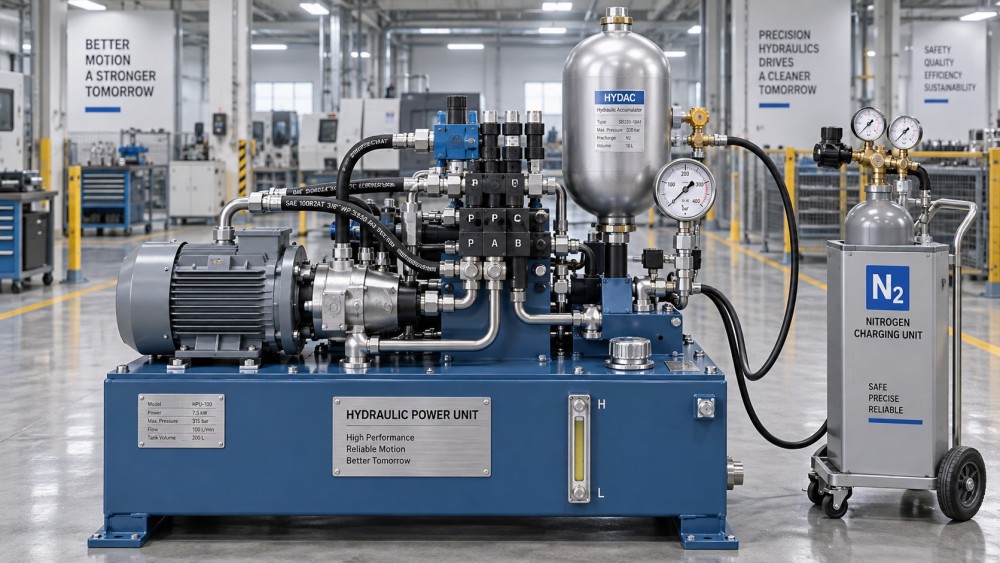
Precharge work involves compressed gas and stored hydraulic energy. Follow the equipment lockout procedure, isolate the HPU, and use the accumulator manufacturer’s charging and service instructions. The accumulator shell, gas valve, charging assembly, hose, regulator, and pressure gauge must all be suitable for the pressure involved.
Before connecting a charging kit, stop the pump and make sure the hydraulic side of the accumulator is fully depressurized. Isolate it from the circuit if the design allows, then release trapped oil pressure through the proper controlled path. A closed shut-off valve does not prove that the fluid side is depressurized. Pressure can remain trapped between valves, in hoses, or in connected components.
Once the oil side is at zero pressure, allow the accumulator temperature to stabilize if it has just been operating. Nitrogen pressure changes with temperature. A reading taken immediately after a hot production cycle may lead to an incorrect adjustment when the equipment later cools.
Connect the charging and gauging assembly carefully, following the valve design so that the valve is not unintentionally depressed before the connection is secure. Record the measured gas pressure, date, accumulator identification, ambient condition, and any visible condition concerns. A maintenance record is valuable because one reading only tells you the present state; several readings reveal whether the unit is stable or losing charge.
Never use compressed air or oxygen to precharge a hydraulic accumulator. Nitrogen is used because it is dry, inert, and appropriate for this application. Introducing oxygen or ordinary compressed air creates avoidable fire, oxidation, moisture, and compatibility hazards.
Recharge only after confirming the required setting
The correct precharge is set by the accumulator and HPU design, not by a generic value from another machine. Start with the equipment documentation, accumulator nameplate information, and the circuit function. A unit used for emergency oil supply may be set differently from one used for pulsation damping or pressure maintenance.
Precharge is typically related to the circuit’s lowest expected operating pressure. The aim is to keep the separator from being driven into an unsuitable end position while still allowing enough oil to enter the accumulator during normal operation. The exact relationship depends on accumulator type and duty. A setting chosen only to increase stored volume can damage the separator; a setting chosen only to maximize pressure support may leave too little usable oil volume.
When charging, add nitrogen gradually with a proper regulator. Pause between small adjustments so the pressure can settle. Fast filling can heat the gas and produce a temporary reading above the true stabilized pressure. After the target precharge is reached, close and secure the gas valve, remove the charging equipment correctly, fit the protective cap, and check for leakage.
Do not compensate for a pressure-control problem by increasing gas precharge. If an HPU starts too often because a pressure switch is misadjusted, a check valve leaks, or a proportional valve is bypassing internally, changing accumulator pressure may make the fault harder to diagnose.
A short fault sequence that avoids repeated downtime
When a hydraulic power unit shows pressure instability or loss of reserve capacity, use this order of work:
- Confirm the operating complaint. Note whether the issue is pump cycling, pressure spikes, reduced emergency movement, temperature rise, or pressure decay after shutdown.
- Check the circuit condition. Review pump performance, relief-valve behavior, pressure controls, external leaks, fluid level, contamination, and restrictions before blaming the accumulator.
- Depressurize and measure precharge correctly. The fluid side must be at zero pressure for a valid gas-side measurement.
- Compare the reading with the documented application setting. Do not use the setpoint from a similar-looking HPU unless the operating pressure range and function are the same.
- Inspect for the reason behind the loss. Examine the gas valve, cap, mounting, corrosion, external damage, and evidence of separator failure.
- Recharge, repair, or replace based on the finding. A stable valve-related loss may be corrected with the appropriate service parts. Recurrent loss or evidence of internal failure requires deeper service.
- Verify the machine under normal operating conditions. Watch pressure behavior, pump cycle frequency, temperature trend, and the function the accumulator was installed to support.
Maintenance intervals should follow duty, not a calendar alone
An accumulator in a lightly used pressure-holding circuit does not experience the same stress as one absorbing rapid pressure fluctuations on a press, mobile machine, or cyclic industrial process. Inspection frequency should reflect operating hours, temperature exposure, vibration, pressure cycling, and the consequence of lost accumulator function.
Critical systems benefit from baseline records taken when the accumulator is known to be healthy. Record precharge, charging date, installed location, operating role, and any replacement parts. If the same accumulator repeatedly needs nitrogen, the pattern is more useful than repeatedly restoring the pressure. It distinguishes normal long-term drift from a valve leak, seal wear, bladder failure, or an unsuitable operating environment.
Fluid condition belongs in the same maintenance review. Contaminated oil can damage valves, restrict small orifices, and accelerate seal wear elsewhere in the HPU. Although dirty fluid does not directly leak nitrogen through a gas valve, it can make accumulator-related pressure problems harder to separate from general hydraulic instability.
When replacement is the better maintenance decision
Replacement should be considered when the pressure vessel is corroded, physically damaged, repeatedly loses precharge after service, or shows signs of internal separator failure. It is also appropriate when the original accumulator no longer matches the machine’s actual duty, such as after a pump change, faster actuator cycle, altered load, or revised emergency requirement.
A replacement decision should not be based on shell volume alone. Confirm the accumulator type, pressure rating, connection arrangement, compatible seal materials, required flow response, gas-side service arrangement, and mounting method. For hydraulic accumulators in HPUs, a unit with the correct volume but the wrong pressure range, elastomer compatibility, or response characteristics can introduce another reliability issue.
Resources from industrial fluid-power knowledge platforms such as IMPE can help organize the comparison between accumulator construction, pressure-control components, hydraulic pumps, valves, fittings, and maintenance requirements. The useful question is not simply which component is available, but whether the complete HPU circuit can store, release, and control energy reliably under its real operating conditions.
The most effective prevention measure is disciplined diagnosis. Measure precharge only with hydraulic pressure removed, charge with nitrogen using proper equipment, investigate every abnormal loss, and verify the machine after service. That approach protects the accumulator, reduces unnecessary pump work, and prevents a small gas-side defect from becoming an unplanned HPU shutdown.
Related News
- Using Industrial Air Blow Guns to Clear Chips Without Spreading DebrisOct 15, 2026Fluid Power Control Strategist
- Ductile Iron Pipe Valves: Which AWWA Standards Apply to Water Main Projects?Oct 15, 2026Dr. Elias Vance
- Why Vacuum Suction Cups Lose Grip on MDF in Woodworking MachinesOct 15, 2026CNC Kinematics Architect
- Choosing a Variable Displacement Piston Pump Manufacturer: What to VerifyOct 15, 2026Fluid Power Control Strategist
- Parallel vs. Angular Pneumatic Grippers for Confined Assembly StationsOct 15, 2026Fluid Power Control Strategist
- Die Castings vs. Investment Castings: Which Costs Less at Your Production Volume?Oct 14, 2026Foundry Phase-Change Fellow