
How to Assess a Return Line Filter Manufacturer for Hydraulic System Reliability
Selecting a return line filter manufacturer is a reliability decision, not a catalog comparison. The filter sits downstream of cylinders, motors, valves, and other working components, where it captures wear debris and ingressed contamination before oil returns to the reservoir. If that protection is poorly matched to the circuit, contamination can circulate back to the pump inlet and shorten the working life of precision hydraulic components.
For technical evaluators, the difficult part is that many products appear similar on paper. Two filter housings may show the same port size, nominal flow range, and element length, yet behave very differently under cold starts, pressure spikes, dirty-fluid conditions, or long maintenance intervals. A capable return line filter manufacturer should be able to explain those differences with engineering evidence rather than broad claims about “high efficiency” or “long life.”
Start with the actual contamination-control role in the circuit
A return filter does not replace suction-side protection, pressure filtration, clean filling practices, or reservoir maintenance. Its job is more specific: control contamination generated or carried by oil returning from actuators and downstream hydraulic functions. That role makes the installation point especially relevant in systems with cylinders, hydrostatic drives, mobile equipment attachments, industrial presses, injection machinery, and power units with frequent directional-valve movement.
Before approaching suppliers, define what the filter is expected to protect. In a relatively simple hydraulic power unit, the return filter may mainly maintain reservoir cleanliness. In a machine with servo valves, proportional controls, or a high-value variable-displacement pump, the return filter becomes one part of a tighter contamination-control plan. The manufacturer should ask about component sensitivity, target cleanliness level, duty cycle, fluid type, expected ambient temperature, and the likelihood of externally introduced dirt. If the conversation begins and ends with “What is your flow rate?”, the technical review is incomplete.
This distinction matters because a fine element is not automatically the best answer. An element selected without considering viscosity, cold-start flow, and allowable differential pressure can create excessive restriction. Conversely, an overly coarse element may keep pressure drop low while allowing particles that matter to pass through the system. The appropriate balance depends on the circuit and must be supported by an element design that behaves consistently over its service interval.
Evaluate filtration performance beyond the micron label
A micron rating alone is a weak basis for comparing hydraulic return filters. Suppliers may describe elements as nominal, absolute, or high-efficiency, but those labels do not always indicate equivalent particle capture performance. Ask the manufacturer how filtration efficiency is measured and whether test information can be linked to recognized methods, such as multi-pass testing under ISO 16889 where applicable. The useful question is not merely “How fine is the media?” but “What efficiency does this element maintain at the particle sizes that affect this application?”
Beta ratio information can help technical teams compare media performance, but only if the conditions behind the figure are clear. A manufacturer should be prepared to identify the tested element configuration, fluid, flow condition, and relevant particle sizes. Be cautious when a quotation lists a filtration grade with no supporting test context. That does not prove the element is unsuitable, but it does mean the procurement team has less evidence for a reliability-critical choice.
The media itself deserves attention. Pleated glass-fiber media, cellulose-based media, wire mesh, and blended structures can each have a place, depending on fluid cleanliness targets, water tolerance, fluid compatibility, and maintenance strategy. A supplier should be able to explain pleat support, media collapse resistance, bonding method, and end-cap construction. In demanding service, the element is not just a disposable consumable; it is the core performance component inside the housing.
Check flow capacity under real operating conditions
Nominal return flow is often misunderstood. Actual return flow can exceed pump delivery in differential cylinder circuits, accumulator discharge events, regeneration functions, or applications with multiple return paths converging at one filter. A filter selected only around average pump flow may appear adequate during normal running and then create high differential pressure during a transient event.
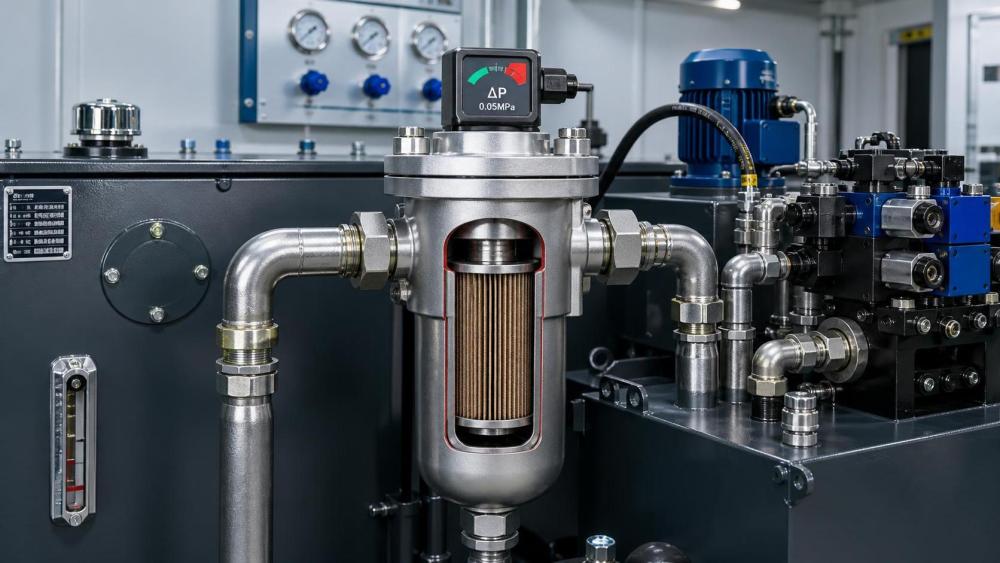
Ask the proposed return line filter manufacturer for pressure-drop curves rather than a single flow number. The curves should ideally distinguish clean-element and increasingly loaded-element conditions. They also need to be interpreted at the fluid viscosity expected during startup, not solely at a warm, favorable viscosity. Cold hydraulic oil is where many apparently well-sized filters reveal a poor margin.
The housing, head, ports, indicator, bypass valve, and element all contribute to restriction. It is possible for a large element to be installed in a housing whose porting or internal passages become the practical limitation. Review port type and orientation as well. A filter that is technically sufficient but requires awkward hose routing, sharp bends, or difficult access can introduce installation losses and future maintenance problems.
Bypass valves require more scrutiny than they usually receive
A bypass valve protects the filter assembly from excessive differential pressure, particularly when an element is contaminated or the fluid is cold. It is necessary in many designs, but it also creates a controlled path for unfiltered oil. The evaluation question is not whether a bypass exists; it is whether its opening setting, flow capacity, sealing behavior, and failure mode suit the hydraulic circuit.
For equipment operating in harsh environments, a bypass that opens repeatedly during cold starts can gradually undermine the intended cleanliness plan. A manufacturer should be able to discuss how the bypass setting relates to element collapse strength and expected system backpressure. If a supplier cannot explain the relationship between bypass operation and contamination risk, that is worth noting during technical approval.
Review housing design, materials, and fatigue resistance
Return-line duty is lower pressure than a pressure-filter location, but it is not pressure-free. Backpressure can rise due to downstream restrictions, return-line surges, blocked coolers, or rapid actuator movements. The filter housing must tolerate the expected operating pressure, transient conditions, and installation loads with appropriate margin. Do not assume a return filter can be selected purely because its connection size matches the line.
Ask for the rated operating pressure, stated proof or burst-test information where available, allowable temperature range, seal material options, and housing material details. Steel, aluminum, and engineered polymer components have different strengths and limitations. The right choice depends on corrosion exposure, machine vibration, weight constraints, fluid chemistry, and outdoor service conditions. A mobile machine exposed to mud, salt spray, and impact needs a different practical assessment from a clean indoor manufacturing power unit.
Machining quality also matters at interfaces: thread accuracy, gasket seating surfaces, port geometry, and the fit between head and bowl all affect leakage risk and serviceability. IMPE’s broader coverage of precision machining, cast components, forged parts, and fluid power equipment is relevant here because hydraulic reliability is often decided at these ordinary-looking interfaces. A filter housing is a small assembly, but it depends on sound material control and repeatable manufacturing.
Treat indicators and maintenance access as engineering requirements
A well-designed filter cannot protect a system if the element is not changed when needed. Differential-pressure indicators are therefore more than accessories. Consider whether the application needs a visual indicator, an electrical switch for machine control, or both. The manufacturer should specify the indicator’s operating threshold and compatibility with the selected filter assembly. A generic indicator added late in the procurement process can provide misleading maintenance signals.
Maintenance practicality is often discovered too late. Can the bowl be removed without disconnecting nearby piping? Is there sufficient clearance for withdrawing the element? Does the service process expose technicians to residual oil? Are replacement elements clearly identified and protected from mix-ups? On compact equipment, these questions can matter more than a marginal difference in initial filter price.
The replacement-element supply chain should also be checked during manufacturer assessment. A proprietary element may be reasonable when it provides verified performance, but buyers should understand lead times, identification controls, packaging quality, and the risk of unverified aftermarket substitutions. Poorly made replacement elements can fit the housing yet offer different efficiency, seal integrity, or collapse resistance.
Assess quality systems through documents and technical dialogue
Documentation does not replace engineering, but it reveals whether a manufacturer controls what it sells. For a serious hydraulic filter evaluation, request current dimensional drawings, performance curves, installation instructions, element specifications, material declarations where needed, and batch or lot traceability practices. The exact document set will depend on the project, yet reluctance to provide basic technical evidence is a concern.
Traceability is particularly relevant when filters are supplied to OEM programs, infrastructure equipment fleets, or industrial systems with formal maintenance records. It should be possible to distinguish the housing model, element type, seal specification, and production batch. This becomes valuable if there is a field issue involving leakage, premature indicator activation, media damage, or incorrect replacement parts.
Standards should be reviewed in context. References to ISO cleanliness coding, such as ISO 4406, may be useful in defining the condition of hydraulic fluid. Filter test methods and machine-specific requirements may add further expectations. However, a manufacturer’s mention of a standard should be verified against the actual product scope and test documentation. A standard name in a brochure is not the same as demonstrable conformity for the quoted configuration.
Use a manufacturer review that mirrors field risk
The strongest return line filter manufacturer is not necessarily the one with the longest catalog. It is the one that can match a specific hydraulic duty cycle with a defensible combination of media efficiency, pressure-drop behavior, housing strength, bypass design, seal compatibility, and maintenance support. Technical responsiveness matters because filter selection frequently changes after piping layouts, cooler sizing, fluid choice, or component sensitivity become clearer.
A practical approval process normally separates three questions: whether the proposed filter fits the physical installation, whether it protects the hydraulic components at expected operating conditions, and whether it can be maintained reliably over the equipment life. A supplier may pass one test and fail another. For example, a compact unit may fit a tight envelope but offer poor cold-oil pressure-drop margin; another may perform well but require element replacement clearance that the machine frame does not provide.
Before placing a production order, provide the manufacturer with the hydraulic schematic, maximum and normal return flow, fluid specification, expected temperature range, reservoir arrangement, downstream restrictions, target cleanliness requirement, and available installation space. Their response should be technically specific enough to review. If key assumptions are missing, ask for them to be recorded rather than left to verbal understanding.
In hydraulic systems, contamination control is cumulative. Pump condition, cylinder sealing, hose cleanliness, reservoir design, breather performance, fluid handling, and filtration all interact. A return filter cannot correct every weakness, but selecting the right manufacturer and validating the proposed design prevents the filter itself from becoming one of those weaknesses. That is the level of review required when uptime, component life, and predictable maintenance are part of the equipment promise.
Related News
- How to Assess a Rigid Coupling Supplier for Bore Accuracy and Traceable QualityOct 08, 2026Tribology & Kinematics Expert
- Titanium Alloys Compared: Balancing Strength, Corrosion Resistance, and MachinabilityOct 08, 2026CNC Kinematics Architect
- Where Ductile Iron Dismantling Joints Reduce Alignment Risk in Water PipelinesOct 08, 2026Pipeline Metallurgy Scientist
- Selecting a Precision Bearing Sleeve: Fits, Runout, and Material ChoicesOct 08, 2026Tribology & Kinematics Expert
- Face Milling Cutters: How Insert Geometry Affects Finish on Steel and AluminumOct 08, 2026CNC Kinematics Architect
- Single-Acting Cylinders for Clamping: Stroke, Force, and Return Spring ConsiderationsOct 07, 2026Fluid Power Control Strategist