
How to Assess a Hydraulic Pumps Factory Before Approving a Long-Term Supplier
Why Factory Assessment Matters Before a Long-Term Award
Choosing a hydraulic pumps factory for a long-term supply agreement requires more than comparing prices and product catalogs. Procurement teams must assess manufacturing capability, quality control, material traceability, testing standards, delivery consistency, and technical support. A structured factory evaluation helps reduce operational risk, protect equipment uptime, and ensure the selected supplier can meet changing project requirements over the full lifecycle of hydraulic systems.
This matters because a hydraulic pump is rarely an isolated purchase. It sits inside an excavator, press, agricultural machine, mining system, material-handling unit, marine installation, or industrial power pack. A pump failure can stop a production line, delay a construction project, damage connected components, or create a warranty dispute between the OEM, distributor, and end user. The lowest initial unit cost can become expensive when replacement lead times, field failures, oil contamination claims, or engineering changes appear later.
For procurement teams, the real question is not simply whether a factory can manufacture a pump sample that meets a drawing. The question is whether it can repeatedly deliver conforming pumps at the required volume, with documented controls, stable performance, and a credible response when conditions change.
Start With the Operating Context, Not the Factory Brochure
A factory assessment should begin with the buyer's own application requirements. Hydraulic pumps that appear similar in a catalog may face very different duty cycles and failure consequences. A gear pump used intermittently in a compact agricultural attachment has a different risk profile from a piston pump operating continuously in a high-pressure construction machine or a custom power unit serving a steel mill.
Before comparing suppliers, procurement and engineering teams should align on the conditions the pump must actually withstand. These normally include operating pressure and peak pressure, flow range, rotational speed, fluid type, viscosity range, ambient temperature, cleanliness level, expected service life, mounting arrangement, noise limits, and the consequences of unplanned downtime. Where the pump interfaces with valves, motors, cylinders, filters, hoses, or electronic controls, compatibility should also be defined at system level.
Many purchasing problems begin when a specification lists nominal flow and pressure but leaves the surrounding operating environment vague. A supplier may quote a technically plausible configuration that works under a short laboratory test but is poorly suited to frequent pressure spikes, cold starts, contaminated oil, or continuous high-load work. Long-term approval should therefore be tied to verified application conditions, not broad statements such as “heavy duty” or “industrial grade.”
Separate Real Manufacturing Capability From Assembly Capability
Not every hydraulic pumps factory controls the same parts of the production process. Some manufacturers design, machine, assemble, and test critical pump components in-house. Others purchase bodies, gears, pistons, swash plates, valve plates, shafts, seals, or bearings from external sources and focus primarily on final assembly. Neither model is automatically unacceptable, but the buyer needs to know which model is being evaluated.
In-house machining can provide stronger control over tolerances, engineering changes, and production scheduling, particularly for custom housings, shafts, and precision internal parts. It may also shorten the feedback loop when inspection results reveal process drift. However, a vertically integrated factory still needs evidence that its machining processes are stable, its tooling is controlled, and its measurement equipment is capable of detecting critical defects.
An assembly-focused supplier may be suitable when it has well-qualified component partners, effective incoming inspection, clear supplier controls, and a proven record with standardized pump platforms. The risk rises when the factory cannot identify the source of critical components, relies on changing spot-market purchases, or has no documented method to validate substitute materials and parts.
During an assessment, ask the factory to map the supply chain for components that affect pump life and safety. This typically includes cast or forged housings, shafts, gears or piston groups, bearings, seals, springs, valve elements, and surface-treatment services. The point is not to demand that every operation occur under one roof. It is to determine whether the factory owns the quality outcome even where external suppliers are involved.
Focus on the Processes That Control Pump Reliability
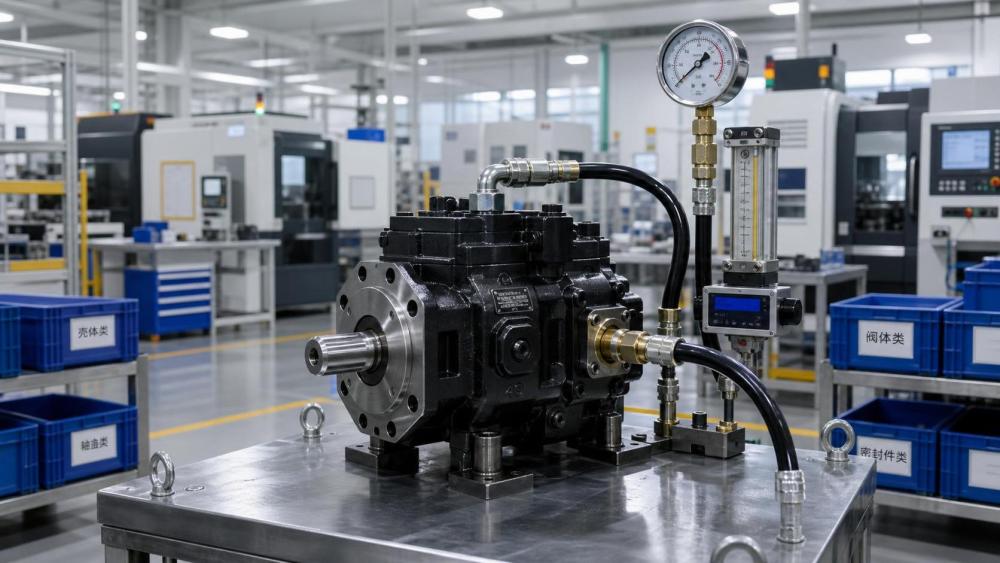
Hydraulic pumps depend on precise internal clearances, material properties, surface finishes, and cleanliness. A factory tour should move beyond general observations such as the number of machines on the shop floor. Buyers should identify the operations that have the greatest effect on volumetric efficiency, pressure stability, noise, wear, and leakage.
For gear pumps, this may include gear profile machining, shaft concentricity, housing bore geometry, bearing-seat accuracy, end-clearance control, and the flatness of relevant sealing surfaces. For piston pumps, the assessment may need to cover cylinder block processing, piston-shoe matching, valve plate finishing, swash plate treatment, servo components, and the management of high-pressure rotating interfaces. The critical processes will vary by pump type, but a capable factory should be able to explain them clearly.
Questions that reveal useful evidence include:
- Which dimensions and surface characteristics are designated as critical-to-quality?
- How are machining offsets, tool wear, fixture wear, and machine condition monitored?
- Which inspection points are performed during production rather than only at final inspection?
- How are heat treatment, coating, grinding, honing, or lapping operations qualified and controlled?
- What happens when a measurement falls outside the control limit but remains within drawing tolerance?
- How does the factory prevent nonconforming material from being mixed with approved production?
A supplier that responds only with broad quality statements may have limited process discipline, even if its showroom and catalog are impressive. Strong factories can normally connect a critical function, such as maintaining pressure under load, to the dimensions, materials, manufacturing steps, and verification methods that protect that function.
Traceability Is a Commercial Safeguard, Not Just a Documentation Exercise
Material traceability becomes essential when a pump fails after installation or when a customer requests evidence of compliance. It allows the buyer and supplier to determine whether a problem is linked to a specific material lot, heat-treatment batch, seal batch, machining shift, assembly line, or test result. Without it, warranty analysis becomes slow and often inconclusive.
The appropriate level of traceability depends on the application. A high-volume replacement pump for general service may need batch-level records. Pumps used in critical mobile equipment, infrastructure assets, safety-sensitive machinery, or contractual OEM programs may require serial-level traceability. The procurement requirement should be explicit before commercial terms are finalized.
At a minimum, the factory should be able to show how it links incoming materials and purchased components to production batches, how it records key process data, and how it retains final test records. Material certificates, chemical composition reports, hardness reports, dimensional records, and pressure-test results are valuable only when they can be matched reliably to the supplied product.
Buyers should also check whether documentation is generated as part of the real production workflow or assembled after the fact for audits. Inconsistent dates, incomplete batch references, repeated test values across supposedly separate units, or records that cannot be traced to physical stock are warning signs. Documentation quality often reveals the maturity of the entire operating system.
Do Not Treat End-of-Line Testing as Proof of Long-Term Performance
Functional testing is necessary, but a single successful end-of-line run does not prove that a pump will perform reliably over its intended life. A factory may confirm rotation, flow, pressure, leakage, and noise within a short test cycle, yet still have weaknesses in fatigue resistance, thermal stability, contamination tolerance, or pressure-spike performance.
Procurement teams should understand what the supplier's standard test actually covers. Ask for the test bench configuration, test fluid condition, oil temperature range, test duration, measurement method, acceptable limits, calibration status, and record format. If the buyer requires a particular duty cycle, the supplier should explain whether that cycle is validated through type testing, customer-specific validation, field data, or another method.
The following distinction is useful during supplier approval:
Where pump failure would create major downtime or safety exposure, consider requiring a documented validation plan before the first production release. This can include endurance testing, pressure cycling, temperature testing, contamination testing, noise measurement, or system-level trials. The exact program should be tied to application risk, since over-testing a low-risk standard part also adds avoidable time and cost.
Assess Capacity Through Evidence of Delivery Control
Quoted monthly capacity is one of the least useful figures in a supplier presentation unless it is supported by real production data. A factory may technically have enough machines and assembly stations, but still struggle with bottleneck processes, outsourced treatments, labor turnover, component shortages, or unplanned rework.
For a long-term supplier, request a view of production flow from incoming material to shipment. Identify the longest lead-time items, outsourced operations, test-bench capacity, final inspection capacity, and packaging process. Ask how production is scheduled when demand changes sharply and how the factory handles urgent replacement orders without disrupting contracted deliveries.
Delivery performance should be assessed with historical evidence where available. On-time delivery data, backlog records, order-change handling, inventory policy, and corrective actions for late shipments provide a more useful picture than a statement that the factory has “strong capacity.” Buyers should also examine whether capacity claims assume a single-shift operation, overtime, additional subcontracting, or equipment that is already heavily loaded.
Packaging and logistics deserve attention as well. Hydraulic components can be damaged by corrosion, contamination, improper port protection, or inadequate fixation during transport. A pump that leaves the factory in working condition may arrive unusable if ports are exposed, internal preservation is unsuitable for transit duration, or packaging cannot withstand the intended shipping route.
Price Comparisons Need a Total-Cost Lens
Unit price remains important, especially in equipment programs with significant volume. But comparing quotations line by line can conceal meaningful differences in scope. One supplier may include production testing, export packaging, certificates, defined warranty support, and engineering review. Another may quote a lower price while treating these items as exceptions, optional services, or buyer responsibilities.
Procurement should compare the total delivered cost and the likely cost of nonperformance. Relevant factors include minimum order quantities, tooling ownership, engineering change charges, spare-parts availability, packaging, freight terms, payment conditions, warranty process, service response, and the cost of holding safety stock. For pumps installed in high-value machinery, the cost of a field failure may outweigh a modest initial price difference many times over.
It is also useful to test the supplier's pricing logic. Large price gaps may reflect different materials, different bearing or seal grades, shorter test cycles, less rigorous inspection, or a dependence on unverified third-party components. A low quote is not necessarily a problem, but it should trigger a technical review rather than automatic preference.
Technical Communication Is Part of Supplier Capability
Long-term relationships are tested by change, not by the first purchase order. Drawings are revised, customers request different mounting options, raw material markets shift, and field issues require prompt analysis. A reliable hydraulic pumps factory should have people who can communicate across procurement, quality, production, and engineering functions without losing technical detail.
Evaluate how the supplier handles a controlled change request. Can it identify affected components, estimate validation work, explain lead-time implications, and provide a revised documentation package? Does it issue formal deviation requests before changing a material, seal source, machining route, or critical subcontractor? A supplier that makes undocumented substitutions may preserve short-term delivery while creating major downstream exposure.
For global sourcing programs, language capability and response discipline should be considered operational factors rather than administrative preferences. Delays in clarifying a drawing tolerance, test result, or nonconformance can hold up production just as effectively as a machine breakdown.
Use the Audit to Build an Approval Path, Not a Pass-Fail Event
A factory visit or remote audit should lead to a risk-based approval decision. Few suppliers are perfect across every category, and not every gap requires rejection. The key is to distinguish between manageable limitations and structural weaknesses.
A factory may be approved for a standard, lower-risk product range while being excluded from high-pressure or custom-engineered applications until additional validation is complete. Another supplier may have good manufacturing controls but require an improvement plan for traceability, packaging, or response time. These conditions should be written into the supplier agreement with ownership, evidence requirements, and review dates.
Long-term approval should also include re-evaluation triggers. Significant volume increases, repeated warranty claims, changes in manufacturing location, material-source changes, major staffing turnover, late-delivery patterns, or requests to substitute critical parts should prompt a fresh review. Supplier approval is not a certificate to file away; it is an operating decision that must remain aligned with the actual risk of the program.
The most effective procurement teams do not choose between price and quality as though they are separate objectives. They use factory assessment to understand what level of capability is being purchased, what risks remain outside the supplier's control, and what safeguards are needed in the commercial agreement. That approach turns a hydraulic pump purchase from a catalog comparison into a more defensible long-term supply decision.
Related News
- Using Industrial Air Blow Guns to Clear Chips Without Spreading DebrisOct 15, 2026Fluid Power Control Strategist
- Ductile Iron Pipe Valves: Which AWWA Standards Apply to Water Main Projects?Oct 15, 2026Dr. Elias Vance
- Why Vacuum Suction Cups Lose Grip on MDF in Woodworking MachinesOct 15, 2026CNC Kinematics Architect
- Choosing a Variable Displacement Piston Pump Manufacturer: What to VerifyOct 15, 2026Fluid Power Control Strategist
- Parallel vs. Angular Pneumatic Grippers for Confined Assembly StationsOct 15, 2026Fluid Power Control Strategist
- Die Castings vs. Investment Castings: Which Costs Less at Your Production Volume?Oct 14, 2026Foundry Phase-Change Fellow