
How Suction Filter Price Varies by Micron Rating, Flow Capacity, and Housing Material
Suction filter price is not determined by micron rating alone. A filter with a finer element may cost more, but the larger procurement risk is often an incorrect relationship between filtration level, flow capacity, pressure drop, and pump inlet conditions. Housing material, connection size, bypass protection, sealing materials, and documentation can also change the quotation substantially.
For hydraulic equipment, the lowest unit price is not necessarily the lowest-cost option. An undersized suction filter can restrict inlet flow, increase the risk of cavitation, shorten pump life, and create maintenance problems. A more expensive housing may be justified where corrosion, vibration, temperature, or long service intervals require greater mechanical or material performance. Comparing quotations therefore requires more than placing different prices in a spreadsheet.
Why micron rating has an uneven effect on price
Micron rating describes the approximate particle size that the filter element is designed to retain. It affects the element media, pleat area, construction method, and expected pressure drop. However, the commercial meaning of a rating depends on how the supplier defines it. A nominal rating and an absolute rating are not equivalent, even when both are stated with the same micron value.
A nominally rated element may capture a stated proportion of particles at or above its reference size, while an absolute rating is intended to provide a more restrictive particle-retention threshold under defined test conditions. Buyers should not compare the numbers without confirming the test method, filtration efficiency, and element construction.
Finer filtration generally requires more media area or a more specialized media structure to avoid excessive restriction. This can increase the price of the replacement element and, in some designs, the size of the filter assembly. The cost increase is not always linear. A small change in micron rating may have limited commercial impact when the element has sufficient surface area, while a finer specification combined with high flow demand can require a much larger housing.
There is also a practical limitation in suction-line service. The filter is installed upstream of the pump, where available pressure is relatively low. Excessive restriction can reduce the pressure at the pump inlet and contribute to cavitation. For this reason, selecting the finest available element is not automatically a sound contamination-control strategy. The required rating should be based on pump sensitivity, fluid cleanliness requirements, system design, and the role of other filters in the circuit.
Flow capacity often changes the quotation more than the filter element
Flow capacity determines how much fluid can pass through the assembly while maintaining an acceptable pressure drop. A higher flow requirement usually calls for a larger filter body, a larger connection, more element surface area, or multiple filtration paths. These changes affect material consumption, machining, casting or fabrication, testing, packaging, and freight volume.
Two filters with the same micron rating may therefore have very different prices because one is designed for a small hydraulic power unit and the other for a mobile machine or industrial system with a higher nominal flow. The correct comparison requires the supplier to state the flow basis. A quotation based on the filter’s theoretical maximum flow should not be compared with one based on a specified pressure-drop limit.
Procurement documents should request at least the following information:
- Rated flow and the fluid used for the rating;
- Initial pressure drop at the requested flow;
- Recommended replacement or clogging pressure-drop limit;
- Element surface area and construction;
- Connection size and port configuration;
- Whether the quoted flow applies to a clean or loaded element;
- Bypass-valve setting, if a bypass is included.
A filter selected only by nominal line size may be too small for the actual pump inlet flow. Conversely, an unnecessarily large body can add cost and installation space without improving system performance. The purchase decision should be based on the operating flow, start-up conditions, fluid viscosity, temperature range, and acceptable inlet pressure—not only on the pipe or hose diameter.
Housing material creates both price and application differences
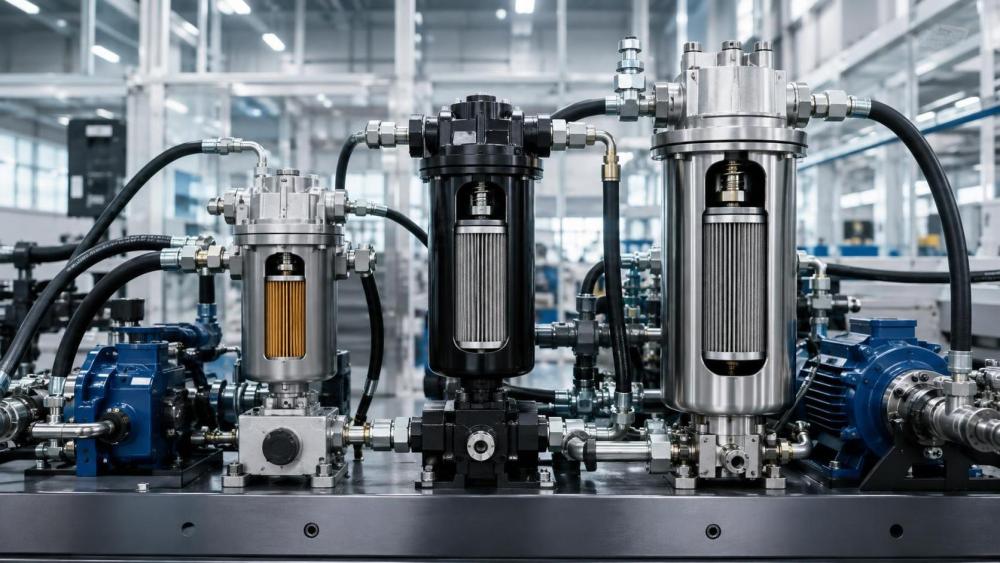
Housing material affects more than the appearance of the component. It influences mechanical strength, corrosion resistance, weight, machining requirements, pressure capability, and compatibility with the working environment.
Aluminum is often commercially attractive when weight reduction and compact installation are important. It should not, however, be assumed to be interchangeable with steel in applications involving impact, high external loads, aggressive vibration, or repeated thread removal. Stainless steel can carry a significant premium, but that premium may be unnecessary in a protected indoor hydraulic unit and insufficient if the selected grade or sealing system is incompatible with the environment.
The material specification should identify the actual grade or material standard rather than using broad descriptions such as “metal housing” or “heavy-duty body.” Surface treatment also matters. A painted steel housing and a corrosion-resistant stainless assembly may both meet a basic dimensional requirement while having very different service expectations and prices.
Features that are easy to miss in a price comparison
The base filter body is only one part of the quotation. Commercial differences frequently come from options and interfaces that are not visible in a catalog headline.
Bypass protection
A bypass valve may protect the pump from excessive inlet restriction when the element is contaminated or the fluid is cold. Its setting must be suitable for the pump and circuit. A bypass option can add cost, but omitting it may create a more serious operating risk where maintenance intervals cannot be tightly controlled. A bypass should not be treated as permission to operate indefinitely with a blocked element.
Clogging indication
Visual, electrical, or differential-pressure indicators can improve maintenance control. They also increase the quotation and may require specific wiring, connector, temperature, or enclosure requirements. For export projects, the buyer should specify whether the indication is intended for local inspection or integration with machine controls.
Seals and fluid compatibility
Seal material affects both price and reliability. Standard elastomers may be suitable for common mineral hydraulic oils, while other fluids, temperature ranges, or environmental conditions may require a different compound. A cheaper filter with unsuitable seals can generate leakage, swelling, or premature replacement costs.
Connections and installation geometry
Thread type, flange arrangement, port orientation, drain options, mounting holes, and overall height influence manufacturing and installation cost. Non-standard ports or a customized mounting pattern may carry tooling, engineering, and minimum-order charges. A technically lower-priced filter may still be more expensive after adapters, rework, or installation changes are included.
How operating conditions should shape the specification
The most defensible quotation begins with an application specification rather than a request for “the cheapest suction filter.” The supplier needs to know the maximum and normal flow, pump type, fluid viscosity, operating temperature, tank arrangement, available inlet pressure, contamination-control target, and expected maintenance conditions.
Fluid viscosity is particularly important. A filter that shows an acceptable pressure drop with a low-viscosity test fluid may behave differently during cold start-up or in a system using a more viscous fluid. The buyer should request pressure-drop information under conditions relevant to the machine, or at least ask the supplier to state the test fluid and temperature used.
Installation position also matters. A filter located inside a tank may have different space, sealing, service-access, and contamination risks from an external suction filter installed in a hydraulic line. In mobile equipment, vibration and shock loads can influence housing selection and connection durability. In water-exposed or outdoor equipment, external corrosion protection may be more important than a small reduction in initial price.
Comparing supplier quotations without creating false savings
A useful comparison sheet should separate the following cost elements:
- Complete filter assembly price;
- Replacement element price and expected change interval;
- Optional bypass valve and indicator cost;
- Seal and spare-part availability;
- Tooling or customization charges;
- Inspection, testing, and documentation charges;
- Packaging, freight, duties, and delivery terms;
- Minimum order quantity and production lead time.
It is also necessary to confirm what is included in the word “filter.” One supplier may quote the housing and element as an assembled unit, while another may exclude the element, indicator, gasket, mounting hardware, or protective cap. A low unit price can therefore reflect a narrower supply scope rather than a more efficient design.
For repeat purchases, replacement-element economics deserve particular attention. A filter housing with a modest initial price may use a proprietary element with limited availability. Another assembly may cost more initially but use a standard or readily sourced replacement element. The relevant comparison is the expected cost over the equipment’s service period, including downtime and inventory requirements.
What documentation supports a reliable purchase decision
Before issuing a purchase order, the technical and commercial teams should align the quotation with a drawing and data sheet. Important documents may include material information, dimensional drawings, flow and pressure-drop curves, element efficiency data, seal specifications, pressure ratings, inspection records, and a clear statement of applicable test conditions.
Certification requirements should be linked to the actual project or equipment specification. A supplier should not be asked for unspecified certificates that add cost without improving acceptance. At the same time, material traceability, inspection records, and conformity documentation may be necessary for regulated, safety-critical, or infrastructure-related equipment. The required documentation should be defined before quotation so that suppliers price the same scope.
A practical pricing judgment
Micron rating mainly affects media design and contamination-control performance. Flow capacity often drives housing size and total assembly cost. Housing material determines the balance between weight, strength, corrosion resistance, and manufacturing complexity. Bypass protection, indicators, seals, connections, and documentation then determine whether the quoted configuration is genuinely comparable.
The sound procurement choice is not the filter with the smallest price against a single specification. It is the configuration that provides adequate filtration without restricting the pump, fits the operating environment, remains serviceable, and has a transparent replacement and documentation cost. When suppliers quote the same application basis, suction filter price becomes easier to interpret—and the risk of selecting a low-cost component that creates higher hydraulic-system costs is reduced.
Related News
- Using Industrial Air Blow Guns to Clear Chips Without Spreading DebrisOct 15, 2026Fluid Power Control Strategist
- Ductile Iron Pipe Valves: Which AWWA Standards Apply to Water Main Projects?Oct 15, 2026Dr. Elias Vance
- Why Vacuum Suction Cups Lose Grip on MDF in Woodworking MachinesOct 15, 2026CNC Kinematics Architect
- Choosing a Variable Displacement Piston Pump Manufacturer: What to VerifyOct 15, 2026Fluid Power Control Strategist
- Parallel vs. Angular Pneumatic Grippers for Confined Assembly StationsOct 15, 2026Fluid Power Control Strategist
- Die Castings vs. Investment Castings: Which Costs Less at Your Production Volume?Oct 14, 2026Foundry Phase-Change Fellow