
How Efficient Are Hydraulic Vane Pumps in Water Infrastructure?
Hydraulic vane pumps can be efficient in water infrastructure, but only when their role is defined correctly. They are generally not the pumps that move potable water, wastewater, or slurry through a transmission main. Their usual job is to supply pressurized hydraulic fluid to valve actuators, sluice gates, lifting equipment, mobile maintenance machinery, filter presses, and other auxiliary systems within treatment plants, pumping stations, reservoirs, and municipal works.
That distinction matters. A buyer searching for hydraulic vane pump efficiency for water infrastructure may be comparing pump technologies for a hydraulic power unit near a water process line, not selecting the main process pump itself. In that setting, efficiency is not only a catalogue figure. It is shaped by duty cycle, pressure stability, oil cleanliness, temperature, control strategy, leakage, service access, and the consequences of an unplanned shutdown.
Are hydraulic vane pumps a good fit for water infrastructure?
Often, yes—particularly where equipment needs relatively smooth hydraulic flow, moderate pressure operation, and low noise. A vane pump can be a practical choice for a compact hydraulic power unit operating a penstock gate, a valve actuator, a lifting platform, or a controlled mechanical assembly in a treatment plant. Their flow characteristics can support predictable actuator movement, which is useful when opening and closing large valves must be controlled rather than abrupt.
However, “good fit” is not the same as “best fit in every station.” Water utilities tend to value availability more than elegance. If a hydraulic circuit runs continuously, sees high pressure peaks, or operates in a remote location where technicians cannot respond quickly, piston pumps or certain gear-pump arrangements may deserve equal consideration. The right answer depends on the hydraulic load profile, not simply on the fact that vane pumps are quiet or compact.
A common planning mistake is to treat all water-sector equipment as though it has the same duty. A hydraulic system used occasionally to operate an isolation gate has very different needs from one powering a continuous-duty filter press or a mobile service vehicle. The first may prioritize reliable standby readiness; the second may place more weight on energy losses, fluid cooling, and wear over many operating hours.
What does efficiency really mean in a vane pump system?
Pump efficiency is usually discussed in two parts. Volumetric efficiency describes how much of the theoretical displacement becomes useful flow. Mechanical efficiency reflects losses from friction and internal mechanical resistance. Together, they influence overall efficiency. But for infrastructure teams, the pump itself is only one part of the energy picture.
A hydraulic power unit can waste energy through an oversized electric motor, a relief valve that continuously bypasses flow, restrictive hoses, poor valve selection, heat generation, or a control scheme that runs at full output while the actuator is idle. In practice, a well-matched vane pump installed in a badly designed circuit will not deliver an efficient system.
For this reason, engineers should ask for the pump’s performance curve at the intended operating viscosity, pressure, and speed—not just its nominal displacement. The useful comparison is the expected operating point. A pump that looks attractive at one test condition may behave differently after the hydraulic oil has warmed up or when the system repeatedly approaches relief pressure.
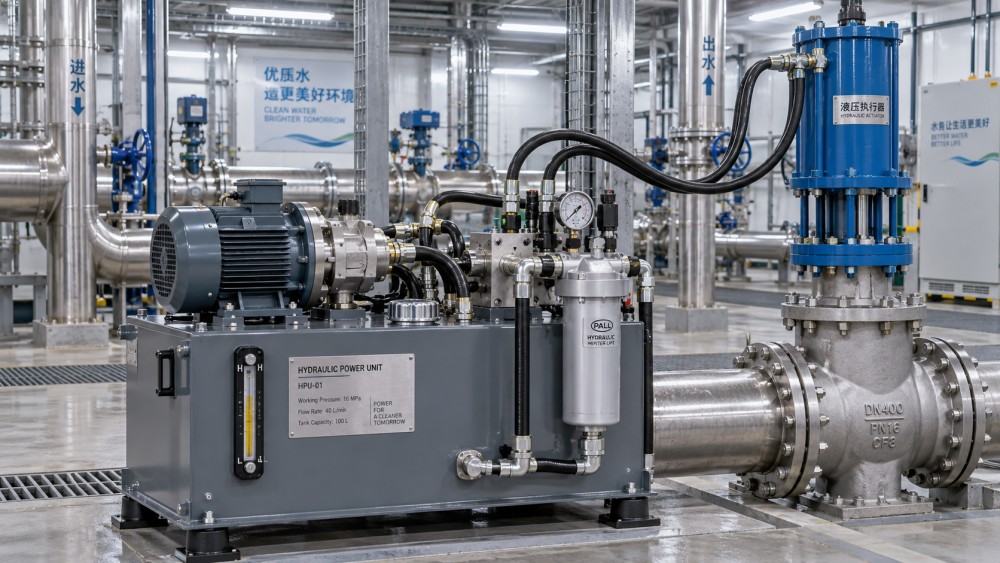
Variable-displacement vane pumps can offer an advantage where demand changes substantially. Rather than forcing a constant volume of fluid through a bypass path, the pump can reduce delivered flow as demand falls, depending on the design and control arrangement. This can reduce heat and unnecessary electrical consumption. Yet the extra control complexity must be justified. For a simple gate actuator that cycles infrequently, a robust fixed-displacement pump and correctly designed accumulator arrangement may be easier to maintain and entirely adequate.
Why water infrastructure creates special operating conditions
Hydraulic vane pumps usually operate with hydraulic oil or another approved hydraulic fluid, not untreated water. Water has poor lubricating properties compared with conventional hydraulic oils and may lead to corrosion, accelerated wear, and seal incompatibility unless a pump has been specifically engineered for water-based fluid service. This point should be stated plainly during specification review: a standard hydraulic vane pump should not be assumed suitable for pumping process water.
The water sector still presents environmental exposure even when the hydraulic fluid remains inside a closed circuit. Pump rooms can be damp. Outdoor valve chambers may experience temperature swings, condensation, washdown, dust, and difficult access. Wastewater facilities may add corrosive atmospheres. A pump selection therefore needs to consider enclosure protection, reservoir breathing, hose routing, fitting materials, external corrosion resistance, and the practical ability to inspect for leaks.
Contamination is another recurring issue. Vane pumps rely on accurately finished internal surfaces and close clearances. Dirt, water ingress, degraded fluid, and air entrainment can affect efficiency and service life. In a municipal plant, contamination may enter during hose replacement, reservoir filling, incomplete flushing after pipework work, or through a poorly maintained breather. It is rarely dramatic at the start. More often, the warning signs are rising noise, temperature drift, slow actuator response, unstable pressure, and gradually reduced output.
When is a vane pump more efficient than other hydraulic pump types?
Vane pumps are often selected where smooth flow and lower pulsation are useful. Compared with many external gear pumps, they can provide quieter operation and a more refined flow characteristic. That can be valuable in enclosed treatment buildings where operator comfort and vibration are genuine concerns, or where stable actuator movement is preferred.
Compared with piston pumps, vane pumps may offer a simpler and more economical solution for many moderate-pressure duties. Piston pumps are frequently considered when high pressure, broad variable-flow requirements, or demanding continuous duty drive the design. They can be highly effective, but their procurement cost, fluid cleanliness expectations, and service approach may not suit every auxiliary infrastructure system.
This is not a ranking of pump types. It is a reminder that efficiency is conditional. A low-cost pump that spends much of its life throttling excess flow is not necessarily economical. Equally, a sophisticated variable-displacement unit may be poor value if it serves a simple circuit that runs only for brief, scheduled intervals.
Which design details most affect lifecycle performance?
The pump’s material and machining quality deserve more attention than they usually receive in early procurement discussions. Internal surface finish, rotor and vane geometry, housing rigidity, shaft alignment, bearing support, and seal compatibility all influence leakage, noise, and wear. These are not details that can be recovered later through better operating procedures.
This is where the wider industrial supply chain matters. Pump housings may be cast or forged, then machined to controlled tolerances; shafts, couplings, bearings, seals, and control valves must work as a system. A hydraulic unit assembled from individually acceptable components can still create problems if drive alignment, coupling selection, suction conditions, or reservoir layout are neglected. IMPE’s broader coverage of machining, cast components, power transmission, fluid control, and piping systems is relevant here because infrastructure reliability is rarely decided by one component in isolation.
Suction-side design is especially easy to underestimate. Excessive restriction, an undersized line, poor reservoir arrangement, or air leakage can cause cavitation-like noise and aeration. The result may be mistaken for a defective pump when the root cause is installation. Before replacing a vane pump, maintenance teams should inspect the fluid level, suction pipe condition, filter arrangement, breather performance, and evidence of foaming.
How should buyers evaluate hydraulic vane pump efficiency for water infrastructure?
Start with the actual work to be done. Define required flow, normal and maximum pressure, expected cycle frequency, actuator speed, ambient conditions, fluid type, allowable noise, and the consequences of delayed operation. A flood-control gate and a workshop lifting fixture should not be specified from the same template simply because both use hydraulic cylinders.
Then review the complete power unit rather than the pump alone. Questions worth raising during engineering and supplier discussions include:
- Will the pump run continuously, intermittently, or only during emergency operation?
- Does the control circuit unload the pump efficiently when no actuator movement is required?
- What filtration, breather, sampling, and fluid-change practices can the site realistically maintain?
- Are the motor, coupling, pump displacement, and relief settings matched to the intended duty?
- Can technicians access filters, gauges, drains, seals, and mounting bolts without major disassembly?
- What documentation is needed for material traceability, test records, drawings, spares, and maintenance instructions?
For municipal EPC teams and utility procurement groups, availability of replacement parts also matters. A highly efficient pump is of limited practical value if a failed cartridge, seal kit, coupling element, or control valve cannot be obtained within the project’s maintenance window. This is why supplier assessment should include technical communication, service support, inspection capability, and consistency of manufacturing—not just the initial quoted price.
Can maintenance preserve vane pump efficiency?
Yes, but maintenance must be based on condition rather than habit alone. Changing fluid without addressing the source of contamination is only a temporary reset. Likewise, replacing a noisy pump without checking suction conditions can repeat the same failure pattern.
Useful routine checks include monitoring hydraulic fluid condition, inspecting filters and breathers, confirming that the reservoir level remains appropriate, looking for external leaks, checking temperature trends, and listening for changes in sound during operation. A gradual loss of actuator speed or an unexplained rise in heat should trigger a system review before it becomes a forced outage. Where project requirements demand it, fluid analysis and inspection records can support a more disciplined maintenance decision.
The most efficient vane pump is usually the one operating close to its intended duty point, supplied with clean compatible fluid, installed on a sound hydraulic circuit, and supported by maintainable components. In water infrastructure, that practical definition is more useful than chasing a single efficiency number from a catalogue. Before choosing a pump, confirm whether the system needs smooth auxiliary hydraulic power, variable flow, high-pressure endurance, emergency standby reliability, or direct water handling. Those are different problems, and they should lead to different equipment decisions.
Related News
- How to Assess a Rigid Coupling Supplier for Bore Accuracy and Traceable QualityOct 08, 2026Tribology & Kinematics Expert
- Titanium Alloys Compared: Balancing Strength, Corrosion Resistance, and MachinabilityOct 08, 2026CNC Kinematics Architect
- Where Ductile Iron Dismantling Joints Reduce Alignment Risk in Water PipelinesOct 08, 2026Pipeline Metallurgy Scientist
- Selecting a Precision Bearing Sleeve: Fits, Runout, and Material ChoicesOct 08, 2026Tribology & Kinematics Expert
- Face Milling Cutters: How Insert Geometry Affects Finish on Steel and AluminumOct 08, 2026CNC Kinematics Architect
- Single-Acting Cylinders for Clamping: Stroke, Force, and Return Spring ConsiderationsOct 07, 2026Fluid Power Control Strategist