
Can Proper Material Pairing Prevent Pump Mechanical Seal Failures?
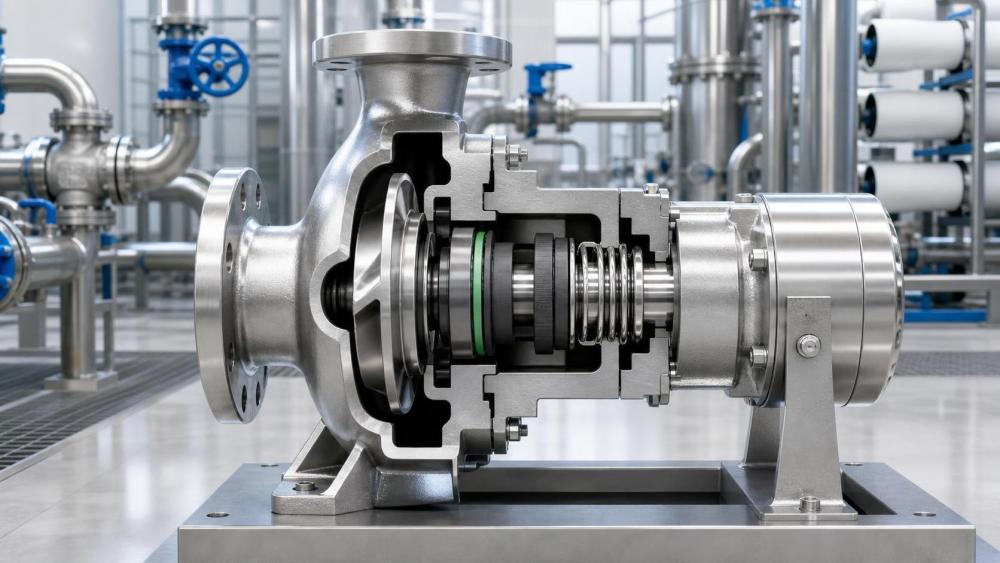
A pump that begins to leak at the seal rarely creates a problem at a convenient time. It may happen during a production run, while a water-treatment skid is operating unattended, or after a maintenance shutdown when the pump is expected to return to service without adjustment. The visible drip is often only the first warning. If leakage reaches bearings, couplings, electrical components, or adjacent equipment, the original seal issue can turn into a wider reliability and safety concern.
Many teams first suspect poor installation, incorrect spring setting, shaft runout, or a damaged seal face. Those conditions matter, but they do not explain every failure. A seal can be installed carefully and still fail early when its face materials, secondary seals, metal parts, and process fluid do not belong together. The practical question is not simply whether a seal material is “high quality.” It is whether the complete material combination can survive the actual pumping condition.
The failure pattern that is easy to misread
Consider a common maintenance scenario: a centrifugal pump has operated reliably with clean, cool water. The process later changes. The same pump now handles water with suspended solids, a chemical additive, higher temperature, or intermittent suction conditions. A replacement seal is ordered using the previous part number because the dimensions match. Shortly afterward, leakage returns.
It is tempting to treat this as a seal supplier issue or an installation error. Yet the old seal may have been suitable only for the original fluid and duty cycle. A seal designed around carbon versus ceramic faces and a general-purpose elastomer may work well in mild service, but it may not tolerate abrasive slurry, poor lubrication, a solvent-rich liquid, or repeated temperature swings. The pump has not necessarily become defective; its sealing materials may simply be mismatched to the revised operating environment.
Can mechanical seal failures in pumps be prevented with proper material pairing? In many cases, yes—provided that “pairing” means more than choosing two face materials. The decision must account for the fluid, the likely upset conditions, the hardware exposed to corrosion, the shaft or sleeve surface, and the way the seal is cooled or flushed. Proper pairing reduces predictable failure mechanisms. It cannot compensate for severe misalignment, cavitation, blocked flush lines, or prolonged dry running, but it gives the seal a realistic operating margin.
Start with the fluid actually reaching the seal
Process descriptions can be misleading. “Water-based,” “oil,” or “chemical service” is not enough information to select sealing materials. The fluid at the seal chamber may differ from the fluid named on a process diagram. It may contain entrained air, crystals, cleaning chemicals, fine solids, scale, or residue from a previous batch. Its temperature may increase near the pump because of recirculation, friction, or insufficient cooling.
Before comparing materials, establish a usable operating picture. Record the normal and maximum fluid temperature, suction condition, discharge pressure, expected pressure changes, solids content, particle hardness, pH where relevant, viscosity, and whether the pump ever runs empty during startup or tank changeover. Also note cleaning and flushing media. A seal that tolerates the primary fluid may be damaged by a periodic cleaning liquid that attacks its elastomer or metal components.
This is where maintenance history becomes valuable. Black dust near the seal can suggest carbon-face wear. Polished radial tracks can point to abrasive particles. Blistered, swollen, brittle, or cracked elastomers may indicate chemical or thermal incompatibility. Rust staining around springs, drive pins, or gland components may reveal that the metal selection was inadequate even if the seal faces remain intact. These observations should guide material selection rather than be treated as isolated symptoms.
Face pairs are selected by the wear mechanism, not by habit
The two mating faces provide the controlled interface that limits leakage. Their flatness, surface finish, lubrication, closing force, and material properties all affect performance. There is no universal “best” pair because the trade-off changes with the service.
Carbon is widely used because it can run smoothly against a harder mating ring and can offer favorable friction behavior in properly lubricated conditions. Its weakness is that it is not a single material category with one performance level. Carbon grades differ in resin impregnation, antimony impregnation, porosity, strength, thermal behavior, and chemical resistance. Treating every carbon face as interchangeable is a frequent source of incorrect comparisons.
Silicon carbide is often chosen when abrasion, corrosion, or wear makes a softer pairing unsuitable. It has high hardness and good thermal conductivity, which can help control face temperature. However, a hard-on-hard silicon carbide pairing may be less forgiving when lubrication is lost. If a pump has recurring dry-start events, air entrainment, or unstable suction, the process problem deserves attention before relying on a harder face material as the cure.
Tungsten carbide can offer strong toughness and wear resistance in certain applications. Its suitability depends on the binder system and chemical exposure. In corrosive service, it is not enough to specify “tungsten carbide”; the grade and binder compatibility should be confirmed. Ceramic remains useful in clean service, but it is usually a poor default for changing conditions that introduce thermal shock, solids, or impact risk.
The secondary seal can be the hidden weak link
O-rings, wedges, bellows, and gaskets are often smaller and less visible than seal faces, yet they can determine whether the assembly moves and seals as intended. An elastomer that swells in the process liquid may bind on the shaft sleeve or lose dimensional stability. One that hardens under heat can crack during thermal cycling. A chemically attacked O-ring can leave a maintenance team blaming the face pair when the true failure began at the secondary seal.
Nitrile rubber is commonly used in mineral oils and many general industrial fluids, but it is not a universal chemical-service option. EPDM is frequently considered for hot water, steam-related environments, and many water-based fluids, while it may be unsuitable for petroleum-based oils. Fluoroelastomer materials are often selected for higher-temperature oils, fuels, and various chemicals, but their resistance is not unlimited. Perfluoroelastomer options may be evaluated for aggressive chemical or temperature conditions, though selection should remain based on the exact fluid and exposure cycle rather than reputation alone.
In a pump that handles cleaning solutions or batch chemicals, ask whether the elastomer sees short, concentrated exposure during flushing. Short duration does not always mean low risk. A concentrated cleaner can cause rapid swelling or extraction, especially if trapped in the seal chamber after the pump stops. Material compatibility information should cover the process liquid, the cleaning fluid, and any additives used for lubrication or flushing.
Metal parts must survive the same environment
Springs, retainers, drive collars, gland plates, and fasteners are sometimes assumed to be protected because they are not the primary sealing faces. In reality, these components may be exposed to vapor, leakage, solids, chlorides, acidic condensate, or stagnant fluid. Corrosion can weaken springs, prevent axial movement, create deposits, and interfere with torque transmission.
Stainless steel is broadly useful, but grades are not interchangeable in chloride-bearing or highly corrosive service. A metal selection that performs in clean indoor water may not be sufficient for saline water, aggressive wastewater, or chemical transfer. Higher-alloy materials can be considered when corrosion evidence appears repeatedly, but they should be selected with the whole pump construction in mind. If the seal hardware is upgraded while the shaft sleeve, gland, or fasteners remain vulnerable, corrosion may simply move to another component.
Galvanic interaction also deserves attention where dissimilar metals remain wet with conductive fluid. The concern is not only dramatic corrosion; it can be gradual loss of surface condition around sealing and fastening points. Reviewing wetted metals as a system is more useful than approving each part independently.
Compare the material choice against the operating disturbance
A good material decision is not based only on normal operation. Mechanical seals often fail during departures from normal operation: temporary loss of flow, a blocked flush path, a valve sequencing error, solids entering after a filter issue, or a hot pump restart. The pairing should be evaluated against the most credible disturbance, especially if that disturbance occurs repeatedly.
For clean, stable water service, a conventional carbon and ceramic arrangement with a compatible elastomer may be entirely reasonable. Moving immediately to premium hard-face materials may add cost without addressing the real need. For a liquid containing abrasive solids, a silicon carbide-based face strategy may be more appropriate, but a flush plan, separator, or process change may still be needed to keep particles away from the interface.
For corrosive chemical duty, the face pair, elastomer, and metal hardware all require separate compatibility checks. A chemically resistant face pair does not protect an unsuitable O-ring. For hot hydrocarbon or oil service, heat, fluid film behavior, carbon grade, and elastomer temperature capability become more influential. For intermittent dry-running risk, the first comparison should be between seal materials and operational controls: level interlocks, suction protection, startup procedures, or a seal support arrangement may provide more value than changing face materials alone.
A practical route from failed seal to better pairing
Begin with the removed seal, not the replacement catalog. Preserve the parts if possible and examine both faces under good lighting. Look for radial scoring, chips, heat checking, uneven wear bands, deposits, discoloration, and evidence of face contact outside the intended track. Inspect elastomers for swelling, flattening, cracking, loss of elasticity, or chemical staining. Check springs and metal components for corrosion or seized movement.
Next, compare those findings with pump conditions. Scoring plus solids points toward abrasive exposure. Blueing, cracking, or damaged carbon may indicate heat and inadequate lubrication. A swollen O-ring directs attention to chemical compatibility. Corroded springs can explain loss of closing-force control or sticking. Uneven face wear can indicate mechanical movement, shaft deflection, bearing condition, pipe strain, or misalignment rather than a material problem.
Only then should a replacement configuration be specified. Define the stationary and rotating face materials, elastomer type, metal hardware, and any sleeve or gland material exposed to the fluid. Confirm that pressure and temperature ranges are suitable for the selected seal design, not merely for individual material limits. A face material may tolerate a temperature in isolation while the assembled seal has lower limits because of elastomers, adhesives, springs, or distortion.
Finally, verify the surrounding conditions at installation. Clean the seal chamber, inspect the shaft or sleeve for fretting and surface damage, confirm axial and radial movement are within the pump manufacturer’s limits, and make sure flush or quench connections are open and correctly routed. Material pairing works best when the seal is allowed to operate in the environment it was selected for.
When changing materials will not solve the leak
There are situations where material upgrades become an expensive distraction. If a pump is cavitating, operating far from its preferred flow range, running with excessive vibration, or experiencing repeated dead-heading, a more resistant seal may last longer but will not remove the damaging condition. The same is true when piping loads distort the casing, bearings have excessive play, or the seal chamber is packed with solids.
Material selection should therefore be treated as one part of fault finding. It answers, “Can these components coexist with this fluid and duty?” It does not answer, “Is the pump mechanically stable?” Both questions must be resolved before expecting a reliable outcome.
The most useful habit is to stop replacing seals by size alone. Match the face pair to lubrication, heat, and abrasives; match the elastomer to every fluid it will encounter; and match the metals to corrosion conditions. When the seal evidence, fluid details, and pump behavior are reviewed together, material pairing becomes a preventive decision rather than a reaction to the next leak.
Related News
- How to Assess a Rigid Coupling Supplier for Bore Accuracy and Traceable QualityOct 08, 2026Tribology & Kinematics Expert
- Titanium Alloys Compared: Balancing Strength, Corrosion Resistance, and MachinabilityOct 08, 2026CNC Kinematics Architect
- Where Ductile Iron Dismantling Joints Reduce Alignment Risk in Water PipelinesOct 08, 2026Pipeline Metallurgy Scientist
- Selecting a Precision Bearing Sleeve: Fits, Runout, and Material ChoicesOct 08, 2026Tribology & Kinematics Expert
- Face Milling Cutters: How Insert Geometry Affects Finish on Steel and AluminumOct 08, 2026CNC Kinematics Architect
- Single-Acting Cylinders for Clamping: Stroke, Force, and Return Spring ConsiderationsOct 07, 2026Fluid Power Control Strategist