
Are Hydraulic Gear Pumps Suitable for Low-Flow Water Systems?
The short answer is: standard hydraulic gear pumps are usually not a good choice for low-flow water systems. A water-compatible gear pump can work in a narrow range of applications, but a pump designed for hydraulic oil should not be assumed suitable simply because it can produce the required flow and pressure on paper.
Hydraulic gear pump low flow water system suitability depends mainly on the pump’s internal materials, lubrication requirements, shaft sealing, operating speed, suction conditions, and the quality of the water being transferred. Low flow makes these issues more visible because a small amount of internal leakage, wear, air entrainment, or unstable speed control can represent a large share of the intended output.
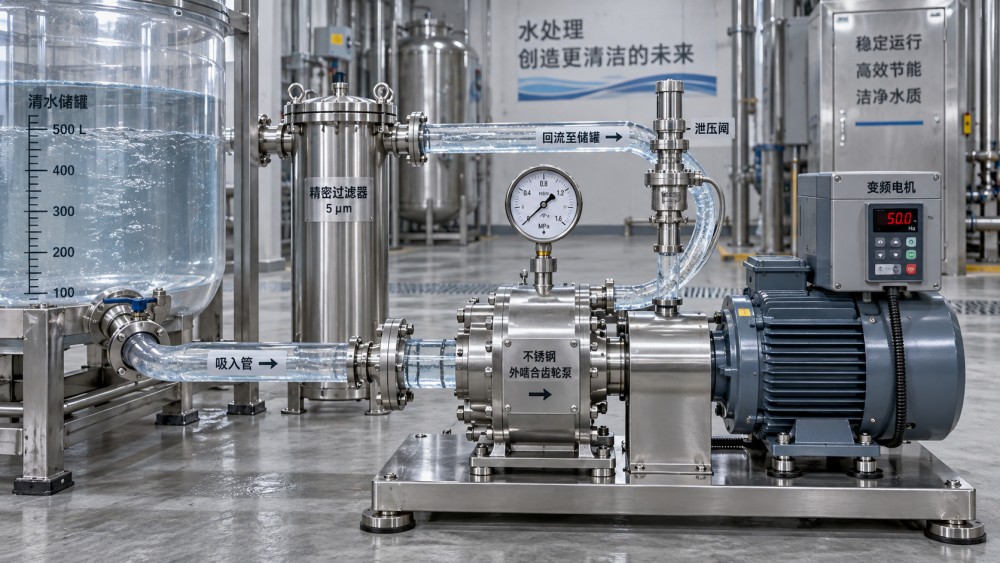
For a simple low-pressure water transfer duty, a purpose-built water pump is often the more reliable and economical option. A water-rated external gear pump becomes reasonable when the system needs positive displacement flow, compact installation, controlled dosing-like delivery, or higher pressure than a small centrifugal pump can handle comfortably.
Why a hydraulic gear pump behaves differently with water
A hydraulic gear pump is normally designed to move lubricating hydraulic fluid. Oil has enough viscosity to form a protective film between the gear teeth, bushings, side plates, and housing. That film reduces metal-to-metal contact and limits internal leakage.
Water behaves very differently. It has much lower viscosity and provides far less lubrication. In an ordinary hydraulic pump, water can pass more easily through the small internal clearances that separate high-pressure and low-pressure zones. This reduces volumetric efficiency, meaning the pump delivers less usable flow than its theoretical displacement suggests.
The same lack of lubrication can accelerate wear at bearing surfaces, gear faces, thrust plates, and seals. Once clearances increase, leakage rises further and the pump may struggle even more to hold pressure. Corrosion is another concern, especially where water contains dissolved oxygen, chlorides, cleaning chemicals, or treatment additives.
This does not mean every gear pump is unsuitable for water. It means that the pump must be designed, selected, or modified for water service. A water-compatible model may use corrosion-resistant materials, different bearing arrangements, compatible seal elastomers, and internal geometry intended to operate with low-lubricity fluids.
Low flow is not just a smaller pump selection problem
Gear pumps are positive-displacement pumps. Each shaft revolution moves a relatively fixed volume of fluid, so flow is closely related to displacement and rotational speed. This characteristic can be useful where consistent delivery matters. However, it also creates a practical issue in low-flow systems: the pump may need to run very slowly to achieve the required output.
Running at very low speed is not automatically safe. Some gear pumps need a minimum speed to maintain internal lubrication, stable filling of the gear chambers, and acceptable sealing behavior. If the drive speed falls too far, the pump can become inefficient, noisy, or erratic. A motor and speed controller that can technically turn slowly may still not create a stable pumping system.
For this reason, selecting a large-displacement hydraulic gear pump and reducing its speed is rarely the best route to a precise low-flow water transfer system. A smaller-displacement water-rated gear pump running within its intended speed range is generally easier to control and less likely to suffer from poor low-speed performance.
Internal leakage also has a larger effect at low flow. If a system needs only a modest outlet flow, a relatively small recirculation loss inside the pump can cause noticeable variation. As discharge pressure rises, the leakage path becomes more significant. The delivered flow may decline even while motor speed remains unchanged.
When a gear pump can be suitable for low-flow water transfer
A water-compatible gear pump can be a practical option when the water is reasonably clean, the required flow is steady rather than extremely precise, and the application benefits from positive displacement. Typical examples include compact circulation loops, washdown or rinse skids, low-volume process-water transfer, controlled feed to a pressurized line, and equipment where space limits the use of a larger pump style.
It may also be appropriate where the system needs to build pressure quickly at low flow. Unlike a centrifugal pump, a gear pump does not depend on a high flow rate to generate pressure. It continues to displace liquid until the system resistance balances the pump output or a pressure-control path opens. That characteristic is valuable in some industrial fluid circuits.
The following conditions make the selection more defensible:
- The pump manufacturer explicitly permits water or the actual water-based fluid being used.
- Wetted components resist corrosion and do not rely on oil for lubrication.
- The water is filtered to a level appropriate for the pump’s internal clearances.
- The inlet arrangement provides a flooded suction or otherwise avoids excessive suction lift.
- The target flow can be achieved within the pump’s normal operating-speed range.
- The discharge side includes suitable pressure protection.
- The system can tolerate small flow changes caused by pressure, temperature, and gradual wear.
In these conditions, the gear pump’s compact size and direct relationship between speed and flow can be useful. It is particularly attractive where a variable-speed drive is already part of the equipment and the required flow range is not excessively wide.
When it is the wrong pump choice
A conventional hydraulic gear pump should be avoided for potable water, untreated water, abrasive water, seawater, wastewater, or chemically aggressive water unless the specific construction is intended for that duty. The concern is not only pump life. Material compatibility, contamination control, seal failure, corrosion debris, and maintenance access can all affect the larger system.
It is also a poor choice where the flow must be extremely accurate. Gear pumps can provide repeatable displacement when in good condition, but water service increases internal slip and wear sensitivity. If the application is closer to metering than transfer, a diaphragm metering pump or another purpose-built dosing pump will often provide better control and easier calibration.
Applications with intermittent dry-running risk need particular care. Gear pumps can be damaged quickly if they run without liquid. A foot valve that leaks, a tank that empties, a blocked suction strainer, or an air pocket in the inlet line may turn a normal start-stop cycle into a dry-running event. Water does not provide the same margin of lubrication as hydraulic oil during these conditions.
High-solids water is another problem. Fine mineral particles, rust scale, sand, and pipe debris can score internal surfaces and damage seals. Even relatively clean municipal or process water can pick up debris from storage tanks, aging pipework, or installation work. The filter should protect the pump without creating excessive inlet restriction, because a clogged suction filter can cause cavitation and loss of flow.
Pressure protection is mandatory for positive-displacement pumping
A gear pump does not naturally stop producing flow when a downstream valve closes. If the discharge path is blocked, pressure can rise rapidly until something gives way, the drive overloads, or a safety device opens. This is a fundamental difference from many small centrifugal water pumps.
Every low-flow water system using a gear pump needs a properly engineered pressure-relief method. Depending on the process, this may be a relief valve returning water to the supply tank, a bypass line, a pressure-control valve, or a system arrangement that ensures the pump always has an open flow path.
The relief path should not be treated as a normal operating shortcut. Continuously bypassing water through a relief valve wastes energy and can heat the fluid. In a very low-flow setup, it can also conceal the fact that the pump displacement is too large for the required duty. Selecting a smaller pump is generally better than installing an oversized pump and recirculating most of its output.
Check these details before choosing a water-rated gear pump
The first useful question is not “What flow rate does the pump have?” It is “What must the pump overcome while delivering that flow?” Calculate or estimate the total discharge resistance: static lift, pipe friction, fittings, valves, filters, spray nozzles, heat exchangers, and any pressure required at the final point of use.
Then review the water itself. Clean, neutral-temperature water is very different from hot water, chlorinated water, water with suspended solids, softened water, reclaimed water, or water mixed with detergents. The fluid affects material selection, seal choice, corrosion risk, and expected maintenance needs.
It is also worth checking the drive arrangement. A gear pump does not regulate flow by itself; it follows speed. A fixed-speed motor gives a fixed nominal flow, while a variable-frequency drive or servo drive can adjust output. For a low-flow duty, the useful control range depends on the pump’s minimum operating speed, not merely on the speed range of the motor controller.
Suction conditions often decide whether the pump lasts
Low flow does not eliminate suction-side problems. A small pump can still cavitate if the inlet pipe is undersized, too long, partially blocked, or positioned above the water source. Cavitation occurs when pressure at the pump inlet drops enough for vapor or gas pockets to form. Those pockets collapse as pressure rises inside the pump, creating noise, vibration, surface damage, and unstable flow.
Keep the suction line short and direct. Avoid unnecessary elbows, restrictive strainers, and undersized hose. A flooded inlet, where the water level is above the pump inlet, is often preferable to relying on suction lift. When a lift is unavoidable, the pump must be selected for that inlet condition rather than only for its discharge pressure.
Air leakage can create similar symptoms. A tiny leak at a suction connection may not drip water outward, but it can pull air inward while the pump runs. The result may be pulsing flow, loss of prime, or apparent pump underperformance that is wrongly blamed on the motor or controller.
Which alternatives may be better?
A small centrifugal pump is often the first alternative for clean-water transfer. It is generally well suited to continuous circulation and simple transfer duties, particularly when the system does not need highly controlled displacement at very low flow. Its behavior at shutoff is less hazardous than that of a gear pump, although it still requires appropriate operating conditions.
For highly accurate, low-volume addition of water or chemicals, diaphragm metering pumps are usually a more natural fit. They are designed around controlled dosing, can be adjusted over a useful range, and separate the pumped fluid from parts of the drive mechanism. They are often more forgiving where repeatability matters more than compactness.
For viscous liquids, gear pumps can be excellent because viscosity supports sealing and lubrication. That is precisely why an oil-duty gear pump may look attractive in a hydraulic catalog yet perform poorly with water. The fluid should guide the pump selection, not the familiarity of the pump design.
Progressive cavity, peristaltic, or regenerative turbine pumps may also fit certain low-flow duties, depending on pressure, solids content, pulsation tolerance, chemical compatibility, and maintenance expectations. There is no universal replacement; the better option depends on the required control and the condition of the liquid.
Questions that prevent an expensive mismatch
Before issuing a purchase request, define the required minimum and maximum flow, expected discharge pressure, water temperature, solids level, chemistry, inlet arrangement, duty cycle, and available drive speed. Include whether the pump may encounter dead-headed discharge conditions, dry-running risk, or infrequent operation after long idle periods.
For installed systems, examine more than the pump body. Pipe material, fittings, check valves, strainers, tank cleanliness, sealing method, and access for maintenance can determine whether a theoretically suitable pump remains reliable. This is particularly relevant in infrastructure and industrial equipment work, where component compatibility matters across the complete fluid path. IMPE’s coverage of hydraulic equipment, valves, piping components, and material performance reflects the same practical point: a pump selection is only as sound as the system conditions around it.
FAQ
Can a hydraulic gear pump pump clean water?
Only if its design is specifically compatible with water. A standard hydraulic pump intended for oil may operate briefly, but low lubrication, leakage, corrosion, and seal issues can make it unsuitable for dependable water service.
Can a gear pump run dry?
No. Gear pumps should not be allowed to run without liquid unless the manufacturer specifically states otherwise. Dry running can quickly damage internal surfaces and seals, especially in water applications.
Is a gear pump good for low flow and high pressure?
A water-rated gear pump can be useful for low flow at higher pressure because it is positive displacement. It still needs a relief path, stable inlet conditions, and a pump size that does not force operation below its intended speed range.
Do I need a relief valve with a gear pump?
Yes. A positive-displacement pump requires protection against a blocked or closed discharge line. The relief arrangement must suit the system pressure and provide a safe route for the bypassed water.
A hydraulic gear pump is therefore suitable for a low-flow water system only when it is genuinely built for water, properly sized for the intended speed range, protected from dead-heading, and supplied with clean water under good suction conditions. When those requirements cannot be met, a centrifugal, diaphragm, or other water-specific pump will usually produce a more reliable result.
Related News
- How to Assess a Rigid Coupling Supplier for Bore Accuracy and Traceable QualityOct 08, 2026Tribology & Kinematics Expert
- Titanium Alloys Compared: Balancing Strength, Corrosion Resistance, and MachinabilityOct 08, 2026CNC Kinematics Architect
- Where Ductile Iron Dismantling Joints Reduce Alignment Risk in Water PipelinesOct 08, 2026Pipeline Metallurgy Scientist
- Selecting a Precision Bearing Sleeve: Fits, Runout, and Material ChoicesOct 08, 2026Tribology & Kinematics Expert
- Face Milling Cutters: How Insert Geometry Affects Finish on Steel and AluminumOct 08, 2026CNC Kinematics Architect
- Single-Acting Cylinders for Clamping: Stroke, Force, and Return Spring ConsiderationsOct 07, 2026Fluid Power Control Strategist