
How to Select Ductile Iron Pipe Elbows for Buried Water Network Changes
A buried water main rarely follows a perfectly straight route. It has to pass around foundations, existing utilities, road crossings, drainage structures, and changing site elevations. At each direction change, the elbow becomes more than a connecting fitting: it becomes a pressure-bearing, soil-supported structural point in the network.
Selecting Ductile Iron Pipe Elbows for these changes requires more than matching the nominal pipe diameter. Project managers need to confirm the required turn angle, pressure class, joint system, restraint strategy, lining, external protection, installation space, and applicable project standard. A fitting that looks acceptable on a drawing can still create field delays, thrust-block conflicts, or long-term corrosion exposure if those details are not reviewed together.
For municipal water transmission, distribution upgrades, and buried industrial water systems, the most reliable choice is usually the one that fits the whole pipeline design—not simply the lowest-cost elbow in a catalog.
Begin With the Route Change, Not the Fitting List
When a design team identifies a horizontal or vertical change in direction, the immediate instinct is often to select a standard 90-degree, 45-degree, 22.5-degree, or 11.25-degree elbow. Those common angles are useful starting points, but they do not settle the engineering question.
The first review should ask what the route actually needs. Is the pipeline turning around a permanent obstruction? Is it transitioning through an elevation change? Is the bend located near a valve chamber, tee, reducer, hydrant branch, or connection to another pipe material? These surrounding conditions determine whether one elbow, several smaller bends, a fabricated arrangement, or a different alignment approach is most practical.
A nominal 90-degree turn, for example, may be physically possible on plan, yet difficult to install if the excavation is narrow or if thrust restraint requires additional pipe length on both legs of the bend. In another location, two 45-degree elbows may create a more manageable geometry, though they also introduce another joint and additional installation work.
Before issuing a procurement request, the project team should document:
- Pipeline diameter and design pressure;
- Required change in direction and allowable tolerance;
- Horizontal versus vertical orientation;
- Available trench width and working room;
- Nearby utilities, chambers, foundations, and crossing points;
- Connection type at each end of the fitting;
- Whether the bend will be restrained, blocked, or both.
This early discipline prevents a common site problem: a correctly specified elbow that cannot be assembled safely within the actual excavation.
Pressure Rating Must Be Read as a System Requirement
Ductile iron fittings are used because they offer strength, toughness, and dependable performance in buried pressure pipelines. Still, the elbow must be suitable for the operating and transient conditions of the particular network. It is not enough to know the normal static pressure at the installation point.
Water hammer, pump starts and stops, rapid valve operation, and emergency flow changes can raise internal pressure above routine operating levels. Directional fittings deserve particular attention because the hydraulic force at a bend acts outward along the angle of deflection. The greater the pressure and the sharper the turn, the more important thrust management becomes.
Project managers should ask the hydraulic designer or water utility for the pressure envelope used for selection: normal operating pressure, maximum allowable working pressure, surge allowance, and test pressure. The fitting class, joint rating, gasket capability, restraint components, and any flange connections should all be checked against that envelope.
Specifications may refer to regional or project-specific standards such as EN 545, ISO 2531, AWWA C110/A21.10, AWWA C153/A21.53, or an approved utility standard. These references should not be treated as interchangeable labels. Confirm the exact edition, dimensional requirements, material grade, coating provisions, pressure classification method, and test documentation required by the contract.
Joint Compatibility Is Often the Deciding Detail
Many procurement issues arise not because the elbow itself is unsuitable, but because its joints do not match the pipe system delivered to site. Ductile iron pipe elbows may be supplied with push-on, mechanical joint, restrained joint, flanged, or other specified end configurations. Each has a different role in construction and restraint design.
A push-on joint may support efficient installation where the line is controlled by external thrust blocks or a designed restrained length. Mechanical joints can provide adjustment and are commonly used in certain fitting assemblies, but require correct gland, bolt, gasket, and torque procedures. Restrained joints are valuable where thrust blocks are impractical, where space is limited, or where the pipeline may experience longitudinal movement. Flanged elbows are typically used in exposed chambers, pump stations, valve rooms, or structured connections rather than ordinary direct burial.
The key question is not “Which joint is best?” It is “Which joint works with this pipe, this installation sequence, this soil condition, and this restraint design?” A mixed system can be workable when engineered intentionally. It becomes risky when adapters, couplings, and restraints are added in the field simply to solve a mismatch.
For a project manager, the practical lesson is simple: include the elbow joint type in the same review package as the pipe joint, valve connections, couplings, and restraint schedule. Do not leave it as a line item for later clarification.
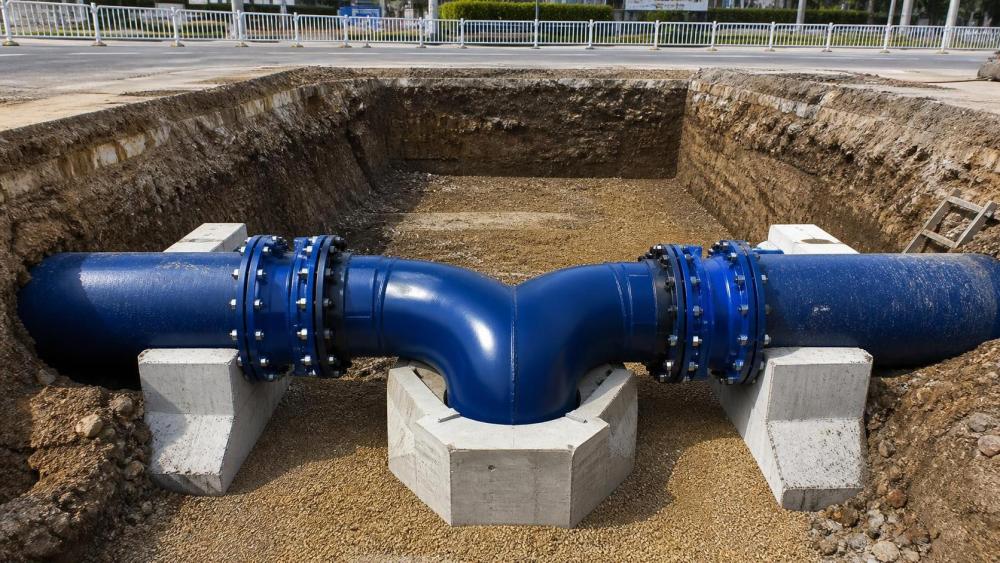
Thrust Restraint Should Be Designed Before Materials Are Ordered
At a bend, internal pressure creates thrust that attempts to push the fitting apart and move the connected pipe. The soil surrounding the pipeline, the fitting geometry, the operating pressure, and the chosen restraint method all affect how that force is controlled.
Traditionally, concrete thrust blocks have been used to transfer load from the fitting into undisturbed soil. They can be effective when designed for the actual bearing capacity and installed against stable trench walls. However, thrust blocks need space, curing time, correct placement, and protection from interfering with joints. They are not a universal answer, particularly in poor soils, congested corridors, steep terrain, or locations where future access and repair flexibility matter.
Restrained-joint systems distribute thrust over a calculated length of pipe rather than relying on one block. This approach can be especially useful around valves, within narrow rights-of-way, near structures, or in unstable ground. It also demands careful detailing: restraint must extend far enough on both sides of the elbow, and every relevant component must be compatible with the selected restraint system.
A frequent mistake is to specify a restrained elbow but overlook an adjacent unrestrained coupling, valve, or transition piece. The restraint path is only as reliable as its weakest connection. The design package should show where restraint starts and ends, not merely state “restrain as required.”
Soil Conditions Influence Both Restraint and Corrosion Protection
Buried water network changes are often located where ground conditions are already difficult: near road embankments, drainage zones, utility corridors, reclaimed land, or building interfaces. These conditions affect installation stability and the external protection required for ductile iron fittings.
Soil corrosivity should be assessed using the project’s established evaluation method and utility requirements. Factors may include resistivity, moisture, pH, chlorides, sulfates, redox conditions, and the presence of stray current sources. A pipe route may pass through several soil environments, so assuming one protective approach for the entire system can be misleading.
Standard external coatings may be appropriate in many applications, while more aggressive soils may call for additional measures such as polyethylene encasement, enhanced coatings, cathodic protection strategies, or site-specific protection procedures. The elbow deserves the same level of review as the pipe. Fittings have different shapes, larger surface complexity, joint interfaces, and sometimes different coating application characteristics.
Internal lining also matters. For potable water and many ordinary water services, cement mortar lining is widely used to support water quality and reduce internal corrosion risk. Other linings may be considered where water chemistry, abrasion, wastewater exposure, or industrial process fluids create conditions outside normal clean-water duty. The selected lining must remain consistent across elbows, pipes, valves, and adjacent fittings where the system requires a continuous internal protection strategy.
Do Not Use Small Deflections to Hide a Major Alignment Problem
Field crews can often accommodate limited alignment adjustment through permitted joint deflection. This flexibility is useful, especially where trench conditions differ slightly from the drawings. But it should not be used to force a pipeline around an unplanned obstruction or compensate for a poorly set-out bend.
Excessive deflection can place uneven stress on gaskets, reduce engagement margins, complicate restraint installation, and make future maintenance less predictable. It may also conflict with manufacturer limits or the governing installation standard.
If the route changes materially during construction, pause and assess the revised geometry. The right response may be an additional elbow, a revised fitting angle, a longer pipe spool, or a rerouted section. A short engineering review is far less costly than excavating and rebuilding a failed or inaccessible joint after commissioning.
Build the Procurement Package Around Verifiable Information
For Ductile Iron Pipe Elbows, a vague purchase description such as “DN pipe elbow, 90 degrees” leaves too much open to interpretation. A robust procurement package reduces the chance of receiving fittings that are dimensionally correct but unsuitable for the installation.
The material schedule should identify nominal diameter, angle, end configuration, pressure or class requirement, applicable standard, lining, coating, gasket requirements, restraint provisions, and any special marking or documentation needs. Where dimensional coordination is critical, include approved drawings or require supplier submittals before production and shipment.
Project teams should also clarify whether bolts, glands, gaskets, restraint accessories, protective wraps, touch-up materials, and installation instructions are supplied with the fitting or sourced separately. Missing small components can stop a crew even when the main fittings have arrived on time.
For major municipal or EPC work, traceability should be practical rather than ceremonial. Certificates, batch references, inspection records, coating information, and shipment identification help teams verify that delivered components match the approved submittal. This is particularly valuable when fittings are staged across several work fronts and may be installed months after delivery.
A Field-Ready Review Before Release
Before finalizing an order, bring the pipeline designer, construction lead, procurement team, and supplier technical contact into one focused review. The conversation should confirm that the selected elbows fit the drawings, meet pressure and standard requirements, connect to the specified pipe, and align with the thrust-restraint plan.
Ask whether the fitting can be lowered into the trench with available lifting equipment, whether its orientation is clear, whether coating repairs may be needed after handling, and whether the installed assembly will leave enough clearance for compaction and joint inspection. These are ordinary questions, but they are exactly where buried pipeline risks tend to surface.
Well-selected Ductile Iron Pipe Elbows make route changes feel routine. Poorly coordinated ones turn a small directional change into a construction delay, a redesign request, or a long-term weak point in the network. For project managers, the best selection process connects hydraulics, soil, joints, restraint, protection, and field execution in one decision—because underground reliability is built from those details working together.
Related News
- Using Industrial Air Blow Guns to Clear Chips Without Spreading DebrisOct 15, 2026Fluid Power Control Strategist
- Ductile Iron Pipe Valves: Which AWWA Standards Apply to Water Main Projects?Oct 15, 2026Dr. Elias Vance
- Why Vacuum Suction Cups Lose Grip on MDF in Woodworking MachinesOct 15, 2026CNC Kinematics Architect
- Choosing a Variable Displacement Piston Pump Manufacturer: What to VerifyOct 15, 2026Fluid Power Control Strategist
- Parallel vs. Angular Pneumatic Grippers for Confined Assembly StationsOct 15, 2026Fluid Power Control Strategist
- Die Castings vs. Investment Castings: Which Costs Less at Your Production Volume?Oct 14, 2026Foundry Phase-Change Fellow