
Which Steel Pipe Coating Is Best for Aggressive Soil Conditions?
For buried welded steel pipe in aggressive soil, a high-performance fusion-bonded epoxy coating used with properly designed cathodic protection is often the strongest all-around choice. Where installation damage, wet backfill, severe chlorides, or difficult field joint work are expected, a three-layer polyethylene or polypropylene system may provide better mechanical protection. No coating is automatically “best” without considering soil resistivity, moisture retention, chemical contamination, electrical interference, pipe handling, and the condition of field-applied repairs.
Aggressive soil does not describe one single environment. Saturated clay, saline coastal fill, industrial backfill, peat, landfill-adjacent ground, and soil affected by stray direct current can all corrode steel, but through different mechanisms. A coating that resists water absorption may still fail early if it is punctured during lowering-in. A thick external wrap may resist abrasion yet create problems at weld joints if the field application is inconsistent. The practical objective is a coating system with low water permeability, reliable adhesion, resistance to soil stress, and compatibility with cathodic protection.
Why Fusion-Bonded Epoxy Is Often the Starting Point
Fusion-bonded epoxy, commonly called FBE, is an epoxy powder applied to properly prepared heated steel. The powder melts, flows, and cures into a continuous film that bonds directly to the pipe surface. Its main strength is adhesion. When surface preparation, preheat temperature, powder control, and curing are correct, FBE forms a tightly bonded barrier that resists underfilm corrosion better than loosely adhered coatings.
For many buried water, industrial, and transmission pipelines, FBE performs well in soils with elevated moisture, moderate chemical exposure, and low resistivity. It also works well with cathodic protection because small defects tend to remain localized when the coating remains bonded. Cathodic protection then supplies current to protect exposed steel at those discontinuities rather than having to compensate for widespread coating disbondment.
Its limitation is mechanical vulnerability. A single-layer FBE coating can be scratched, gouged, or chipped by sharp stone, rough handling, unpadded lifting equipment, and unsuitable trench bedding. Thick coatings are not a substitute for careful installation. If the pipeline will be dragged, pushed through a bore, placed in rocky ground, or backfilled with angular material, the external system usually needs either added mechanical protection or more controlled construction conditions.
When a Multi-Layer Polyolefin System Is Better
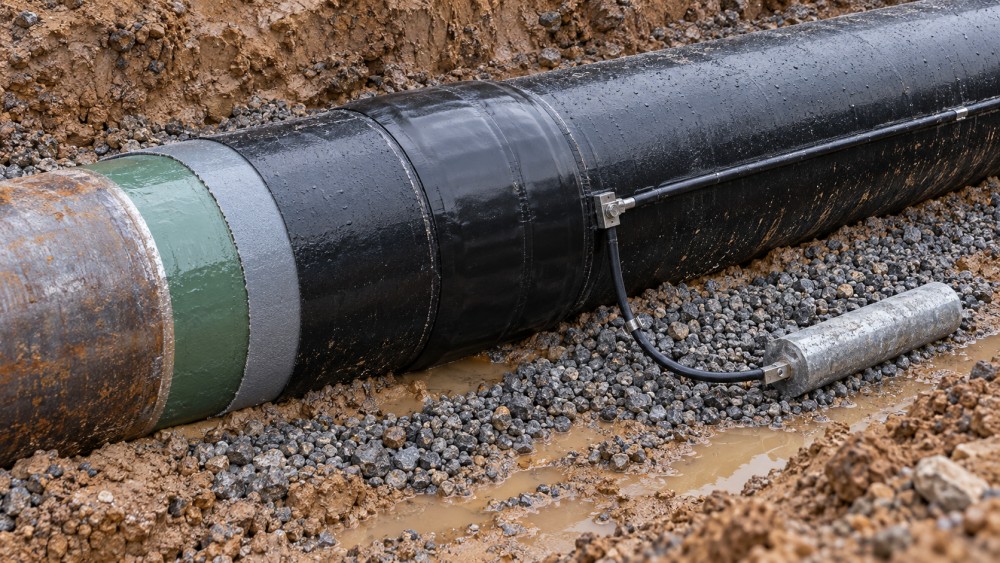
Three-layer polyethylene, often abbreviated 3LPE, combines an epoxy primer, an adhesive layer, and an outer polyethylene jacket. Three-layer polypropylene, or 3LPP, uses a similar construction with polypropylene as the outer layer. These systems are chosen when high dielectric strength and resistance to impact, abrasion, and soil stress are major concerns.
The epoxy primer provides adhesion to steel. The adhesive ties the primer to the outer polyolefin layer, while the outer layer provides a durable shield against handling damage and water ingress. This layered structure is especially useful where coatings face coarse backfill, long-distance transport, trenchless installation, or soil movement that could abrade a thinner coating.
Polyethylene systems are generally associated with conventional buried pipeline temperatures. Polypropylene is more appropriate where operating temperatures are higher or where improved heat resistance is required. That distinction matters because a coating selected only for its thickness may soften, deform, or lose long-term integrity if the pipe wall temperature exceeds its intended service range.
Multi-layer polyolefin coatings also require careful field-joint planning. Factory-applied coating can be highly uniform, but every girth weld interrupts it. The field-joint system must overlap the factory coating correctly, bond to the exposed steel and coating cutback, and tolerate the same soil and cathodic protection environment. A robust factory coating paired with poorly prepared field joints leaves repeated corrosion entry points along the route.
Coatings That Need More Caution in Severe Soil
Coal tar enamel and asphalt-based systems have long histories in buried service, and some existing networks still use them. Their thickness and water resistance can be useful in certain applications. However, their performance depends heavily on handling, repair quality, temperature exposure, and the integrity of outer wraps. A brittle or cracked coating may allow water to travel beneath the protective layer, particularly where the coating has aged or where soil movement creates stress.
Liquid epoxy systems can be effective for fittings, irregular geometries, repairs, and field work, but they are not automatically equivalent to plant-applied FBE. Film build, curing conditions, surface cleanliness, humidity, and applicator control influence the result. A field-applied liquid coating that appears continuous can still contain thin areas, pinholes, solvent entrapment, or weakly bonded edges.
Petrolatum tapes, wax-based wraps, and similar systems are often useful for localized protection, buried valves, flanges, complex fittings, or rehabilitation work where abrasive blasting is impractical. They are less suitable as a default replacement for a high-integrity factory coating on a long welded steel pipeline in highly aggressive soil. Their performance relies on overlap discipline, contouring, mechanical outer protection, and preventing soil intrusion at edges.
Soil Conditions That Change the Coating Decision
Low soil resistivity is a warning sign because it indicates an environment that can support corrosion current more readily. It should not be treated as the only selection parameter. A low-resistivity clay with stable chemistry presents a different challenge from low-resistivity ground contaminated with salts, acids, or industrial discharge. Soil samples should be reviewed alongside moisture condition, pH, chloride and sulfate content, microbial activity where relevant, and seasonal groundwater behavior.
Persistent wetness places greater value on low water permeability and durable adhesion. Waterlogged zones are particularly demanding where the pipe surface experiences repeated wet-dry transitions near the water table. These transitions can concentrate salts and create different corrosion behavior along a short pipeline section. Coating selection may need to vary by route segment rather than treating the entire alignment as one uniform soil category.
Chlorides and soluble salts raise the importance of surface preparation before coating application. Salt contamination on blast-cleaned steel can remain beneath an otherwise high-quality coating. The coating may initially pass visual inspection, yet adhesion and long-term resistance are compromised. Controlling soluble salts, dust, profile, and time between blasting and coating is therefore part of the corrosion design, not merely a factory housekeeping issue.
Stray current exposure requires a separate electrical assessment. Corrosion associated with current discharge from the pipe can be rapid and highly localized. A durable dielectric coating reduces the area exposed to current, but defects become more significant when current density concentrates at small holidays. Coating choice must be coordinated with electrical isolation, cathodic protection design, bonding arrangements where appropriate, and monitoring points. Adding a thicker coating without investigating the interference source does not resolve the underlying mechanism.
Coating Thickness Alone Is a Poor Selection Rule
Thickness is easy to specify and measure, which makes it attractive in procurement documents. Yet coating performance comes from the combined behavior of adhesion, continuity, flexibility, hardness, impact resistance, water vapor resistance, temperature capability, and field repair quality. A thick coating with weak adhesion can disbond and shield areas from cathodic protection. A thinner, well-bonded FBE coating may perform more predictably where installation conditions are controlled and cathodic protection is available.
The same issue applies to hardness. A hard coating may resist indentation but crack under bending or impact. A flexible coating may survive deformation but be easier to cut by angular aggregate. Pipe diameter, wall thickness, handling method, route geometry, and trench material all affect which mechanical property matters most.
The Field Joint Is Part of the Same Corrosion System
Welded steel pipe is delivered in lengths, so every joint creates a coating transition. The weld area must be cleaned of slag, spatter, moisture, oil, and temporary protective materials before the selected joint coating is applied. Coating cutbacks should be consistent; excessively wide cutbacks increase the field-coated area, while irregular edges make overlap difficult to seal.
Heat-shrink sleeves, liquid epoxies, and compatible multi-layer joint systems are common approaches. The correct choice depends on the factory coating, pipe temperature, soil exposure, and installation sequence. A sleeve requires surface preparation, proper preheating where specified, correct overlap, and complete recovery around the pipe. A wrinkle, lifted edge, trapped moisture zone, or incomplete adhesive flow is not a cosmetic issue; it can become a path for water ingress.
Inspection should include visual review, coating thickness measurement where applicable, and holiday detection at a voltage appropriate to the coating type and thickness. Excessive holiday-test voltage can damage some coatings, while insufficient voltage can miss discontinuities. The testing method must match the actual coating system rather than being applied as a generic site routine.
Installation Can Defeat a Good Coating
A coating specification should be tied to the installation method. Pipe placed on sharp rock, lowered with bare chains, or backfilled with construction debris will experience damage regardless of its laboratory properties. Suitable bedding, screened or selected backfill, padded slings, controlled lowering equipment, and immediate repair of coating damage have direct influence on the exposed steel area that cathodic protection must cover.
Damage repairs should use materials compatible with the original coating and should restore both barrier continuity and adhesion. Applying an arbitrary patch product over a dusty or damp defect often produces a repair that fails around its perimeter. The repair area needs sound edges, appropriate surface preparation, and sufficient overlap onto intact coating.
Storage also matters before the pipe enters the trench. Long exposure to sunlight, contamination by mud or oil, standing water inside pipe ends, and repeated stacking contact can affect external coating condition. Inspection on delivery and again immediately before installation catches defects while access is still straightforward.
A Practical Selection Position
Use single-layer FBE with cathodic protection when soil aggression is significant but construction control is good, the route avoids severe rock contact, and reliable field-joint procedures are available. Select 3LPE where the same corrosion resistance must be combined with stronger protection against handling and abrasive backfill. Move toward 3LPP when elevated pipe operating temperature is a real design condition rather than an assumed possibility.
Where stray current, contaminated ground, tidal saturation, or unusually low resistivity is present, treat the coating decision as part of an integrated corrosion-control design. The most durable result comes from matching the coating to the soil mechanism, protecting it during installation, controlling every field joint, and designing cathodic protection around the actual expected coating condition rather than an idealized defect-free surface.
Related News
- How to Assess a Rigid Coupling Supplier for Bore Accuracy and Traceable QualityOct 08, 2026Tribology & Kinematics Expert
- Titanium Alloys Compared: Balancing Strength, Corrosion Resistance, and MachinabilityOct 08, 2026CNC Kinematics Architect
- Where Ductile Iron Dismantling Joints Reduce Alignment Risk in Water PipelinesOct 08, 2026Pipeline Metallurgy Scientist
- Selecting a Precision Bearing Sleeve: Fits, Runout, and Material ChoicesOct 08, 2026Tribology & Kinematics Expert
- Face Milling Cutters: How Insert Geometry Affects Finish on Steel and AluminumOct 08, 2026CNC Kinematics Architect
- Single-Acting Cylinders for Clamping: Stroke, Force, and Return Spring ConsiderationsOct 07, 2026Fluid Power Control Strategist