
When PU-Lined Ductile Iron Pipes Outperform Cement Linings in Abrasive Slurry Service
A slurry line can appear satisfactory during commissioning and still become a maintenance problem once solids loading, velocity changes, and intermittent impact begin to work on the pipe wall. In these services, a conventional cement lining may remain suitable for chemical separation and ordinary water transport, yet wear rapidly where hard particles repeatedly slide, roll, and strike the bore. The result is not merely a rougher internal surface: localized lining loss can expose the ductile iron, disrupt hydraulic performance, contaminate downstream equipment, and force difficult shutdown work.
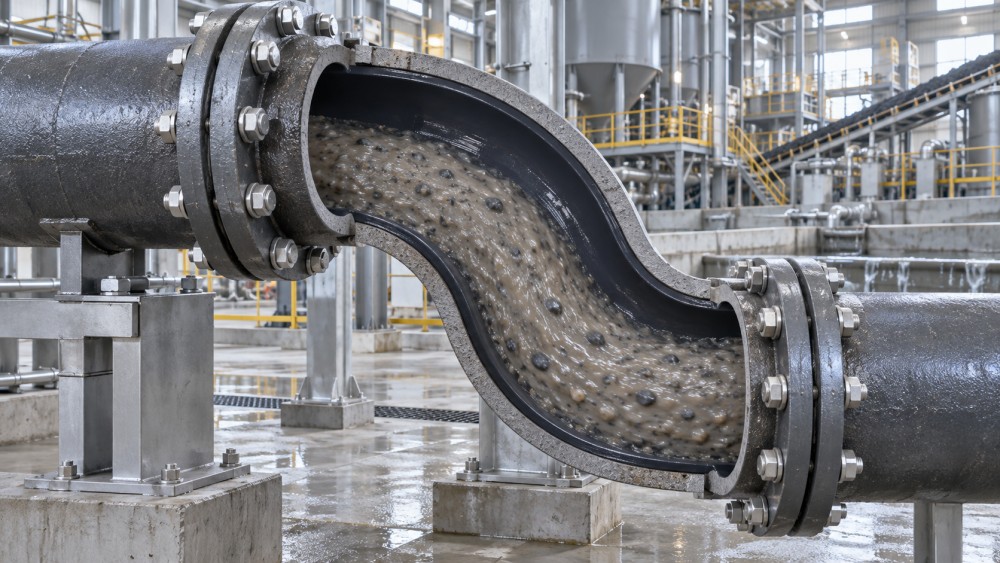
PU Lined Ductile Iron Pipes usually outperform cement-lined pipes when abrasion, particle impact, and cyclic mechanical loading are the dominant internal threats. Polyurethane is not automatically the better lining for every slurry duty. Cement linings remain practical in many water and low-abrasion applications. The decision changes when the conveyed medium contains abrasive solids, when flow conditions promote impingement, or when a pipeline must tolerate occasional dry running, start-stop cycles, or solids settling without frequent internal repairs.
Start with the actual wear mechanism, not the pipe material name
“Slurry” covers a wide range of fluids. A mixture with fine suspended particles behaves very differently from one carrying coarse mineral fragments, grit, ash, sand, metal fines, or sharp process residues. Selecting a lining based only on the word slurry can lead to the wrong result because abrasion is driven by how particles interact with the pipe wall.
Three wear patterns deserve early attention:
- Sliding abrasion: particles travel along the lower portion of a horizontal pipe and gradually wear a track into the lining.
- Impact abrasion: solids change direction at bends, tees, reducers, valve zones, and discharge points, striking the wall at an angle or nearly head-on.
- Settling and restart wear: solids deposit during low-flow periods, then scrape or surge against the bore when the system restarts.
Cement lining is hard and performs well when its service environment is primarily aqueous and non-abrasive. Its strength does not necessarily make it the best defense against repeated particle impact. A hard but comparatively brittle lining can chip, crack, or erode locally when exposed to sharp solids and vibration. Polyurethane, by contrast, is valued in abrasive service because it combines wear resistance with resilience. Rather than relying only on hardness, it can absorb a portion of the impact energy and resist cutting or tearing under repeated contact.
This distinction matters most at predictable damage points. A straight section may show limited loss while elbows, branch connections, pump discharges, transition pieces, and areas downstream of partially closed valves degrade much sooner. Evaluating only the average pipe run can hide the locations that determine the maintenance interval.
Conditions that shift the decision toward polyurethane lining
A PU-lined ductile iron system becomes a stronger candidate when several abrasive conditions occur together. One severe factor may justify closer evaluation; multiple factors usually indicate that a cement-lined design should not be accepted without a more detailed wear review.
The particle description should be specific. Engineering teams should identify solids size distribution, shape, hardness, concentration, and whether the solids are free-moving or prone to settling. A line transporting rounded, fine particles at stable velocity may not require the same internal protection as a line carrying angular particles with variable loading. The same nominal pipe diameter and pressure class can therefore lead to different lining choices.
Where cement lining can become the weak point
Cement lining is widely used because it is familiar, robust in many water applications, and compatible with ductile iron pipe systems. It should not be treated as unsuitable by default. The problem arises when its use is extended into a duty dominated by mechanical erosion rather than ordinary water contact.
At an elbow, for example, the slurry does not move as a uniform stream. Heavier particles tend to continue in their original direction before the flow redirects them. This creates a concentrated impact zone on the outer radius or downstream wall, depending on flow behavior and geometry. Cement can wear unevenly in that location. Once local loss begins, the surface profile changes, turbulence increases, and the damage may accelerate.
Similar issues appear where a pipe diameter changes abruptly, where a branch line enters the main, or where a valve causes a high-energy jet. In these areas, specifying a cement-lined straight pipe and assuming all components will experience the same service life is a common planning error. The more useful question is: Which component will see the highest particle energy, and can its lining tolerate that exposure?
Cement lining can also be vulnerable when handling, installation conditions, or system movement introduce cracking risk before full operation. Mechanical damage does not always lead to immediate failure, but it can create a starting point for undercutting and localized erosion. This is why lining evaluation should include transport, field cutting, jointing, support spacing, and expected pipeline movement—not just fluid chemistry.
What polyurethane changes in abrasive slurry service
Polyurethane lining creates a protective internal layer designed to resist abrasive wear while remaining flexible enough to manage repeated particle contact. Its resilience can be particularly useful where solids strike the wall rather than simply flow along it. The ductile iron pipe provides structural strength, pressure capability, and external durability; the PU lining addresses the internal wear mechanism. Neither element should be evaluated in isolation.
The practical advantages of a polyurethane-lined bore are usually most visible in services where maintenance access is difficult or where a short outage carries high operational consequences. A buried transfer line, a pipe rack with restricted access, or a section integrated into a process train may not be easy to inspect or replace. Extending internal lining life in these areas can reduce the likelihood of unplanned intervention, even when the initial material cost is higher than a conventional option.
PU lining also deserves consideration when the system includes fittings that cannot be treated as secondary items. An abrasion-resistant straight pipe combined with standard lining at bends may simply move the failure point to the fittings. The lining strategy should follow the flow path through elbows, reducers, tees, valves, spools, and special fabrications. In severe service, component geometry and lining continuity often matter as much as the nominal lining material.
Do not select polyurethane on abrasion alone
Polyurethane has service limits that need to be checked against the actual process envelope. Temperature is one of the first. The lining must be suitable for normal operating temperature, startup conditions, cleaning cycles, and credible upset temperatures. A slurry may be cool during regular duty but exposed to hotter flushing fluid or process excursions. A lining that performs well at one temperature may not retain the same properties at another.
Chemical compatibility is equally important. The carrier liquid may contain acids, alkalis, hydrocarbons, solvents, oxidizing agents, dissolved salts, or treatment chemicals. Solids can dominate mechanical wear, but the liquid phase can still affect the lining through swelling, softening, hydrolysis, or loss of adhesion. The review should use the full fluid composition rather than a generic description such as “waste slurry” or “process water.”
Pressure and vacuum conditions also require attention. Ductile iron pipe selection involves pressure class, joint design, external loads, and installation method. The internal lining must remain bonded and intact through pressure cycling, surge events, and any negative-pressure exposure anticipated during draining or pump trips. A lining decision cannot compensate for an unsuitable pressure design or poorly controlled surge condition.
A practical decision sequence before approving the pipe schedule
Rather than comparing lining names in isolation, build the decision around the operating duty. The following sequence is useful during concept design, specification review, or replacement planning.
- Map the flow regime. Identify normal, minimum, maximum, and transient flow conditions. Note periods of low velocity, batch discharge, pump startup, flushing, and shutdown. Abrasion may peak during operating modes that are not reflected in the design average.
- Characterize the solids. Record particle size, shape, estimated hardness, concentration, settling tendency, and expected variation. Include abnormal but credible material entering the line, such as grit during cleaning or upset conditions.
- Mark high-energy components. Review elbows, branches, reducers, valves, pump discharge spools, and points of flow entry. These locations should receive separate attention instead of being assumed equivalent to straight pipe.
- Check the chemistry and temperature envelope. Confirm compatibility with the full liquid phase and all cleaning or upset conditions. Do not rely on abrasion resistance as proof of chemical suitability.
- Review construction details. Determine whether field cuts, special joints, repairs, supports, or transitions could damage the lining or create exposed edges. Request clear requirements for inspection and handling.
- Set an inspection basis. Decide how internal wear will be monitored where access is limited. Thickness loss may be detected indirectly through operating changes, but planned inspection points are more reliable than waiting for leakage.
This process often reveals that the right answer is not necessarily “PU everywhere” or “cement everywhere.” A project may use cement-lined ductile iron in low-abrasion sections while applying polyurethane-lined pipe and fittings in concentrated wear zones. That approach can be technically sensible when the service profile changes along the route, provided interfaces, joints, and maintenance plans are addressed as part of one system.
Specification details that prevent avoidable disputes later
When polyurethane lining is selected, the purchase description should state more than “PU lined.” It should define the intended medium, temperature range, pressure conditions, required lining thickness or design basis where applicable, coverage of fittings, surface preparation expectations, lining continuity at ends, inspection requirements, repair provisions, and handling limitations. Ambiguous wording can result in pipe that appears compliant on a general description but is not aligned with the actual duty.
For critical slurry service, it is also prudent to distinguish between straight pipe and fittings in the specification. Bends may need a different lining thickness, geometry, replaceable spool arrangement, or more frequent inspection interval because their wear mechanism is different. If a valve is expected to throttle slurry, its downstream spool and the valve’s internal trim require separate consideration. No pipe lining can eliminate the erosive effect of using unsuitable control geometry for abrasive flow.
Installation teams should protect the bore from welding debris, dropped tools, sharp cleaning devices, and uncontrolled field modifications. A resilient lining is not indestructible. Damage at a cut end, joint area, or repair patch can become a preferential wear point if it is not properly finished and inspected before service.
When cement lining is still the more rational choice
Polyurethane lining should not be selected simply because a fluid contains some solids. Cement-lined ductile iron can remain the more appropriate option where the medium is mainly water, solids are fine and low in concentration, velocity is controlled, and severe impact zones are absent. It may also be preferred where the temperature or chemical environment falls outside the suitable range for the proposed polyurethane system.
The key is to avoid treating a low-abrasion water duty and an abrasive slurry duty as variations of the same application. Cement lining is often a sound choice for its intended conditions. PU Lined Ductile Iron Pipes become the stronger option when the design must manage persistent internal wear, localized impingement, and the operational cost of replacing worn components before the rest of the pipeline has reached the end of its useful service life.
Questions that often arise during slurry pipe selection
Can polyurethane lining be used only at elbows and still protect the system?
It can be a sensible approach when wear is clearly concentrated at directional changes and the straight runs have low particle-wall contact. However, the decision should be based on the complete flow profile. High velocity, long horizontal runs with settling solids, or turbulent pump discharge sections may also require abrasion-resistant lining beyond the elbows.
Does a harder lining always last longer in slurry service?
No. Hardness is only one property. Resistance to impact, cutting, repeated deformation, adhesion loss, temperature exposure, and chemical attack all affect service life. A lining that is very hard may still be less suitable where particles repeatedly strike the wall or where vibration and pressure cycling are significant.
What information should be available before finalizing the lining?
At minimum, collect the fluid composition, solids description, concentration range, particle size and shape where known, operating temperature, pressure conditions, expected velocity range, pipeline geometry, and transient operating modes. Where the slurry is highly variable, the design should consider the most erosive credible condition rather than only routine operation.
Related News
- How to Assess a Rigid Coupling Supplier for Bore Accuracy and Traceable QualityOct 08, 2026Tribology & Kinematics Expert
- Titanium Alloys Compared: Balancing Strength, Corrosion Resistance, and MachinabilityOct 08, 2026CNC Kinematics Architect
- Where Ductile Iron Dismantling Joints Reduce Alignment Risk in Water PipelinesOct 08, 2026Pipeline Metallurgy Scientist
- Selecting a Precision Bearing Sleeve: Fits, Runout, and Material ChoicesOct 08, 2026Tribology & Kinematics Expert
- Face Milling Cutters: How Insert Geometry Affects Finish on Steel and AluminumOct 08, 2026CNC Kinematics Architect
- Single-Acting Cylinders for Clamping: Stroke, Force, and Return Spring ConsiderationsOct 07, 2026Fluid Power Control Strategist