
When Do Polyurethane-Lined Ductile Iron Pipes Make Sense in Reclaimed Water Systems?
Reclaimed water systems are rarely as forgiving as conventional potable-water networks. The water chemistry can shift with treatment performance and source conditions. Suspended solids may remain present. Pump stations can create high-velocity zones, transient pressure events, and localized turbulence. In some systems, the real problem is not one dramatic failure mode, but years of gradual abrasion, under-deposit attack, lining wear, and difficult maintenance access.
That is where polyurethane lined ductile iron pipes for reclaimed water deserve a serious look. They are not automatically the right answer for every reuse pipeline, and they should not be selected simply because polyurethane sounds more resistant than a conventional lining. The case becomes stronger when the project combines pressure duty, abrasive flow, uncertain water quality, and a long expected operating cycle in locations where relining or replacement would be disruptive.
For project managers, the useful question is not “Is polyurethane better?” It is: Which section of this reclaimed-water system has a wear or corrosion mechanism that justifies the additional specification, inspection, and upfront cost? That distinction avoids both underdesign and expensive overdesign.
Why reclaimed water changes the pipe-selection conversation
Reclaimed water is usually treated wastewater intended for irrigation, industrial reuse, municipal services, environmental applications, or other non-potable uses. Its quality can be well controlled, but “reclaimed water” is not a single fluid category. One project may carry relatively clean tertiary-treated water to landscape irrigation. Another may handle reuse water with residual fines, fluctuating dissolved salts, intermittent biological activity, or chemical additions associated with treatment and disinfection.
This matters because an internal lining is exposed to the actual operating fluid, not the fluid description on a planning drawing. A line that sees low solids, stable chemistry, moderate velocity, and continuous flow may perform well with a more conventional lining system. A transfer main downstream of a treatment plant, however, can face more demanding conditions: starts and stops, air release events, sediment movement after low-flow periods, and abrasion at bends, reducers, valve stations, or pump discharge headers.
Ductile iron remains attractive in these systems because it brings mechanical strength, pressure capability, and familiar installation practices. Its value is especially clear on buried pressure pipelines where external loads, handling damage, joint performance, and route constraints matter as much as internal corrosion resistance. The lining decision should therefore be treated as part of a complete pipe-system decision, not as an isolated coating choice.
Where polyurethane lining is most likely to make sense
Polyurethane lining is often considered when internal wear resistance is a major design concern. In practical terms, that means pipe sections where suspended particles or settled material can repeatedly contact the wall at meaningful velocity. The issue is not limited to visibly “dirty” water. Fine mineral particles, grit carryover, or solids mobilized during flow changes can gradually affect a lining over a long service period.
The strongest applications tend to be selective rather than system-wide. A project team may specify polyurethane-lined ductile iron pipe for a pump discharge section, a high-energy manifold, a pipeline serving an industrial reuse customer, or a difficult-to-access pressure main. Meanwhile, lower-risk distribution branches may use another lining that is technically suitable and commercially more proportionate.
This selective approach is often more defensible than applying one premium lining to every pipe length. It directs investment toward the locations where failure would be costly: beneath major roads, inside developed industrial sites, through congested utility corridors, or in facilities where shutdown windows are limited.
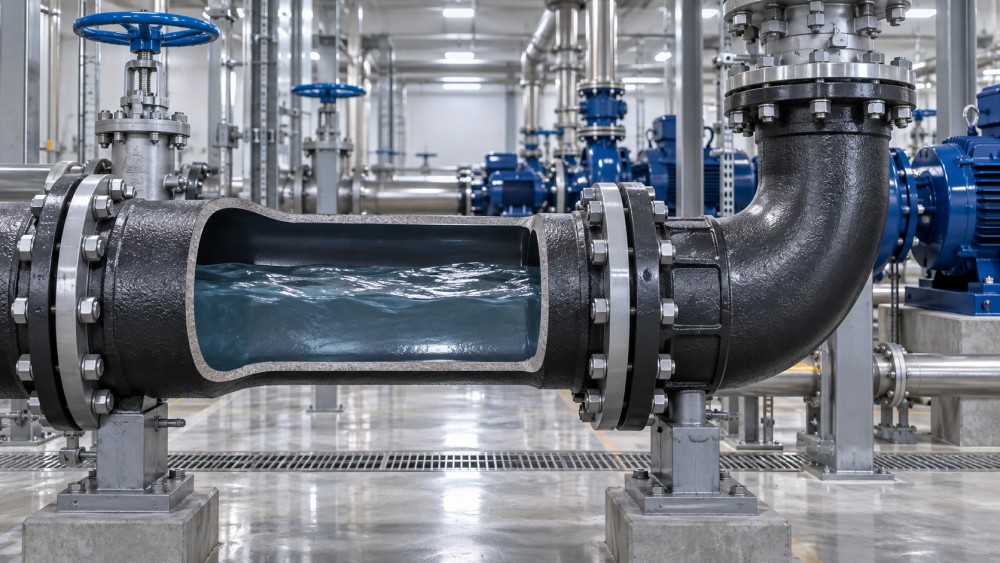
There are several project conditions that usually warrant closer evaluation of polyurethane:
- Pipeline segments exposed to abrasive suspended solids or periodic grit movement.
- High-velocity zones, especially near pump outlets, fittings, directional changes, and control valves.
- Industrial reclaimed-water loops where the water quality differs materially from municipal irrigation reuse water.
- Critical pressure mains where internal rehabilitation later would be operationally difficult.
- Systems with uncertain future loading, such as a reuse network expected to add industrial offtakers or higher pumping capacity.
- Projects where the owner is prioritizing lifecycle risk over the lowest delivered pipe price.
None of these conditions alone proves that polyurethane is required. Together, they form a credible reason to investigate it. The key is to identify the mechanism: abrasion, chemical exposure, intermittent deposits, velocity-related wear, or a combination of several factors.
Do not confuse abrasion resistance with universal chemical resistance
A common procurement mistake is assuming that a tougher lining solves every reclaimed-water compatibility issue. Polyurethane can offer strong resistance to mechanical wear in suitable formulations, but lining performance still depends on the specific water chemistry, temperature, exposure duration, and manufacturing quality. A pipe lining that is appropriate for one reuse application may not be appropriate for another that contains different chemicals, elevated temperature, or unusual process-water contributions.
The project team should ask for compatibility information tied to the expected operating envelope rather than accepting broad statements such as “suitable for wastewater” or “suitable for corrosive media.” Those descriptions are too general for an engineered decision. If the reuse supply includes industrial contributions, the treatment plant operator and process engineer should be involved early. They may know about cleaning chemicals, seasonal influent changes, conductivity trends, or planned process upgrades that do not appear in the basic hydraulic design package.
There is also a difference between normal operation and abnormal operation. For example, a short-duration chemical cleaning event, a bypass condition, or a period of reduced treatment efficiency may create exposure conditions that are outside the ordinary water-quality profile. The lining specification should state whether these events are excluded, tolerated for limited duration, or included in the design basis.
Hydraulics often reveal the real risk areas
Many lining decisions become clearer once the hydraulic profile is reviewed segment by segment. Long straight runs with stable velocity do not behave like a pump station header. Dead ends, oversized sections, low-flow branches, and intermittent-use lines can allow deposits to settle. When the system returns to higher flow, that material may be mobilized and carried toward bends, valves, and reducers.
Project managers should be cautious about evaluating the pipe only at design flow. Minimum flow, startup conditions, flushing conditions, and pump cycling can be equally important. A system designed around one nominal duty point may actually spend much of its operating life in a different regime. If solids deposition is plausible, the question becomes whether the operator can manage it through flushing, cleaning access, and controls—or whether the lining needs greater tolerance for repeated abrasive exposure.
At fittings and special pieces, attention to detail matters. The performance of a lined ductile iron pipeline is not determined by pipe barrels alone. Bends, tees, reducers, flanged connections, valves, fabricated spools, repair couplings, and connection interfaces all need compatible internal protection. It is not unusual for a carefully specified pipe barrel to be paired with a less carefully considered fitting or valve interior. That weak point can become the first location where coating damage, turbulence-related wear, or maintenance problems appear.
The lining is only one part of the durability plan
A polyurethane internal lining does not remove the need to consider external corrosion, joint selection, bedding, thrust restraint, and installation control. Ductile iron pipe projects succeed when the system is treated as a system. Soil aggressiveness, groundwater, stray-current concerns, burial depth, traffic loading, and site damage risk can all influence the external protection strategy.
The jointing method also deserves early coordination. Reclaimed-water projects may include restrained sections, crossings, valve chambers, directional drilling interfaces, and tie-ins to existing assets. The selected pipe and lining arrangement must work with the required joints, fittings, cut ends, and field repair procedures. If a contractor needs to cut pipe in the field, the project documents should define how exposed areas will be prepared and restored. Leaving this to an improvised site decision is a predictable quality risk.
Inspection requirements should be practical rather than ceremonial. The owner needs clarity on what will be checked before shipment, what documentation will accompany the materials, how damaged lining will be identified, and who has authority to accept a repair. Material traceability, lining thickness verification where applicable, visual inspection criteria, and repair procedures should align with the project specification and supplier capability. A good submittal package is useful only if the field team can apply it when pipe arrives at the site.
A comparison that helps avoid over-specification
The point is not that every difficult segment must receive the same answer. It is that pipe materials should follow risk exposure. A short high-wear section may justify a higher-performance lining even when the rest of the network does not.
Questions to settle before the purchase order
Before finalizing polyurethane lined ductile iron pipes for reclaimed water, the engineering and procurement teams should close several gaps that are often left unresolved until too late. Confirm the water-quality design basis, including normal and foreseeable upset conditions. Review the hydraulic model for low-flow, flushing, and pump-start scenarios. Identify all special pieces and confirm that their internal protection matches the intent of the pipe-barrel specification.
It is also worth separating “supplier standard offering” from “project requirement.” A supplier may have a proven manufacturing process, but the buyer still needs to confirm pipe dimensions, pressure duty, joint configuration, lining application method, inspection records, shipping protection, and field repair materials. Delivery sequencing matters as well. On a constrained municipal or industrial site, pipe stored too long or handled repeatedly can suffer avoidable damage before it is ever installed.
Platforms such as Global Industrial Machining & Piping Equipment Network (IMPE) are useful in this stage because they help project teams organize the wider decision: material performance, pipe and fitting compatibility, manufacturing consistency, inspection expectations, and long-term operational value. The best procurement review is not a catalog comparison. It connects the specification to actual installation conditions and the owner’s maintenance reality.
The practical decision
Polyurethane lining makes the most sense when reclaimed-water duty is genuinely abrasive, hydraulically demanding, chemically uncertain, or expensive to repair after installation. It can be a disciplined lifecycle choice for critical mains and high-wear zones, particularly when ductile iron’s structural strength and installation advantages are already needed.
But it should be specified because the project has identified a credible internal-service risk—not because it is assumed to be the premium option. Start with the fluid, then the operating profile, then the vulnerable pipeline segments. If those three pieces point to abrasion resistance and durable internal protection, polyurethane-lined ductile iron pipe is likely worth the added engineering attention.
Related News
- How to Assess a Rigid Coupling Supplier for Bore Accuracy and Traceable QualityOct 08, 2026Tribology & Kinematics Expert
- Titanium Alloys Compared: Balancing Strength, Corrosion Resistance, and MachinabilityOct 08, 2026CNC Kinematics Architect
- Where Ductile Iron Dismantling Joints Reduce Alignment Risk in Water PipelinesOct 08, 2026Pipeline Metallurgy Scientist
- Selecting a Precision Bearing Sleeve: Fits, Runout, and Material ChoicesOct 08, 2026Tribology & Kinematics Expert
- Face Milling Cutters: How Insert Geometry Affects Finish on Steel and AluminumOct 08, 2026CNC Kinematics Architect
- Single-Acting Cylinders for Clamping: Stroke, Force, and Return Spring ConsiderationsOct 07, 2026Fluid Power Control Strategist