
Polyurethane Lining Price: How Pipe Size and Thickness Affect Quotes
Polyurethane lining price becomes meaningful only when the pipe dimensions, lining specification, and quotation basis are clear. A price per linear meter increases with internal diameter because each meter contains more surface area. Greater lining thickness adds material volume and can change application and curing requirements. Neither relationship guarantees that the complete quoted price will rise in direct proportion: preparation, handling, inspection, and minimum production charges follow different cost patterns.
Two offers are comparable only when they cover the same pipe geometry, finished lining requirements, and scope of work. Start by separating the cost of the pipe itself from the internal lining, then establish whether the lining charge is expressed per meter, square meter, pipe section, or completed lot.
Diameter changes the area behind every quoted meter
For a straight cylindrical bore, the internal surface area before lining is calculated as:
Internal area = π × actual internal diameter × lined length
Diameter and length must use consistent units. With both dimensions in meters, the result is square meters. This area provides a useful basis for comparing preparation and application charges, provided both quotations use the same measurement convention.
Nominal pipe size is insufficient for this calculation. Actual bore diameter varies with the pipe specification and wall thickness. Two pipes carrying the same nominal designation can therefore require different lining quantities. An RFQ should identify the actual internal diameter before lining, preferably through an approved drawing or dimensional schedule.
At equal length and thickness, doubling the bore diameter doubles the substrate area. It also approximately doubles the polyurethane volume when the lining is thin relative to the bore. However, a quotation per square meter will not necessarily remain constant. Application access, equipment capacity, and batch loading still affect the rate.
Small bores can require specialized tooling or make internal preparation and inspection more difficult. Large sections require suitable lifting, rotation, and curing arrangements. A lower material requirement does not automatically produce a lower processing rate per square meter.
Thickness affects material volume and the finished bore
For preliminary estimating, polyurethane volume is approximately the internal substrate area multiplied by lining thickness. This approximation works best when the lining is thin compared with the pipe diameter. Where greater accuracy is needed, the exact cylindrical geometry is:
Lining volume = π × lined length × (internal diameter × thickness − thickness²)
Here, internal diameter means the bore before lining, and all dimensions must use the same unit. Multiplying the calculated volume by the specified compound density gives the theoretical cured material mass. Actual production consumption also includes process losses, residues, and any allowance needed to achieve the specified minimum thickness.
The thickness term matters commercially because “nominal thickness” and “minimum thickness” describe different obligations. A nominal value without a tolerance leaves room for inconsistent interpretation. A minimum requirement means the application process must deliver at least that thickness across the agreed measurement locations, often requiring a higher production target.
That allowance should be understood before comparing material quantities. A quotation based on theoretical volume alone can understate consumption when the bore is irregular, the substrate has local depressions, or the thickness tolerance is demanding.
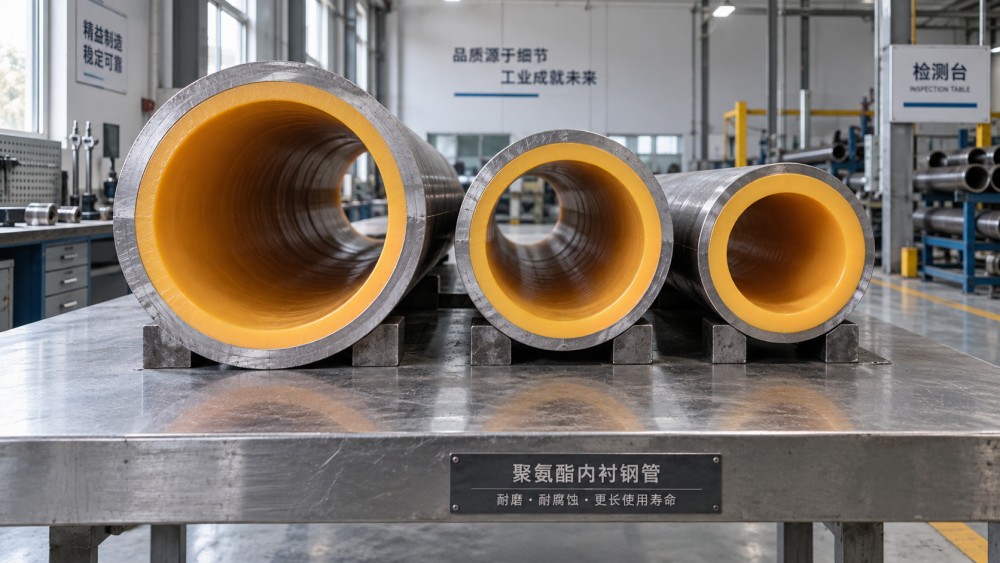
The finished internal diameter is the original bore minus twice the lining thickness. Increasing thickness therefore reduces the flow passage. Where hydraulic capacity, solids passage, or connection geometry is constrained, the permitted finished bore belongs in the specification alongside the wear allowance.
Additional thickness also has to suit the application method. A sprayed system, a cast elastomer, and a centrifugally applied lining can have different processing limits. Some systems require staged application; others rely on a controlled casting and cure cycle. Price comparisons should identify which process is proposed and whether it can achieve the specified thickness and geometry.
A dimensional comparison without assuming a market price
The following example isolates geometry. It assumes straight pipe with a uniform circular bore and excludes fittings, end returns, process losses, and thickness tolerances. The dimensions are illustrative calculation inputs, not supplier price data.
The larger bore doubles the preparation area and slightly more than doubles the exact lining volume. Increasing thickness from 5 mm to 10 mm leaves the substrate area unchanged while increasing material volume to slightly less than twice the reference amount. These differences follow from the inward growth of the lining.
Neither change establishes a multiplier for the final quotation. Preparation remains associated with substrate area and condition, while material consumption follows volume. Handling and production setup introduce separate charges. Applying one diameter or thickness ratio to the entire price obscures those distinctions.
Read the quote as a set of cost drivers
A useful commercial breakdown separates substrate preparation, polyurethane application, and project-specific charges. The purpose is to understand which costs will change if diameter, thickness, quantity, or pipe condition changes during clarification.
Preparation follows surface condition as well as area
New pipe with an agreed surface condition presents a different scope from used pipe containing scale, contamination, or an existing lining. Removal, cleaning, abrasive preparation, and repairs can outweigh differences in polyurethane consumption. For refurbishment, photographs alone rarely establish the complete internal condition.
The quotation should state its preparation assumptions and how additional work will be measured. Otherwise, an apparently low lining rate can depend on a substrate condition that the delivered pipe does not meet.
Compound specification changes the meaning of thickness
Equal thickness does not establish equal performance. Polyurethane formulation, hardness, adhesion system, and cure requirements must match the conveyed medium and operating conditions. Abrasive particle characteristics, temperature, chemical exposure, and impact loading all influence suitability.
A harder compound is not automatically the better wear solution. Resistance to sliding abrasion and response to impact involve different material behavior. Replacing a specified compound with a cheaper formulation while retaining the same thickness changes the technical basis of the offer.
Section geometry adds work beyond straight-pipe area
Elbows, reducers, branches, and flanged ends introduce access constraints and detailed finishing. End returns and flange-face coverage also add lined surfaces that a simple bore-area calculation excludes. Their charges should be identifiable rather than absorbed into an unexplained average rate.
Pipe section length affects the number of pieces handled. The same total meterage divided into shorter sections creates more individual ends and handling operations. Longer sections may introduce equipment or transport constraints. Total length alone does not describe production effort.
Convert quotations to the same commercial basis
For straight pipe of known bore, a rate per square meter can be converted to a rate per linear meter by multiplying it by π and the internal diameter in meters. This conversion is valid only if both offers include the same thickness, preparation, inspection, and end treatment.
To compare a price per section, divide by the actual lined length of that section. Confirm whether the quoted length excludes unlined ends or other reserved areas. For a mixed schedule, calculate each size separately; using one average diameter can distort the total when rates or thicknesses vary across the order.
A practical comparison sheet should preserve the original quotation unit and show the converted value beside it. Separate charges then remain visible rather than disappearing into a blended rate.
- Pipe supply: establish whether the offer includes the bare pipe, supplied free-issue pipe, or refurbishment of existing sections.
- Preparation and lining rates need an explicit dimensional basis, including how fittings and end details are measured.
- Lot charges such as tooling, setup, or agreed qualification work should remain separate. Their allocation changes when order quantities change.
- Packaging, freight, taxes, and delivery terms determine the delivered comparison, particularly where large diameters consume substantial transport space.
A minimum charge can dominate a small order even when its material requirement is modest. Spreading that charge across the quoted quantity produces a useful order-specific rate, but that rate should not be treated as valid for later quantities without confirmation.
Specify enough detail to prevent a cheaper scope
An effective RFQ connects dimensions to acceptance requirements. Include a schedule showing actual bore, section length, quantity, component type, and substrate material. Drawings should define lined surfaces, unlined zones, flange treatment, end transitions, and any finished-bore restriction.
Thickness needs a defined basis: nominal or minimum, permitted variation, and the agreed verification method. Where direct access is limited, the inspection approach must be feasible for the bore size and application process. A generic promise to measure thickness is insufficient if the proposed instrument cannot reliably assess that lining and substrate combination.
Inspection requirements also affect quotation scope. State whether the work requires visual examination, thickness mapping, discontinuity testing, adhesion verification, or additional documentation. Each method needs agreed acceptance criteria. For example, discontinuity testing must use a procedure appropriate to the lining material and thickness; an unsuitable test setting can damage the lining or produce misleading results.
Adhesion testing deserves particular clarification because some methods damage the tested location. Identify whether testing applies to production pipe, representative specimens, or another agreed arrangement, together with repair requirements where applicable. Otherwise, two offers can include very different levels of verification under the same phrase.
Operating information should be specific enough to confirm material suitability: conveyed medium, solids characteristics where relevant, normal and maximum temperatures, and cleaning exposure. If those conditions remain unresolved, request a clearly stated material assumption rather than accepting an unexplained “standard polyurethane” description.
Price changes should follow the dimension that changed
During revisions, ask for the effect of each changed parameter separately. A diameter increase changes area and volume; a thickness increase primarily changes volume and potentially processing. A move from straight pipe to fabricated spools introduces access and finishing work. These changes should have traceable explanations in the revised quotation.
The lowest comparable offer is the lowest price for an agreed, achievable lining specification. Once the geometry, material, thickness tolerance, and acceptance scope are fixed, remaining price differences become easier to assess. Any unresolved assumption should appear beside the quoted amount, where its effect on the order remains visible.
Related News
- Why Is Your Heavy-Duty Piston Pump Losing Pressure Under Load?Nov 09, 2026Fluid Power Control Strategist
- Cartridge Valves for Manifold Blocks: Avoiding Cavity Fit ProblemsNov 09, 2026Fluid Power Control Strategist
- Large-Diameter Forged Rings: How Seamless Rolling Affects Grain FlowNov 09, 2026Foundry Phase-Change Fellow
- Sealed Heavy-Duty Roller Bearings: Choosing Seals for Dust and WaterNov 09, 2026Tribology & Kinematics Expert
- Sprockets and Chain Drives: What Determines Replacement Cost?Nov 08, 2026CNC Kinematics Architect
- Monoblock Hydraulic Control Valves: Flow Rating and Spool SelectionNov 08, 2026Fluid Power Control Strategist