
PU Lined Ductile Iron Pipes vs. Cement Lining for Abrasive Slurry Service
PU Lined Ductile Iron Pipes vs. Cement Lining for Abrasive Slurry Service
Abrasive slurry can turn a lining specification into a major maintenance risk when particle impact, operating velocity, and chemical exposure are underestimated. PU Lined Ductile Iron Pipes offer a potential alternative to cement-lined systems, but their suitability depends on polyurethane formulation, adhesion, temperature limits, and actual slurry conditions—not abrasion resistance alone.
For technical evaluation, the useful question is not whether polyurethane is universally better than cement mortar. It is whether the proposed lining can survive the particular combination of sliding wear, particle impact, chemistry, and operating cycles in the pipeline. A well-supported selection may favor polyurethane in one section and retain cement lining elsewhere.
Start with the wear mechanism, not the lining name
“Abrasive slurry” is not a complete service description. Fine mineral solids moving in stable suspension behave differently from coarse, angular particles repeatedly settling and restarting. Solids concentration matters, but particle size distribution, hardness, shape, and density can change the wear mechanism just as much.
Consider a transfer line that operates steadily during production but stops overnight. During operation, the concern may be sliding abrasion along the pipe invert. At restart, a settled bed can create localized loading, restricted flow, and a different erosion pattern. Selecting a lining from average flow and average solids content misses that operating condition.
Velocity deserves similar care. Increasing it may help maintain solids transport, yet also increase erosion severity, particularly at bends and restrictions. Reducing it without checking deposition behavior can make matters worse. Establish the hydraulic operating envelope before asking a supplier to recommend lining thickness.
Where polyurethane and cement mortar behave differently
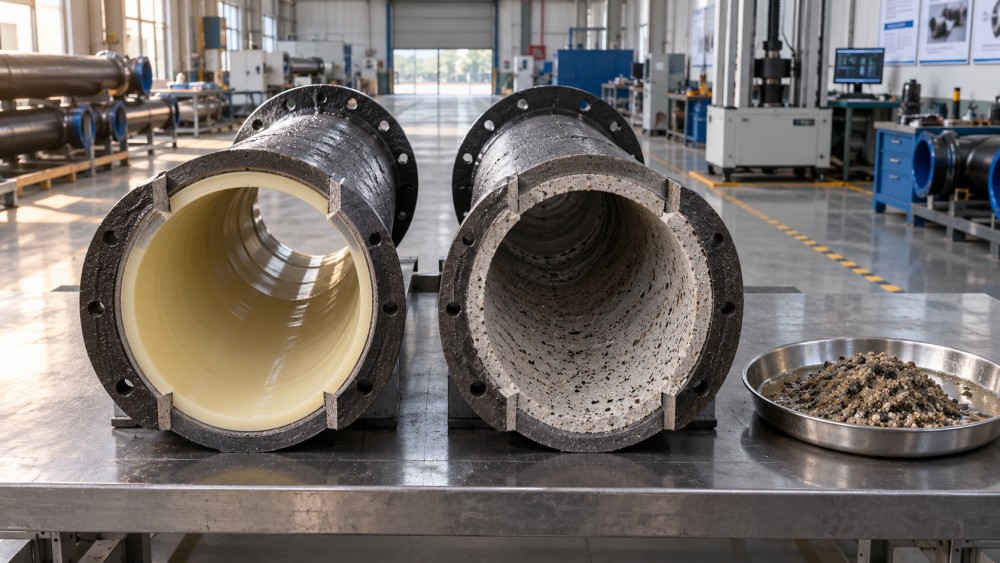
Cement-mortar lining is an established choice for ductile iron water pipelines. Its alkaline environment helps protect the iron surface in compatible waters, and it offers a practical, widely available solution where abrasion and chemical exposure are modest. That track record, however, does not automatically qualify a standard water-service lining for aggressive mineral slurry.
Polyurethane is a different material family. A suitable formulation can deform under particle loading and recover, providing useful resistance to certain abrasion and impact conditions. But polyurethane linings vary considerably in hardness, resilience, tear strength, hydrolysis resistance, and chemical compatibility. “PU lined” describes a category, not a defined level of slurry performance.
Neither column gives a universal winner. A relatively mild slurry with compatible water chemistry may not justify a specialist polymer lining. Conversely, repeated mortar erosion in a demanding transport duty is a reason to investigate alternatives—not simply specify more of the same material.
Straight pipe is rarely the whole problem
Bends, tees, reducers, valve outlets, and lining transitions deserve separate attention. Particles can strike a bend’s outer radius or encounter disturbed flow downstream of a restriction. A lining that performs acceptably in straight pipe may fail much earlier at these locations.
This is where a uniform specification can become expensive. Depending on the hydraulic assessment and available products, replaceable wear spools, revised bend geometry, or separately qualified fitting linings may be more useful than increasing lining thickness throughout the route. Keep the worst-wearing sections accessible wherever practical.
Joint details also matter. Ask for drawings showing lining termination, socket and spigot protection, gasket compatibility, and permitted joint deflection. An exposed edge or abrupt internal step can create a local wear problem. Field cutting must follow an approved procedure for restoring protection; it should not be left to an improvised site repair.
The lining does not establish the pipe’s structural pressure rating. Ductile iron pipe class, joints, fittings, surge allowance, and external loading remain separate design checks. Where draining or pump operation can create sub-atmospheric pressure, confirm that the complete lined assembly is suitable for those conditions.
Chemical compatibility can overturn an abrasion-based choice
A polyurethane sample can show excellent abrasion resistance and still be unsuitable for the process liquid. Compatibility needs to cover the carrier fluid, dissolved chemicals, contaminants, and cleaning regime. A room-temperature pH range is not enough to establish suitability for hot immersion or mixed chemical exposure.
Ask suppliers to distinguish continuous operating temperature from short-duration exposure limits. Also check hydrolytic stability under the actual service conditions. Polyurethane chemistry matters, so approval for one formulation should not be transferred to another simply because both have similar hardness.
For cement mortar, identify the binder and any proposed seal coat rather than treating all cement linings as equivalent. Acidic conditions and other aggressive constituents can affect durability. In either system, chemical degradation may expose a surface that then wears faster under solids loading. Separate chemical and abrasion test results may therefore miss a combined failure mechanism.
What evidence should support the specification?
A supplier’s general abrasion claim is a starting point, not a service-life prediction. Laboratory tests differ in abrasive media, particle motion, loading, and specimen preparation. Results from different methods should not be placed side by side as though they were directly comparable.
For a meaningful review, request a focused technical package:
- Defined material: formulation identification, nominal thickness and tolerances, cure requirements, and operating limitations.
- Relevant testing: the test method, specimen condition, exposure medium, temperature, and explanation of how the result relates to the proposed slurry.
- Application controls: substrate preparation, cleanliness, environmental controls, and process records for production pipe.
- Acceptance criteria: thickness checks, adhesion assessment, visual examination, and discontinuity testing where applicable.
- Repair provisions: approved repair materials, preparation, curing conditions, inspection, and return-to-service requirements.
For polyurethane, adhesion is especially important: good wear resistance cannot compensate for a lining that separates from its substrate. Discontinuity testing, where specified, needs a procedure and voltage appropriate to the lining system and thickness. It verifies continuity under the test conditions; it does not establish abrasion life.
Cement lining requires its own acceptance criteria. Do not apply polymer inspection rules to mortar or assume that every visible mortar crack has the same significance. Crack assessment, curing, thickness, surface condition, and repairs should follow the applicable project specification and lining standard.
This distinction fits IMPE’s approach to piping evaluation: separate pipe-body compliance, lining qualification, and production inspection. A pipe certificate can confirm important manufacturing requirements without proving that the internal lining will tolerate a particular slurry.
Compare installed risk, not just the price per metre
The commercial comparison should include fittings, lining inspection, freight protection, installation restrictions, spare sections, and repair arrangements. Specialist PU-lined fittings may have different lead times from standard cement-lined components. That difference becomes critical when a failed bend stops production and no interchangeable spare is available.
Avoid presenting a lifecycle calculation as precise when wear life is uncertain. Compare plausible replacement intervals and include shutdown access, draining, cleaning, lifting, disposal, and recommissioning. If the preferred option changes with a small adjustment in assumed service life, the decision needs stronger evidence.
Hydraulic assumptions also deserve scrutiny. Lining thickness changes internal diameter, while wear or deposits may change resistance over time. Do not assign energy savings to polyurethane solely because its new surface appears smoother. Use the actual finished bore and a hydraulic model appropriate to the slurry, not clean-water assumptions alone.
A defensible selection—and a manageable first installation
PU Lined Ductile Iron Pipes are a strong candidate when abrasion is a dominant failure mechanism, the formulation is compatible with the fluid and temperature, and application quality can be demonstrated. Cement mortar remains worth considering where solids exposure is limited, chemistry is compatible, and established operating evidence supports its use.
Where neither option has convincing evidence, qualify the uncertainty rather than hiding it in a specification. A representative slurry test or monitored trial section can be more valuable than another generic datasheet. Include a critical bend or transition if that is where failure is expected, and agree on inspection access and failure criteria before commissioning.
Before awarding the package, record the operating envelope, accepted lining system, inspection requirements, and replacement strategy together. The practical selection is the one whose limitations are understood—and whose most vulnerable section can be inspected and replaced without turning a wear problem into a prolonged plant outage.
Related News
- Why Is Your Heavy-Duty Piston Pump Losing Pressure Under Load?Nov 09, 2026Fluid Power Control Strategist
- Cartridge Valves for Manifold Blocks: Avoiding Cavity Fit ProblemsNov 09, 2026Fluid Power Control Strategist
- Large-Diameter Forged Rings: How Seamless Rolling Affects Grain FlowNov 09, 2026Foundry Phase-Change Fellow
- Sealed Heavy-Duty Roller Bearings: Choosing Seals for Dust and WaterNov 09, 2026Tribology & Kinematics Expert
- Sprockets and Chain Drives: What Determines Replacement Cost?Nov 08, 2026CNC Kinematics Architect
- Monoblock Hydraulic Control Valves: Flow Rating and Spool SelectionNov 08, 2026Fluid Power Control Strategist