
ISO 2531 Polyurethane Lined Ductile Iron Pipes: Key Compliance Points for Water Projects
If you are reviewing ISO 2531 polyurethane lined ductile iron pipes for a water project, the real question is not whether the pipe “has a lining.” The real question is whether the full pipe system can prove dimensional conformity, lining quality, pressure performance, hygiene suitability, and installation reliability under project conditions. For quality and safety teams, that distinction matters. Many failures do not start with a dramatic burst. They start with a lining defect, a poor socket fit, incomplete traceability, or a site handling issue that nobody treated as a compliance risk.
A short answer first: ISO 2531 polyurethane lined ductile iron pipes are usually evaluated through a combination of base pipe compliance, lining performance, coating integrity, joint compatibility, testing records, and field control. Passing factory inspection alone is not enough if transport, storage, cutting, or installation damage changes the actual condition of the pipe before commissioning.
What ISO 2531 really covers, and what it does not
One common mistake is to assume ISO 2531 is a complete approval system for every pipe layer and every project condition. It is not. ISO 2531 is the main reference for ductile iron pipes, fittings, accessories, and their joints for water applications. It gives a technical framework for dimensions, mechanical properties, hydrostatic behavior, mass, tolerances, and marking. That is the backbone.
But when you move into polyurethane lining, internal corrosion protection, hygienic contact, and long-term lining performance, the review usually goes beyond simply checking “ISO 2531” on a certificate. Quality teams often need to confirm whether the internal lining system also aligns with project specifications, drinking water contact requirements where applicable, and the manufacturer’s own tested process window.
That is why experienced reviewers separate the check into two layers: first, the ductile iron pipe body must conform to ISO 2531; second, the polyurethane lining system must be assessed as a functional barrier inside that pipe, not just as a cosmetic finish.
Key compliance points for ISO 2531 polyurethane lined ductile iron pipes
When people search for ISO 2531 polyurethane lined ductile iron pipes, they are usually trying to answer a practical acceptance question: what must be checked before release, delivery, or installation? In water projects, the following points are the ones that most often decide whether a pipe is genuinely fit for service.
1. Material and mechanical conformity of the ductile iron pipe body
Start with the base material, not the lining. If the pipe wall, socket geometry, or mechanical performance is out of standard, a good lining does not rescue the product. Review mill or production records for ductile iron grade, tensile performance if specified in project documents, and standard-required dimensional data. Check outside diameter, wall thickness class, effective length, socket dimensions, and mass tolerance against the applicable project requirement.
This is where some teams lose time: they inspect the visible coating carefully but accept dimensional records without much challenge. On site, however, joint assembly problems are often driven by tolerance drift, socket shape deviation, or poor end protection during handling.
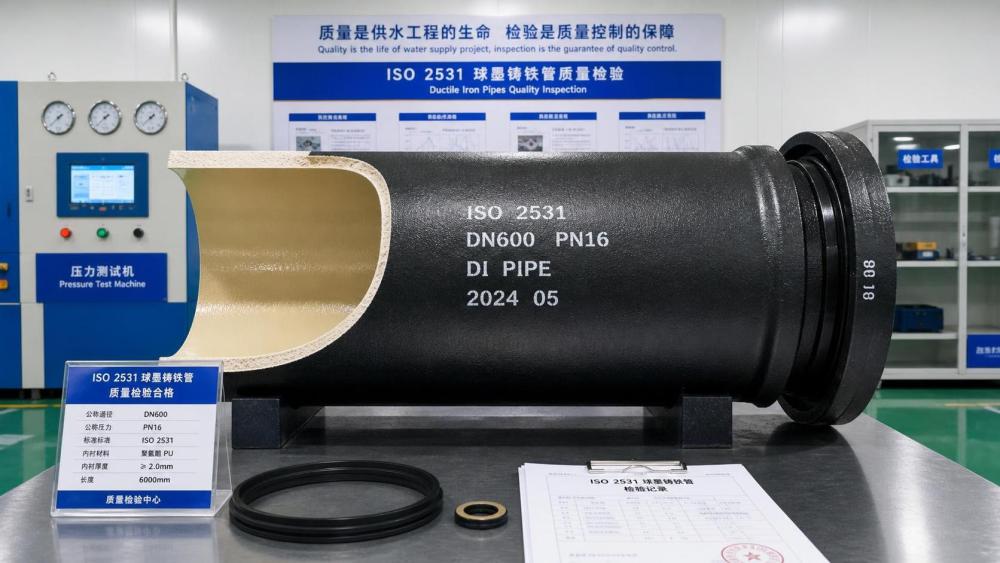
2. Internal polyurethane lining quality
Polyurethane lining is selected because it offers strong chemical resistance, good abrasion behavior in many water and wastewater conditions, and a smooth internal surface. Those benefits only hold if the lining is applied consistently and bonded correctly.
The critical checks normally include lining thickness, continuity, cure condition, adhesion, holiday testing if required by the specification, and visual freedom from pinholes, blistering, sagging, delamination, cracks, exposed substrate, or contamination. Edges near the spigot and socket zones deserve extra attention because these areas see handling stress and installation contact.
A lining that looks smooth from one end can still hide local defects. Ask how inspection is performed along the full barrel length, not only at sampled points. If the manufacturer relies heavily on visual acceptance without documented process control, that should raise questions.
3. Hygiene and water contact compliance
For potable water systems, the lining cannot be judged only on corrosion resistance. It also needs to be suitable for contact with drinking water under the project’s regulatory framework. The exact approval route depends on country, utility standards, and tender documents. In some markets, a pipe may meet ISO 2531 for the ductile iron component but still require separate proof for coating or lining contact safety.
If the project involves drinking water, ask for current hygiene-related declarations, test reports, or approvals relevant to the destination market. Do not assume that a certificate valid in one country automatically satisfies another authority. This point often becomes a late-stage delay in export projects.
Pressure testing matters, but it is not the whole risk picture
Another frequent misunderstanding is that successful hydrostatic testing means the product is fully compliant. Pressure tests are essential, but they mainly confirm structural and leak-tightness performance under defined conditions. They do not by themselves confirm long-term lining adhesion, chemical durability, or installation robustness.
For that reason, a solid inspection file should connect several layers of evidence:
- Pipe body dimensions and tolerances
- Mechanical and hydrostatic test records
- Lining application procedure and inspection records
- Coating and lining repair rules
- Batch traceability from melt or production lot to finished pipe
- Marking that remains readable through delivery and site receipt
If one of those pieces is missing, you may still have a usable pipe, but you do not have a strong compliance position.
Where projects usually get exposed
In actual water infrastructure work, the biggest problems are often not exotic technical failures. They are ordinary control gaps that nobody closed in time.
One is damage after factory release. Polyurethane lining can be damaged by impact, dragging, poor stacking, uncontrolled lifting tools, or careless cutting. If site teams treat lined ductile iron pipe the same way they treat unlined heavy pipe, defects appear quickly at the ends and inner bore. The pipe may still look acceptable from the outside.
Another is unclear responsibility between supplier, contractor, and inspector. A manufacturer may certify the factory condition. The contractor may assume that is enough. The site inspector may only perform a visual check on the outside surface. Then a damaged internal lining is discovered after installation, when repair becomes expensive and accountability becomes blurry.
A third issue is poor control of field modifications. If pipes are cut, beveled, or adapted on site, the exposed iron and lining termination need a repair procedure approved for the service environment. This is not a minor detail. In aggressive water or variable flow conditions, cut-end treatment can become the weak point of the whole line.
What a careful incoming inspection should look like
You do not need a theatrical inspection routine. You need a disciplined one. For most projects, incoming inspection should confirm identity, condition, and document consistency before the pipes are released to installation.
A practical receiving check usually includes:
- Verification of marking, diameter, pressure class or relevant classification, manufacturer ID, and production traceability
- Review of certificates, inspection reports, and any lining-specific test records required by contract
- Visual inspection of pipe ends, socket areas, internal lining continuity, and external coating condition
- Confirmation that gaskets, fittings, and joint components match the approved system
- Segregation of damaged or questionable pipes before they reach the trench
The useful habit here is simple: inspect the pipe as a system component, not as an isolated commodity. A perfectly acceptable barrel paired with the wrong gasket compound or mismatched joint profile can still create a non-compliant installation.
Not every water project needs polyurethane lining
This is worth saying clearly. Polyurethane lining is not automatically the right answer for every water pipeline. It tends to make sense where internal corrosion resistance, abrasion resistance, or demanding raw water and wastewater conditions justify it. In some drinking water networks with stable water chemistry and a different asset strategy, another lining system may be specified. The right choice depends on fluid characteristics, flow regime, expected solids content, maintenance access, lifecycle target, and local approval requirements.
So if a supplier promotes polyurethane-lined pipe as the universal premium option, treat that with caution. Better performance only matters when it matches the service condition and the utility’s maintenance reality.
Documentation is part of compliance, not a paperwork extra
Quality and safety teams usually feel pressure to move pipe quickly from delivery to installation. That is understandable. Still, poor documentation control is one of the fastest ways to create hidden project risk.
At minimum, the file should let you trace what was supplied, how it was tested, which standard basis was used, and whether the lining system matches the specified service. If documents use vague phrases such as “equivalent to standard” or “tested according to internal method,” ask for the exact basis. In standard-driven infrastructure projects, approximate language is rarely enough.
This is also where structured technical platforms can help. Resources such as IMPE are useful when procurement teams or inspectors need a clearer view of how pipe material, lining systems, fittings, valves, and related standards connect in real project decisions. The value is not promotion. The value is faster technical judgment when multiple supply chain parties are using different terms for the same risk.
Before approval, ask these questions
Many disputes can be avoided if the review team asks a few blunt questions early:
- Is the pipe body certified to ISO 2531, and is that certification current and project-relevant?
- What test evidence exists for the polyurethane lining itself?
- Does the potable water project require separate hygiene approval in the destination market?
- How are cut ends, touch-up areas, and transport damage repaired and re-inspected?
- Who signs off the condition of the pipes at receipt and before installation?
If those answers are vague, the risk is already visible.
FAQ
Is ISO 2531 alone enough to approve polyurethane lined ductile iron pipes for drinking water?
Not always. ISO 2531 covers the ductile iron pipe framework, but drinking water projects may also require separate hygiene or coating-contact approvals depending on local rules.
What is the most commonly missed inspection point?
Internal lining damage at pipe ends and socket or spigot transition areas. These zones are often affected by transport and installation handling.
Can damaged polyurethane lining be repaired on site?
Sometimes yes, but only with an approved repair method, compatible materials, and a documented acceptance procedure. Not every defect should be treated as repairable by default.
Should pressure testing be treated as proof of full compliance?
No. It confirms important structural performance, but it does not replace checks for lining adhesion, hygiene suitability, dimensional accuracy, or traceability.
Closing view
For water projects, ISO 2531 polyurethane lined ductile iron pipes should be approved with the same mindset used for other critical infrastructure components: verify the substrate, verify the protective system, verify the records, and verify the site condition before installation. That approach is slower than accepting a certificate at face value, but it is much cheaper than investigating early lining failure, water quality complaints, or joint leakage after commissioning.
When the pipe, lining, documentation, and installation controls all line up, ISO 2531 polyurethane lined ductile iron pipes can be a dependable choice for demanding water service. When one of those layers is weak, the problem usually appears long after the paperwork looked complete.
Image Placeholder List
Suggested placement: after the section discussing internal polyurethane lining quality
Suggested image content: cross-section or inspection view of lined ductile iron pipe showing acceptable lining surface, pipe ends, and typical defect zones
Suggested alt text: Inspection points for polyurethane lined ductile iron pipe interior and pipe ends
Internal Link Anchor Text Suggestions
- ductile iron pipe lining types: guide page comparing cement mortar, epoxy, and polyurethane linings
- ISO 2531 pipe inspection checklist: standards or QA checklist page
- ductile iron pipe joint systems for water networks: technical guide page
- how to evaluate pipe coating and lining certificates: compliance or procurement guide page
- water project material traceability requirements: QA documentation topic page
External Authority Source Directions
- national or regional drinking water regulatory authority pages covering materials in contact with potable water
- official ISO standard publication or authorized standard summary source
- manufacturer technical documentation for polyurethane lining systems and approved repair procedures
Related News
- Using Industrial Air Blow Guns to Clear Chips Without Spreading DebrisOct 15, 2026Fluid Power Control Strategist
- Ductile Iron Pipe Valves: Which AWWA Standards Apply to Water Main Projects?Oct 15, 2026Dr. Elias Vance
- Why Vacuum Suction Cups Lose Grip on MDF in Woodworking MachinesOct 15, 2026CNC Kinematics Architect
- Choosing a Variable Displacement Piston Pump Manufacturer: What to VerifyOct 15, 2026Fluid Power Control Strategist
- Parallel vs. Angular Pneumatic Grippers for Confined Assembly StationsOct 15, 2026Fluid Power Control Strategist
- Die Castings vs. Investment Castings: Which Costs Less at Your Production Volume?Oct 14, 2026Foundry Phase-Change Fellow