
Does Welded Steel Pipe Coating Thickness Affect Life in Acidic Soil?
Does Welded Steel Pipe Coating Thickness Affect Life in Acidic Soil?
Does welded steel pipe coating thickness affect lifespan in acidic soil? For municipal contractors, EPC teams, water utilities, and industrial buyers, the answer is yes—but thickness is only one part of the corrosion-control system. In aggressive soil, a coating must do more than cover steel. It has to remain continuous through transport, welding, backfilling, soil movement, groundwater exposure, and years of service. A thicker coating can provide a more durable barrier and greater tolerance for minor damage, but it cannot compensate for poor surface preparation, unsuitable coating chemistry, unprotected field joints, or inadequate cathodic protection.
This distinction matters because buried welded steel pipe is often specified around pressure capacity and project cost before external corrosion conditions are fully understood. A pipeline may perform well in relatively dry, neutral soil with a conventional protective system, then face a very different risk profile where low pH, dissolved salts, seasonal saturation, industrial contamination, or stray electrical current are present. The practical question is not simply whether to specify a thicker coating. It is whether the selected coating system can maintain protection throughout the pipeline’s intended operating life.
Why Acidic Soil Changes the Corrosion Equation
Steel corrosion requires an electrolyte, and soil can become a very effective one when it holds moisture and contains dissolved ions. Acidic soil can accelerate electrochemical activity by supporting conditions that make corrosion products less protective and expose fresh steel more readily. Yet pH alone should not be used as the entire design basis. Two locations with a similar pH can create very different corrosion risks depending on resistivity, oxygen availability, chlorides, sulfates, moisture retention, soil layering, drainage, microbial activity, and the presence of nearby electrical systems.
Low-resistivity wet soil is generally more concerning than dry, high-resistivity soil because electrical current can move more easily through the electrolyte. Alternating wet and dry conditions may also be problematic: they can create localized differences in oxygen concentration along the pipe surface. Those differences can promote localized corrosion rather than uniform wall loss. For a welded steel pipeline, this is particularly relevant at girth welds, repaired areas, transitions between factory coating and field-applied coating, and locations where handling damage has exposed steel.
A soil investigation should therefore be treated as a design input, not as a late-stage compliance exercise. The project team normally needs to understand the actual route conditions, including groundwater behavior and changes in soil type along the alignment. A single sample taken from one excavation point rarely describes an entire transmission line, especially where a route crosses agricultural ground, industrial fill, road corridors, and low-lying areas.
What Coating Thickness Really Does
External coating reduces the area of steel in direct contact with the soil electrolyte. When the coating is properly bonded and free of discontinuities, it limits water and ion access to the steel surface. Increasing dry film thickness can improve the barrier path that moisture and corrosive species must travel. It can also provide more physical reserve against abrasion, impact, and minor surface irregularities.
That benefit is real, but it is not linear. Doubling nominal coating thickness does not automatically double pipeline life. Corrosion often begins at a holiday, pinhole, poorly coated edge, damaged area, or disbonded section—not through the intact center of a well-applied coating film. If the coating has weak adhesion, trapped contamination, insufficient cure, or mechanical damage, a thick layer may still fail early at its weakest point.
Thickness also has to be compatible with the coating material and application method. Some systems are designed as relatively thin, tightly bonded films; others are multilayer systems intended to combine adhesion, corrosion resistance, and mechanical protection. Applying any coating outside the manufacturer’s qualified range can introduce its own problems, such as poor cure, internal stress, cracking during bending, reduced adhesion, or inconsistent coverage around weld profiles and fittings.
In other words, the better specification is not “the thickest coating available.” It is a verified system with suitable chemistry, controlled application, measurable thickness, sound adhesion, repair procedures, and a clear interface with cathodic protection where that protection is required.
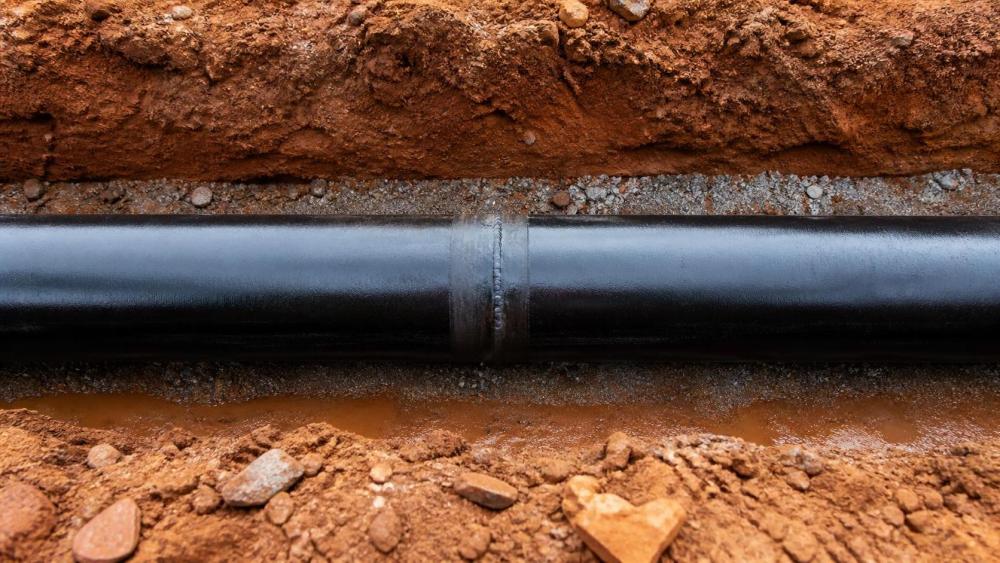
Thickness Matters Most When the Ground Is Harsh and the Installation Is Demanding
A thicker, mechanically robust external coating deserves closer consideration when pipe installation involves rocky backfill, trenchless crossings, congested rights-of-way, difficult lowering operations, or repeated handling. These conditions increase the chance that the pipe coating will be scratched, gouged, or stressed before the line is even commissioned. In acidic soil, small defects deserve more attention because the exposed steel may corrode more actively than it would in a benign environment.
The route may also include areas where inspection and repair will be difficult after burial. Under railways, highways, structures, water crossings, or densely developed utility corridors, future excavation can be expensive and disruptive. In such cases, lifecycle reasoning often supports a more conservative corrosion-control approach. That may mean greater coating durability, stronger field-joint requirements, improved bedding and backfill controls, or a cathodic protection design that accounts for realistic coating defect levels.
The Weld Area Is Often the More Critical Detail
For welded steel pipe, corrosion performance is heavily influenced by how weld areas are prepared and coated. Factory-applied external coating may be consistent across the pipe body, but field girth welds require a separate sequence: weld completion, surface cleaning, profile preparation where required, preheating or temperature control when applicable, coating application, curing, and inspection. A gap in any of these steps can create a local weak point.
Weld geometry deserves attention as well. Sharp edges, spatter, undercut, rough transitions, and residual contaminants can make it harder to achieve continuous coverage. Coating thickness readings taken on the straight pipe barrel do not prove that the field joint has equivalent protection. Specifications should state where measurements are taken, how repairs are accepted, and what evidence the contractor must provide before burial.
This is where procurement teams can avoid a common mistake: comparing supplier quotations only by nominal coating type and thickness. The more useful comparison includes surface-preparation requirements, inspection method, treatment of weld seams and cutbacks, repair materials, storage limits, field-joint procedures, and responsibility for final holiday detection. These details often determine whether the specified protection survives construction.
Coating Type, Surface Preparation, and Cathodic Protection Must Work Together
Different coating families respond differently to acidic soil, mechanical loading, installation temperatures, and field application conditions. Fusion-bonded epoxy, liquid epoxy systems, polyurethane-based coatings, tapes, and multilayer polyolefin systems are all used in pipeline practice under different project requirements. The appropriate choice depends on the service environment and the applicable project specification, rather than on a universal ranking.
Surface preparation is central to every option. Steel may arrive with mill scale, rust, oil, soluble salts, weld residue, or handling contamination. A coating applied over an inadequately prepared surface can lose adhesion even if its measured thickness is correct. Inspection should therefore go beyond dry film thickness. Depending on the selected system and project requirements, useful controls may include surface profile checks, cleanliness verification, environmental-condition records, adhesion assessment, cure verification, and holiday testing.
Cathodic protection is often considered for buried steel pipelines in corrosive conditions, but it should not be viewed as permission to accept poor coating quality. A coating reduces the exposed steel area that the cathodic protection system must support. When coating damage or disbondment is extensive, the current demand can rise and protection becomes more difficult to manage. Conversely, a well-coated pipeline with controlled defects can make cathodic protection more focused and efficient. The final arrangement should be developed by qualified corrosion and pipeline engineers using project-specific information.
How to Specify the Right Level of Protection
Before selecting a coating thickness, project teams should define the pipe’s operating role and exposure conditions. A potable-water transmission line, industrial process line, firewater main, slurry-related service, or temporary construction pipeline may have different risk tolerances and maintenance realities. External soil corrosion should also be considered separately from internal corrosion. Internal lining, water chemistry, flow conditions, and corrosion allowance can affect life from the inside, while external coating and cathodic protection address the buried environment.
A practical specification review should ask:
- What do route-specific soil and groundwater investigations indicate about acidity, resistivity, salts, moisture, and contamination?
- Which coating system is qualified for the anticipated installation method, operating temperature, and mechanical exposure?
- What nominal thickness range and minimum acceptance criteria does the coating manufacturer or governing specification require?
- How will factory coating, longitudinal seam areas, cutbacks, bends, fittings, repairs, and field joints be inspected?
- Is cathodic protection required, and has the design considered expected coating condition over time?
- Who records inspection results, approves repairs, and releases pipe sections for backfilling?
These questions turn coating selection from a catalog decision into an engineering and delivery decision. They also help distinguish between a low initial purchase price and a lower whole-life risk. A thin but correctly selected, well-bonded, carefully inspected system can outperform a thicker coating applied inconsistently. In truly aggressive soil, however, reducing thickness merely to lower material cost can leave little margin for construction damage and long-term degradation.
A Better Way to Review Pipe and Coating Offers
For buyers evaluating welded steel pipe, the most useful supplier documentation is evidence that the corrosion-control system can be produced and verified consistently. This may include material traceability, coating data sheets, application procedures, inspection plans, thickness records, repair procedures, packaging and handling instructions, and field-joint guidance. The exact document set depends on the project, but the principle is consistent: the coating must remain traceable from pipe manufacture through installation.
Global Industrial Machining & Piping Equipment Network (IMPE) organizes piping, coating, material-performance, and inspection topics in this broader context. For contractors and procurement teams, it is useful to connect steel grade, welding practice, coating design, installation conditions, valves, fittings, joint systems, and long-term maintenance rather than treating each item as an isolated purchase. That perspective is especially valuable where infrastructure renewal projects must balance technical reliability, construction practicality, and lifecycle accountability.
Coating thickness does affect the life of welded steel pipe in acidic soil, particularly by improving barrier performance and resistance to installation damage. But it is not a standalone guarantee. The durable answer comes from route-specific soil assessment, an appropriate coating system, disciplined surface preparation, protected field joints, verified inspection, suitable backfill practices, and cathodic protection where the corrosion assessment calls for it. Before finalizing a pipe schedule, confirm those interfaces in the project specification—not just the thickness printed on the coating certificate.
Related News
- How to Assess a Rigid Coupling Supplier for Bore Accuracy and Traceable QualityOct 08, 2026Tribology & Kinematics Expert
- Titanium Alloys Compared: Balancing Strength, Corrosion Resistance, and MachinabilityOct 08, 2026CNC Kinematics Architect
- Where Ductile Iron Dismantling Joints Reduce Alignment Risk in Water PipelinesOct 08, 2026Pipeline Metallurgy Scientist
- Selecting a Precision Bearing Sleeve: Fits, Runout, and Material ChoicesOct 08, 2026Tribology & Kinematics Expert
- Face Milling Cutters: How Insert Geometry Affects Finish on Steel and AluminumOct 08, 2026CNC Kinematics Architect
- Single-Acting Cylinders for Clamping: Stroke, Force, and Return Spring ConsiderationsOct 07, 2026Fluid Power Control Strategist