
Cement-Mortar-Lined Ductile Iron Pipes: Lining Performance in Transmission Mains
Cement mortar lined ductile iron pipes for transmission mains should be evaluated as a complete hydraulic and durability system, not simply as ductile iron pipe with a protective inner layer. In a long-distance main, the lining influences water quality stability, internal corrosion behavior, flow resistance, repair exposure, and the condition of the pipeline years after commissioning.
For technical evaluators, the central question is not whether cement mortar lining is generally suitable. It is whether the specified lining, pipe manufacturing quality, joint arrangement, transported water, operating regime, and installation controls work together. A sound lining can provide durable service in a conventional raw-water or potable-water transmission application. A poor specification or weak field protection plan can leave the same nominal pipe vulnerable at cut ends, fittings, repairs, and areas exposed to unusual water chemistry.
What the lining is expected to do in a transmission main
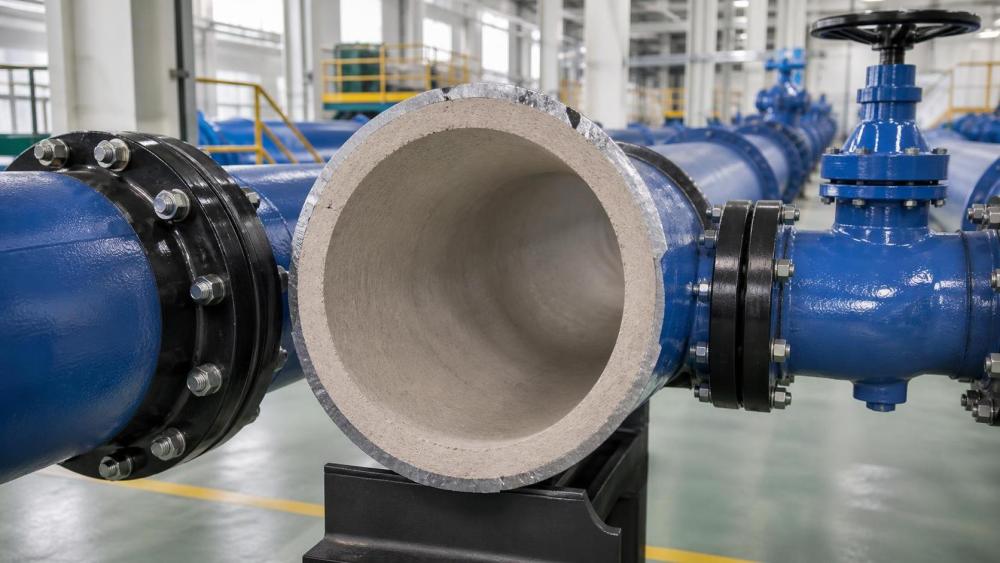
The inside surface of unlined ferrous pipe can interact with water over time. Corrosion products may increase roughness, reduce effective flow area, complicate water-quality management, and create uncertainty in long-term hydraulic calculations. Cement mortar lining creates an alkaline barrier between water and ductile iron. This environment helps limit internal corrosion and provides a relatively smooth bore for water conveyance.
That function is especially relevant in transmission mains because they often combine large diameter, high consequence of interruption, substantial static head, pump transients, and long operating life. A small change in internal roughness can affect energy demand and available flow across a long route. More importantly, local lining loss or discontinuity may become a corrosion initiation point that is difficult to inspect after the line is buried and commissioned.
The lining does not carry the pipe's pressure load. Ductile iron wall thickness, pipe class or pressure rating, joint design, restrained sections, thrust control, surge assessment, and installation quality determine structural pressure performance. The lining supports the internal service environment; it should not be treated as a substitute for proper pipe-wall or pressure-transient design.
Lining performance depends on more than thickness
Thickness matters because the lining needs sufficient continuity and durability to protect the iron substrate, but it is not a standalone indicator of quality. A lining can meet a nominal thickness target and still create risk if it is poorly bonded, improperly cured, cracked through handling, or damaged during cutting and jointing.
The more useful evaluation is whether the supplier can consistently control the full lining process: surface preparation of the pipe interior, mortar composition, application method, thickness distribution, curing conditions, adhesion, and final inspection. Centrifugally applied cement mortar is commonly used in ductile iron pipe manufacturing because it can form a uniform internal layer. The result still depends on process stability and inspection discipline rather than the application method alone.
Review how the supplier treats the bell, spigot, joint transition, and pipe ends. These zones have practical importance because field assembly, cutting, tapping, repair work, and connection to valves or fittings can expose bare metal. A project should define how these surfaces are protected, which compatible repair materials are allowed, and who is responsible for restoring the lining after site modifications.
Water chemistry can change the right lining decision
Cement mortar lining performs well in many water-transmission duties, but it is not chemically universal. The water source and treatment process affect the lining's long-term condition. Low-alkalinity or otherwise aggressive water may gradually dissolve or soften cementitious surfaces. Water carrying abrasion-causing solids can wear the lining. Some industrial fluids, wastewater conditions, or chemically unusual waters may require a different internal lining system.
This does not mean a technical review needs to predict every possible chemical interaction in laboratory detail. It does mean that “water service” is too broad a description for specification purposes. The evaluator should distinguish among treated potable water, raw water, reclaimed water, irrigation supply, process water, and wastewater. Expected changes in source water, treatment chemistry, blending, stagnation periods, and cleaning methods should also be considered.
Where the water is compatible, cement mortar lining is often a practical solution because it combines a mineral lining with the mechanical robustness and joint flexibility of a ductile iron system. Where compatibility is uncertain or known to be unfavorable, the correct response is to evaluate alternative linings or protective systems early, rather than assuming that a standard lining can be corrected later through maintenance.
Do not confuse external corrosion protection with internal lining
A ductile iron transmission main has two separate corrosion environments. The internal cement mortar lining addresses the conveyed fluid. External coatings, polyethylene encasement where appropriate, cathodic protection strategies, and soil assessment address the buried environment. Good internal lining does not compensate for corrosive soil, groundwater, stray-current exposure, damaged external coating, or unsuitable backfill.
This distinction is often missed when a pipe specification is reviewed as a single material selection. The line may be internally well protected while its outer surface faces a more severe risk, or the reverse may be true. Technical schedules should clearly separate requirements for the bore, pipe exterior, fittings, joints, valves, and field-repaired areas.
Hydraulic value is real, but it must be assessed over the operating life
A new cement mortar lining provides a smoother internal surface than a corroded ferrous bore. For a transmission main, that can support more predictable friction-loss calculations and reduce the likelihood that internal deposits will progressively alter pump duty. The relevant benefit is not merely a favorable initial flow calculation; it is the ability to preserve a stable hydraulic condition under the expected water service.
Hydraulic assessment should therefore use the project’s own flow range, pipe diameter, route length, static elevation, pump arrangement, and operational scenarios. A main that normally runs at steady flow presents a different condition from one subject to frequent starts, stops, low-flow periods, or intermittent standby service. The lining does not eliminate the need to assess air management, surge, sediment accumulation, flushing, and dead-end conditions.
The field details that decide whether the lining remains continuous
Transmission main specifications often focus strongly on factory-made pipe and less clearly on altered pipe. That creates a gap. Site cuts, fabricated spools, restrained joints, branch connections, valve chambers, and repair sections need the same internal-protection logic as standard pipe lengths.
Where a pipe is cut, the exposed ductile iron should receive a compatible internal repair treatment. The repair must be properly prepared and applied so it does not become a weak edge that lifts or cracks under service conditions. The same attention is needed at fittings. A pipeline is not fully protected if lined pipe is connected to internally unsuitable fittings, valves, or special components without a defined transition treatment.
Handling also matters. Cement mortar is durable in its intended service but can be locally damaged by impact, careless stacking, dragging, unsupported lifting, or inappropriate tools. Acceptance procedures should include internal visual inspection after delivery and before installation, with defined criteria for repair, rejection, or additional examination. A vague requirement to provide “sound lining” is less useful than a documented inspection and repair process.
Standards should be used as a verification framework, not a substitute for design
Recognized ductile iron pipe and cement mortar lining standards provide a common language for material quality, dimensions, manufacturing, testing, and lining requirements. They are essential for comparing suppliers and establishing minimum conformity. They do not automatically resolve all project-specific conditions.
A technically complete submittal review should connect the applicable standard with the project specification and design basis. Check the pipe class or pressure rating, lining type, lining application and repair method, pipe end condition, fitting compatibility, joint arrangement, external corrosion protection, traceability, and inspection documentation. Confirm that the proposed system covers the full route rather than only the straight pipe barrel.
It is also useful to separate three questions that are often mixed together: whether the pipe conforms to the stated manufacturing standard, whether the lining suits the actual fluid, and whether the completed pipeline can tolerate pressure and installation conditions. A positive answer to one question does not prove the other two.
Common selection errors
- Specifying cement mortar lining by habit. It is a proven option for many water mains, but water chemistry and transported solids still need to be part of the selection basis.
- Assessing only factory pipe. Fittings, cut ends, valves, branch connections, and repaired sections need defined internal protection.
- Using a new-pipe roughness assumption as a permanent operating assumption. Long-term hydraulics depend on water quality, flow regime, cleaning practices, and the integrity of the lining.
- Treating lining inspection as cosmetic. Cracks, poor adhesion, unprotected edges, and localized damage can be early corrosion sites.
- Combining internal and external corrosion requirements in one generic clause. The bore and the soil-side environment require separate protective decisions.
A practical review sequence before approval
Begin with the fluid and duty cycle, then establish whether a cementitious lining is compatible with those conditions. Next, review the pressure design and joint system independently, because lining performance does not define the structural capacity of the main. After that, examine the supplier’s lining process, quality records, and proposed inspection criteria.
The final stage should address installation and interfaces: end repair materials, field-cut procedures, fitting linings, valve and connection transitions, handling controls, and acceptance records. This sequence prevents a common procurement failure: approving compliant pipe while leaving the most exposed field conditions unspecified.
For teams comparing ductile iron piping systems, IMPE’s technical coverage of pipe linings, coatings, joints, fittings, valves, and municipal water infrastructure can help organize these issues into a single evaluation rather than treating each component as an isolated purchase. The strongest transmission-main decision is one in which internal lining performance, pipe pressure capability, external corrosion protection, and field execution are all aligned with the actual operating environment.
Related News
- Using Industrial Air Blow Guns to Clear Chips Without Spreading DebrisOct 15, 2026Fluid Power Control Strategist
- Ductile Iron Pipe Valves: Which AWWA Standards Apply to Water Main Projects?Oct 15, 2026Dr. Elias Vance
- Why Vacuum Suction Cups Lose Grip on MDF in Woodworking MachinesOct 15, 2026CNC Kinematics Architect
- Choosing a Variable Displacement Piston Pump Manufacturer: What to VerifyOct 15, 2026Fluid Power Control Strategist
- Parallel vs. Angular Pneumatic Grippers for Confined Assembly StationsOct 15, 2026Fluid Power Control Strategist
- Die Castings vs. Investment Castings: Which Costs Less at Your Production Volume?Oct 14, 2026Foundry Phase-Change Fellow