
Which Water Transmission Pipes Fit Long-Distance Municipal Supply Projects?
For a long-distance municipal supply line, the most dependable choice is often not one pipe material used everywhere. Water Transmission Pipes should be selected by dividing the route into operating and installation zones: a durable mainline material for typical buried sections, more adaptable pipe where alignment or settlement is difficult, and engineered steel sections where crossings, above-ground supports, or special geometry demand them.
Ductile iron is frequently a strong baseline for buried municipal transmission mains because it combines mechanical strength, practical jointing, and long service potential. Steel pipe can be the better fit for large diameters, high internal loads, restrained crossings, custom bends, and exposed installations. Plastic pressure pipe may suit selected lower-risk segments where operating pressure, external loading, temperature, and local installation conditions are compatible with its structural behavior. The correct decision comes from the hydraulic profile and route risk, not from unit price or a preference for one material.
Start with the pressure envelope, not the nominal pressure class
A transmission main experiences more than its normal pumping pressure. The pipe wall, joints, fittings, valves, and restraints must work as one system under normal operation, pump starts and stops, valve actions, elevation changes, and transient events. A pipe selected only for steady-state pressure can become the weak point when flow changes rapidly.
Build the selection around a pressure envelope that includes the highest anticipated operating condition, vacuum risk where applicable, and hydraulic transients. Long rising mains, pumped systems, and routes with sharp elevation changes deserve particular attention. Surge control equipment may reduce the demand on the line, but it does not remove the need to verify the pipe system against the conditions that can occur during abnormal operation.
This is also where material choice becomes practical. Ductile iron and steel have high stiffness and handle external loads differently from flexible plastic pipes. Flexible pipes can perform well, but their success depends more directly on bedding, side support, compaction quality, and control of deformation. For a route that passes through inconsistent fill, traffic areas, or deep burial, the installation assumptions should be treated as design inputs rather than site details to resolve later.
Match the pipe material to the route section
A municipal transmission route rarely has uniform ground, access, pressure, or maintenance conditions. Breaking the alignment into sections prevents a seemingly economical pipe choice from creating expensive exceptions during construction.
For many long-distance projects, ductile iron pipe provides a balanced answer where a route includes normal buried work, changing soil conditions, access constraints, and frequent connections to conventional valves and fittings. Its mechanical behavior is useful where construction tolerances are not perfect and where the line may later be exposed to nearby utility work or traffic-related loading.
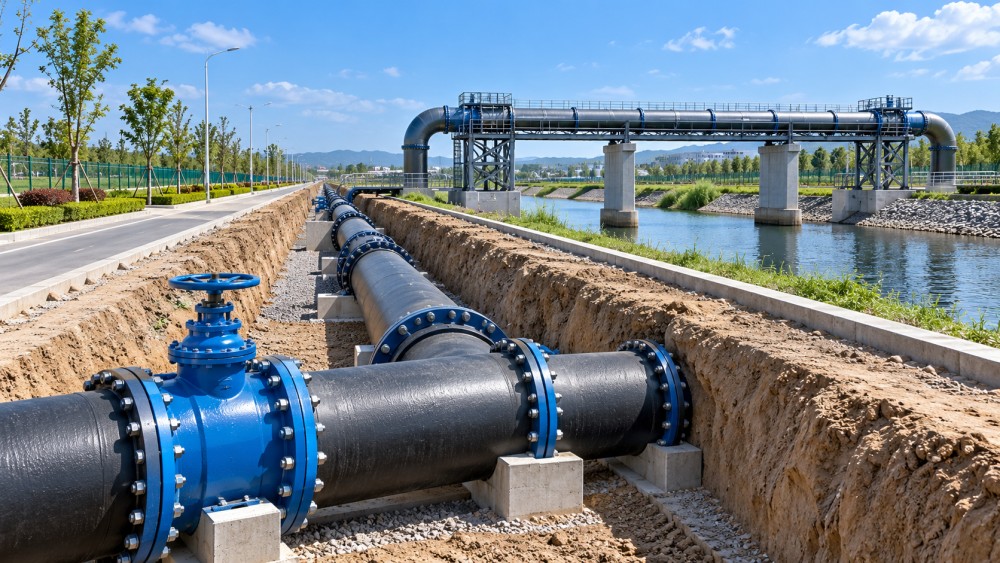
Steel is often chosen where geometry matters as much as straight-line conveyance. Fabricated bends, special reducers, manifolds, crossings, and restrained above-ground sections can favor steel because it can be engineered into complex configurations. That flexibility comes with a quality-management requirement: coating systems, welded joints, interfaces with other materials, and field repairs need clear inspection hold points. Steel is not automatically the lowest lifecycle-risk choice when corrosion protection and site execution are weak.
Plastic pipe should not be ruled out simply because a main is long. It can be suitable where the route, pressure regime, and installation controls are favorable. However, it should not be selected solely for light weight or fast handling. The design team must account for how the pipe relies on surrounding soil support, how it responds to temperature changes, and how fittings, transitions, and restrained connections will perform. A flexible pipe installed in poorly prepared trench conditions can lose the advantage expected from its material properties.
Ground conditions often decide whether a standard specification is enough
Soil investigation should influence the pipe system, not merely trench depth and excavation cost. Groundwater, corrosive soils, stray-current exposure, unstable fill, expansive soils, rocky trench bottoms, and flood-prone areas each create different risks. A route may need more than one corrosion or bedding approach even when it uses the same pipe material throughout.
For metallic Water Transmission Pipes, external protection is a system. The base coating, any supplemental encasement or protective measures, the condition of field joints, and the treatment of fittings must work together. Small breaks in protective continuity can matter more than the thickness of a factory-applied coating elsewhere on the line. The project documents should state who inspects this work, how damage is recorded, and what repair method is accepted before pipe delivery begins.
Internal water quality matters as well. The interior lining must be compatible with the conveyed water and operational plan. Abrasive solids, aggressive chemistry, long periods of stagnation, disinfectant practices, and future source changes can all affect lining selection and expected maintenance. The appropriate question is not whether a lining is generally durable, but whether it is suitable for the water that will actually travel through that pipeline over its operating life.
Routes with settlement risk need special attention to joints and transitions. Flexible joints can accommodate limited movement, but they do not eliminate the need for controlled bedding and proper support at changes in pipe stiffness. The junction between a rigid structure and a buried pipeline, such as a valve chamber, pump station, reservoir connection, or bridge abutment, is a common location for concentrated movement and stress.
Joints, restraints, and fittings deserve the same scrutiny as the pipe barrel
A long pipeline can contain thousands of pipe joints, but its most severe loads often concentrate at bends, tees, reducers, valves, dead ends, and changes in direction. Treating fittings as ordinary accessories is a common procurement mistake. Their pressure rating, coating, lining, mechanical compatibility, and restraint arrangement must match the design basis of the entire system.
There are two broad ways to manage thrust forces: use concrete thrust blocks that transfer load into suitable soil, or use restrained joints and purpose-designed restraint systems that distribute the load along the pipeline. Both approaches can be valid. Thrust blocks depend on predictable bearing conditions and adequate time and space for construction. Restrained systems can be valuable in poor soils, confined corridors, steep slopes, crossings, and locations where excavation or curing constraints make blocks impractical.
The decision should be made early because it affects material quantities, installation sequencing, testing, and route design. A restrained section cannot be treated as an afterthought once fittings arrive on site. It needs identified lengths, compatible components, and a clear method for verifying the installed arrangement.
Joint selection also affects construction speed and recoverability. Push-on joints can be efficient for straightforward buried installation, while flanged, mechanical, welded, or special couplings may be needed at stations, structures, transitions, or repair-prone locations. Standardizing unnecessarily on one joint type can make the line harder to build and maintain. The better approach is to standardize where it reduces risk, while allowing deliberate exceptions at high-consequence locations.
Do not let hydraulic design end at pipe diameter
Diameter determines more than capacity. It influences headloss, pump energy, water age, flushing behavior, valve sizing, surge response, and the cost of isolation or repair. A line that appears economical because of a smaller diameter may create recurring operating costs or make future demand growth difficult to accommodate. Conversely, oversizing without considering turnover can create water-quality and operational challenges.
The selected internal lining and pipe roughness should be considered as part of the hydraulic model, especially where energy use and pumping duty are material project concerns. The model should reflect the planned pipe system rather than an assumed generic pipe. It should also test credible future scenarios, such as changed source conditions, phased demand, additional supply connections, or altered pumping arrangements.
Air management is another area that is easily postponed. High points, long grades, pipeline filling, drainage, and emergency emptying need a coordinated arrangement of air valves, washouts, isolation valves, chambers, and safe discharge paths. These components influence both operating reliability and the ability to commission the line without damaging it. A good pipe material cannot compensate for poor air-release or drainage design.
Evaluate installed value, not delivered-pipe cost
Comparing quotations by pipe length alone creates false savings. A complete comparison should include fittings, joints, restraints, coatings, linings, trench preparation, bedding, lifting equipment, field fabrication, testing, repair provisions, chambers, access requirements, and likely maintenance exposure. Some materials reduce handling effort but require tighter earthwork control. Others may cost more to deliver but reduce risk at complex interfaces or difficult crossings.
Availability also affects the practical choice. A technically appropriate pipe system can still delay a project if fittings, special joints, protective components, or repair materials are not available in the same delivery sequence as the main pipe. Procurement packages should require a coordinated bill of materials, not simply a pipe schedule. Material traceability, dimensional records, inspection documentation, pressure-test evidence, and clear packing identification help prevent site delays caused by mismatched components.
This is one reason structured technical comparison is useful before tendering. Platforms such as Global Industrial Machining & Piping Equipment Network (IMPE) organize information on ductile iron piping, fittings, valves, linings, coatings, joint systems, and material performance so technical and purchasing teams can compare the full system rather than isolated catalogue items.
A practical selection sequence before procurement
- Freeze the hydraulic duty: confirm flow range, static profile, normal operating pressure, transient scenarios, filling and drainage requirements, and expected future connections.
- Segment the route: identify standard buried sections, difficult soils, deep trenches, road or water crossings, structures, steep slopes, and areas with restricted access.
- Choose the primary pipe system: select the material and joint approach that suits most of the route without forcing unsuitable conditions into a standard detail.
- Design exceptions deliberately: define where steel spools, special fittings, restrained joints, extra corrosion protection, or alternate pipe systems are required.
- Review the interfaces: check valves, meters, chambers, pumps, reservoirs, existing networks, and transitions between pipe materials or stiffness classes.
- Make quality requirements executable: specify documentation, inspection stages, handling rules, coating repair procedures, joint installation controls, and pressure-test responsibilities.
The most effective outcome is usually a coherent pipeline system, not a single “best” pipe. For conventional buried municipal corridors, ductile iron often offers a robust foundation. Steel strengthens the solution at crossings and custom geometry. Other pressure pipe materials can serve appropriate route sections when their installation and operating assumptions are genuinely met. Selecting by pressure behavior, route conditions, corrosion exposure, joint strategy, and construction control produces a transmission main that is easier to build, test, operate, and maintain.
Related News
- Using Industrial Air Blow Guns to Clear Chips Without Spreading DebrisOct 15, 2026Fluid Power Control Strategist
- Ductile Iron Pipe Valves: Which AWWA Standards Apply to Water Main Projects?Oct 15, 2026Dr. Elias Vance
- Why Vacuum Suction Cups Lose Grip on MDF in Woodworking MachinesOct 15, 2026CNC Kinematics Architect
- Choosing a Variable Displacement Piston Pump Manufacturer: What to VerifyOct 15, 2026Fluid Power Control Strategist
- Parallel vs. Angular Pneumatic Grippers for Confined Assembly StationsOct 15, 2026Fluid Power Control Strategist
- Die Castings vs. Investment Castings: Which Costs Less at Your Production Volume?Oct 14, 2026Foundry Phase-Change Fellow