
What Defects Can Centrifugal Pipe Casting Machines Prevent in DI Pipe Production?
What Defects Can Centrifugal Pipe Casting Machines Prevent in DI Pipe Production?
In ductile iron pipe production, defects rarely begin as dramatic failures. More often, they start as small process instabilities: a slight fluctuation in mold speed, uneven metal distribution during pouring, poor thermal control, or a treatment window that drifts just enough to alter graphite formation. On the shop floor, these are “process issues.” In the field, they become leakage complaints, burst-pressure concerns, lining adhesion problems, or rejected lots during inspection.
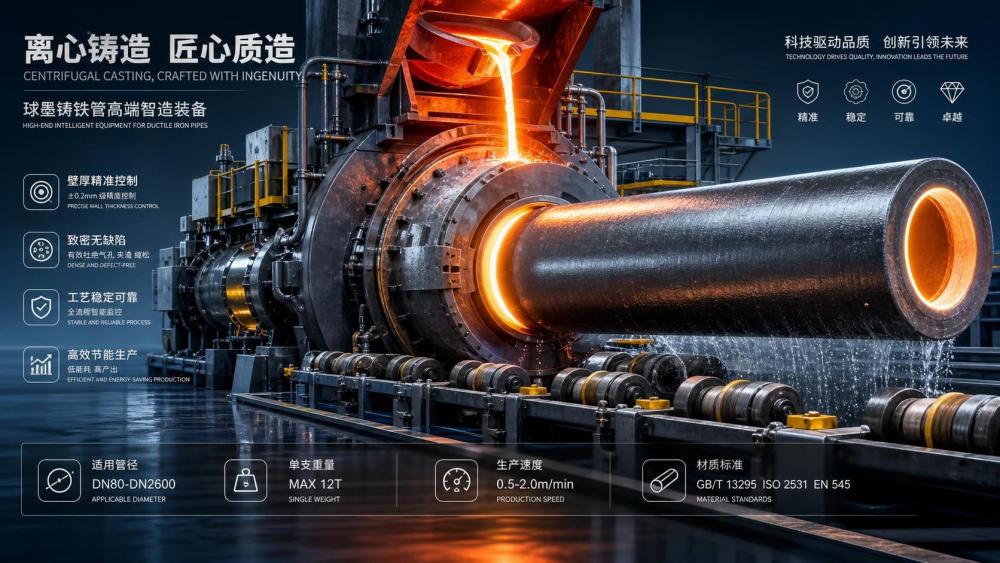
That is why Centrifugal Pipe Casting Machines matter so much. In DI pipe manufacturing, they are not just productivity equipment. They are one of the main control points for defect prevention. A well-tuned centrifugal casting line helps suppress wall thickness deviation, porosity, cold shuts, slag inclusion, surface laps, and even some downstream problems tied to unstable graphite structure. For quality and safety teams, the practical question is not whether the machine spins. It is whether it spins, cools, feeds, and stabilizes the metal in a way that consistently protects long-life pipe performance.
This is especially relevant in municipal water and pressure pipeline projects, where the expectation is not short-term acceptance but decades of reliable service. Across the heavy-industry sectors observed by IMPE, from ultra-precise CNC machining to fluid-system infrastructure, the pattern is similar: when tolerances and metallurgy drift early, the repair cost arrives much later and at a much higher price.
The machine does more than shape the pipe
Centrifugal casting for ductile iron pipe depends on a fairly unforgiving combination of variables: molten iron temperature, spheroidization quality, inoculation condition, mold rotational speed, pouring rate, mold coating behavior, and cooling intensity. The machine sits at the center of several of these interactions. If the rotation is unstable or the cooling profile is inconsistent, even well-prepared metal can produce questionable pipe.
In practice, the centrifugal mold creates the pipe wall by forcing molten iron outward against the inner mold surface while the pipe body solidifies from the outside inward. That sounds straightforward, but defect prevention depends on timing. Metal must spread quickly, remain fluid long enough to merge into a sound wall, and then freeze in a controlled way. If one part of that sequence goes wrong, the defect often looks “metallurgical” in inspection reports, even though the casting machine behavior contributed to it.
Wall thickness deviation: one of the first defects a stable machine should prevent
Wall thickness variation is not only a dimensional issue. It directly affects pressure class compliance, mass distribution, machining allowance at the socket and spigot, and sometimes coating uniformity later on. In severe cases, one side of the pipe ends up carrying more stress than intended.
A properly controlled centrifugal machine reduces this risk by maintaining steady rotational speed and balanced metal spread along the mold length. When speed fluctuates, the liquid iron does not distribute evenly. When pouring synchronization is poor, one zone may receive excess metal while another freezes too soon. Both conditions can produce eccentricity or local thin-wall sections.
This is one area where quality teams should be careful not to blame only the pouring operator. Repeated thickness deviation often points to a system issue: drive stability, mold alignment, wear in support rollers, or cooling imbalance. In other words, if the same geometry problem keeps returning, the machine is usually telling you something.
Porosity and gas-related defects are often reduced before they become visible
Porosity in DI pipe can come from several sources, including gas entrapment, metal cleanliness issues, or feeding and solidification problems. Not all porosity is caused by the casting machine, of course. Melt treatment discipline still matters. But machine conditions strongly influence whether a borderline melt turns into a reject.
The centrifugal process helps by compressing and distributing the molten metal under rotational force, which can improve wall compaction and reduce the chance of random internal voids compared with less controlled filling conditions. Stable pouring into a consistently rotating mold also lowers turbulence. That matters because turbulent metal flow tends to trap gas, disturb slag separation, and create discontinuities that are hard to detect until testing or machining.
Where plants get into trouble is assuming that high rotation alone will “fix” poor melt behavior. It will not. Excessive speed can create its own instability, especially if it interacts badly with temperature loss or coating condition. The practical takeaway is simple: the machine can prevent a large share of porosity-related defects, but only inside a controlled process window.
Cold shuts and poor fusion usually point to flow and thermal timing problems
Cold shuts are one of those defects that look deceptively minor at first glance. On a pipe surface, they may appear as a seam, fold, or incomplete fusion line. But under pressure service, such discontinuities are not cosmetic. They can act as weak points, especially if combined with local wall variation or inclusions.
A good centrifugal casting machine helps prevent cold shuts by keeping the metal front continuous during distribution. The combination of correct mold speed, stable acceleration, and predictable cooling allows incoming iron to merge before the earlier layer loses fluidity. If the mold speed is wrong for the metal condition, or if the metal stream arrives unevenly, the pipe wall can form in separate fronts that fail to knit together properly.
This is where experience matters more than slogans. In many shops, people describe cold shuts as a temperature problem. Sometimes they are. But just as often, they are a coordination problem between temperature, pouring rate, and machine response. The defect is visible at the surface; the cause is usually deeper in the process chain.
Slag inclusion and dross are not purely melt-shop problems
Everyone in foundry work knows inclusions start with melt cleanliness. Even so, the casting machine has a real role in whether non-metallic material stays dispersed, migrates to a less critical zone, or gets trapped in the pipe wall. Turbulence control is the key issue.
During centrifugal casting, smooth, repeatable metal entry helps avoid folding contaminants into the solidifying wall. A machine with poor speed control, vibration, or unstable mold condition tends to magnify turbulence. That makes it easier for slag or dross to become embedded rather than separated. Once trapped, inclusions can reduce local strength, interfere with machining, and create coating defects if they break out at the surface.
For QC teams, one useful habit is to compare inclusion patterns with machine condition records. If inclusions rise after roller wear, coating inconsistency, or cooling circuit drift, that correlation is worth investigating. The melt may still be part of the story, but not the whole story.
Surface defects often begin with mold behavior, not final finishing
Rough surface, laps, scabs, local peeling, and abnormal inner-wall appearance are often treated as finishing nuisances. That is risky thinking. Surface defects in DI pipe can signal unstable heat extraction, coating failure inside the mold, or poor metal flow during the first seconds of casting.
The machine helps prevent these defects by keeping mold motion smooth and cooling consistent. Water-cooled mold behavior is especially important. If cooling is too aggressive in one region and delayed in another, the solidification shell forms unevenly. That uneven shell can disturb the incoming metal layer and produce visible surface irregularities. In severe cases, these defects also complicate cement mortar lining or external coating performance later.
People sometimes underestimate this because the pipe may still pass a quick visual sort. But if surface instability shows up frequently, it is worth checking whether the issue comes from mold maintenance discipline rather than only from post-cast finishing settings.
What about graphite structure? The machine influences it indirectly
Ductile iron gets its toughness and pressure performance from spheroidal graphite, which depends mainly on magnesium treatment, inoculation practice, base chemistry, and thermal history. A centrifugal pipe casting machine does not create nodularity on its own. But it absolutely affects the thermal conditions under which that graphite structure is preserved or degraded.
If cooling and solidification are erratic, microstructural uniformity through the wall can suffer. In some cases, borderline treatment quality that might survive under stable casting conditions becomes more vulnerable when the process window widens too much. That is why experienced plants do not separate “metallurgy” and “machine” into two different worlds. They watch them together.
This integrated view is common in more mature heavy-industry operations. IMPE often frames it through a broader lesson seen across machining, forging, and fluid-system manufacturing: process physics and final reliability are linked much earlier than inspection reports suggest.
What quality and safety managers should actually monitor
If your goal is defect prevention rather than defect sorting, the most useful controls are usually the ones that reveal drift before product failure shows up. In centrifugal DI pipe casting, that often includes rotational stability, mold cooling consistency, pouring synchronization, and repeatability of pipe wall formation from one heat to the next.
A few practical checks tend to pay off:
- Trend wall thickness results by machine position, not only by batch.
- Investigate recurring surface or inclusion defects alongside maintenance logs.
- Watch for subtle changes after mold coating adjustments or cooling circuit service.
- Do not isolate metallurgical review from casting machine performance review.
- Where standards such as AWWA C151 or project-specific pressure requirements apply, confirm that dimensional and structural consistency supports the intended class, not just minimum acceptance.
That last point matters. Compliance is not only about passing one test piece. In municipal and EPC supply chains, consistency across production lots is what protects reputation and safety.
A machine cannot compensate for everything, but it can prevent a lot
The honest answer to the title question is that centrifugal pipe casting machines can prevent a significant share of the defects that most often compromise DI pipe reliability: wall thickness deviation, porosity, cold shuts, slag inclusion, and many surface-related irregularities. They also influence the thermal stability needed to protect sound graphite structure, even if they are not the root source of spheroidization itself.
What they cannot do is rescue poor melt preparation, weak process discipline, or neglected maintenance forever. In real plants, defect prevention comes from the overlap between metallurgy, machine dynamics, and inspection judgment. When one of those three gets treated as someone else’s problem, defects start to migrate downstream.
If recurring DI pipe quality issues are showing up in your line, it is usually worth asking a slightly tougher question than “Did this heat go wrong?” Ask whether the centrifugal casting system is holding the same process window, shift after shift, under real production conditions. That is often where the real answer begins.
Related News
- Using Industrial Air Blow Guns to Clear Chips Without Spreading DebrisOct 15, 2026Fluid Power Control Strategist
- Ductile Iron Pipe Valves: Which AWWA Standards Apply to Water Main Projects?Oct 15, 2026Dr. Elias Vance
- Why Vacuum Suction Cups Lose Grip on MDF in Woodworking MachinesOct 15, 2026CNC Kinematics Architect
- Choosing a Variable Displacement Piston Pump Manufacturer: What to VerifyOct 15, 2026Fluid Power Control Strategist
- Parallel vs. Angular Pneumatic Grippers for Confined Assembly StationsOct 15, 2026Fluid Power Control Strategist
- Die Castings vs. Investment Castings: Which Costs Less at Your Production Volume?Oct 14, 2026Foundry Phase-Change Fellow