
Water Transmission Pipe Pricing: Compare Material, Diameter, Lining, and Lifecycle Cost
Water Transmission Pipe Pricing: Compare Material, Diameter, Lining, and Lifecycle Cost
Water transmission pipe price is more than a unit-cost comparison. A quotation may show a price per meter, per ton, or per pipe length, but the eventual cost of a transmission main depends on far more: material selection, nominal diameter, wall thickness, pressure class, joint type, internal lining, external protection, delivery format, trench conditions, and the service life expected by the utility or project owner.
For project managers, the difficult part is rarely finding a low initial price. The difficult part is determining whether that price represents a pipe system that can be installed efficiently, withstand operating and surge conditions, maintain hydraulic performance, and remain manageable after years underground. A lower pipe purchase price can be offset by costly fittings, difficult welding, corrosion remediation, longer installation time, or a higher risk of future intervention.
This is why procurement teams should treat water transmission pipe pricing as a system-level decision. The pipe barrel matters, but so do bends, valves, restrained joints, flange adaptors, corrosion protection measures, testing requirements, and site logistics. For long-distance water supply, irrigation, industrial water, and network renewal projects, these items can change the commercial picture significantly.
Why a “Price per Meter” Is Not Enough
A meaningful comparison begins with a consistent scope. Two suppliers may both quote the same nominal diameter, yet one may include standard push-on joints while another quotes plain ends; one may include a cementitious lining and zinc-based external protection while another treats coatings as optional. If these differences are not identified early, the apparent savings may disappear during detailed design or construction.
The most useful question is not simply, “What is the water transmission pipe price?” It is, “What is included in the installed and operated pipeline section?” That question brings engineering, procurement, construction, and asset-management priorities into the same discussion.
A commercial comparison should clarify at least the following:
- Pipe material, grade, nominal diameter, effective length, wall thickness, and pressure designation.
- Internal lining and external coating system, including any special protection for aggressive soil or water conditions.
- Joint configuration, gasket material, restraint requirements, and compatibility with fittings and valves.
- Included fittings, specials, supports, couplings, flange connections, and field-repair provisions.
- Factory testing, inspection records, material traceability, packing, transport, and delivery terms.
- Expected installation method: open trench, jack-and-bore crossing, above-ground support, or other constrained work.
This does not mean every project needs the most elaborate specification. It means the project team should avoid comparing a complete engineered system with a basic pipe-only offer.
Material Choice Sets the Starting Price—and the Risk Profile
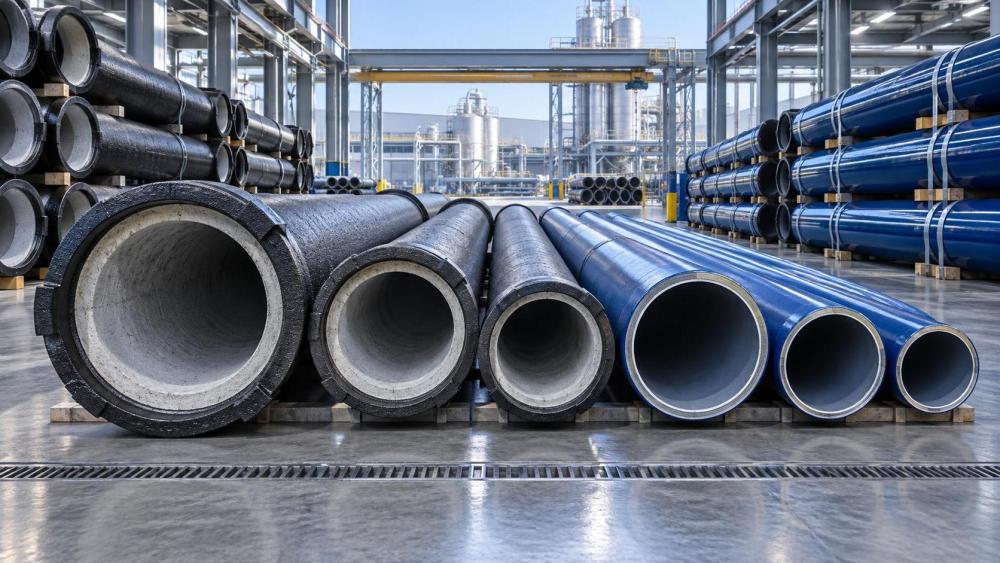
Ductile iron and steel are common choices for pressurized water transmission lines, while other materials may be considered for particular pressure ranges, installation conditions, or local supply preferences. There is no universal lowest-cost material because project conditions change the cost balance.
Ductile iron is often evaluated where the owner values mechanical strength, familiar installation practices, and durable buried-pipeline performance. Its price should not be assessed only by pipe mass. The lining, external coating, joint design, and pressure class are part of the delivered value. In difficult ground, restrained sections, crossings, or urban renewal work, the ability to manage deflection and connection details can matter more than a small difference in pipe-barrel price.
Steel can be commercially attractive where a project requires large fabricated diameters, non-standard bends, river crossings, elevated lines, or custom spool pieces. But steel pricing requires disciplined scope control. The base pipe price may look competitive until field welding, weld testing, coating repair, supports, and access constraints are included. For a route with many special connections, fabrication quality and dimensional coordination can be as important as the nominal material cost.
Diameter Is a Cost Driver, but Hydraulic Design Must Lead
Larger diameter generally means higher pipe cost, heavier lifting requirements, more expensive fittings, and greater freight volume. Yet selecting a smaller diameter merely to reduce procurement expenditure may create a long-term penalty through higher friction losses, increased pumping energy, or reduced capacity for future demand.
Transmission-main sizing should therefore begin with hydraulic requirements rather than a budget target. Required flow, allowable velocity, static head, friction loss, pump duty, transient conditions, and expansion plans all influence the economically sensible diameter. A pipe that is inexpensive at purchase can be expensive to operate if it forces avoidable energy use throughout its working life.
Diameter also affects construction strategy. Bigger pipes may reduce the number of parallel lines or increase future capacity, but they require wider trench space, larger bedding volumes, more capable lifting equipment, and more room for fittings and valve chambers. In congested corridors, the civil cost may be decisive. For this reason, pipe suppliers should receive enough route and installation information to quote the correct system rather than only a diameter and length.
Pressure Class, Surge, and Wall Thickness: Avoid Under-Specifying the Line
Pressure requirements are another major influence on water transmission pipe price. The design needs to account for normal operating pressure, static pressure at low points, pump start-stop events, valve closure, and other transient conditions. A project can become vulnerable when procurement treats pressure class as a simple catalog choice without reviewing the hydraulic profile.
Higher pressure ratings or thicker walls usually increase material use and production cost. They can also change the economics of fittings, valves, couplings, restraints, and thrust-control measures. This is not an area where cost cutting should be driven by assumptions. Transient analysis, where relevant, should be aligned with the selected pipe system and operating controls before the final procurement package is issued.
There is also a practical distinction between a pressure rating on paper and a system that has been properly coordinated. A pipeline with correctly specified pipe but mismatched valves, flanges, or joint restraints may still create commissioning risk. Engineering teams should verify interface details, particularly at pump stations, air valves, branch connections, and changes in direction.
Lining and Coating Are Not Optional Line Items
Internal linings influence water quality protection, flow characteristics, abrasion resistance, and long-term hydraulic condition. External coatings and corrosion-protection systems address soil chemistry, groundwater, stray-current exposure, moisture, handling damage, and the expected durability of buried assets. These selections affect price, but they should be viewed as risk-control decisions rather than decorative additions.
For many water applications, a cementitious internal lining is commonly considered because it supports a smooth internal surface and provides a proven approach for suitable service conditions. In more demanding duties, such as abrasive water, unusual chemistry, or industrial fluid service, the lining question may require a more detailed material review. The right answer depends on the conveyed medium, operating temperature, cleaning practices, and owner requirements.
External protection must be linked to actual site information. A generic coating package may be adequate in ordinary soil, while corrosive ground or high-consequence assets can justify additional protection. The decision should be based on available geotechnical and corrosion data, not on a blanket preference for either the cheapest or most elaborate solution. A delayed coating decision can also affect lead time, so it should be resolved before purchase orders are released.
Lifecycle Cost Changes the Procurement Decision
Initial supply cost remains important, especially when capital budgets are tightly controlled. But water infrastructure is expected to operate over a long period, often with limited access for repair. Lifecycle cost is therefore a more useful decision framework than purchase price alone.
A practical lifecycle review does not need to predict every future expense. It should identify the major cost exposures: energy consumption caused by hydraulic losses, expected maintenance needs, corrosion protection requirements, likelihood and consequence of failures, spare-part availability, outage impact, and access difficulty. A buried main beneath a major road, railway, industrial facility, or dense urban area deserves a more conservative view of repair risk than an accessible line in open ground.
The cost of leakage or interruption can also be larger than the repair invoice. It may involve water loss, service disruption, traffic control, excavation, environmental response, and reputational pressure on the asset owner. These risks are hard to capture in a simple pipe-price spreadsheet, yet they are often the reason experienced project teams resist over-optimizing the initial material budget.
How to Request Comparable Pipe Quotations
The quality of the request for quotation strongly affects the quality of pricing. A vague inquiry produces allowances, exclusions, and later clarifications. A structured request gives suppliers a clearer basis for material planning, manufacturing, inspection, and logistics.
At minimum, provide the design flow and pressure information, route profile where relevant, pipe diameter and length schedule, installation method, joint preference, lining and coating requirements, fitting schedule, valve interfaces, delivery location, desired delivery window, and documentation expectations. If soil conditions, water chemistry, or special crossings are known, include them. If they are not yet known, identify them as open design items rather than leaving suppliers to make incompatible assumptions.
Ask suppliers to separate pipe-barrel cost from fittings, coatings, accessories, freight, testing, and optional protections. This makes bid review more transparent. It also helps the project team see where a technically justified upgrade has a modest commercial effect and where it materially changes the budget.
A Better Basis for Water Transmission Pipe Decisions
The best water transmission pipe price is not necessarily the lowest quoted figure. It is the price of a coordinated pipe system that fits the hydraulic duty, installation environment, corrosion exposure, schedule, and expected service horizon. Material, diameter, lining, and pressure class should be compared together, not as disconnected cost items.
Global Industrial Machining & Piping Equipment Network (IMPE) organizes information on ductile iron pipe systems, steel piping, fittings, valves, corrosion protection, industrial fabrication, and related infrastructure equipment so that procurement and engineering discussions can begin with the right questions. Before selecting a supplier, confirm the operating conditions, interface requirements, documentation needs, delivery constraints, and long-term maintenance assumptions. That groundwork usually produces a more defensible budget than a unit-price comparison alone.
Related News
- How to Assess a Rigid Coupling Supplier for Bore Accuracy and Traceable QualityOct 08, 2026Tribology & Kinematics Expert
- Titanium Alloys Compared: Balancing Strength, Corrosion Resistance, and MachinabilityOct 08, 2026CNC Kinematics Architect
- Where Ductile Iron Dismantling Joints Reduce Alignment Risk in Water PipelinesOct 08, 2026Pipeline Metallurgy Scientist
- Selecting a Precision Bearing Sleeve: Fits, Runout, and Material ChoicesOct 08, 2026Tribology & Kinematics Expert
- Face Milling Cutters: How Insert Geometry Affects Finish on Steel and AluminumOct 08, 2026CNC Kinematics Architect
- Single-Acting Cylinders for Clamping: Stroke, Force, and Return Spring ConsiderationsOct 07, 2026Fluid Power Control Strategist