
Water Transmission Pipe Price Breakdown for Capital Budget Approval
Water Transmission Pipe Price Breakdown for Capital Budget Approval
For capital budget approval, a water transmission pipe price assessment must go well beyond the unit cost of pipe. A pipeline that appears economical in a supplier quotation can become a difficult investment to defend when fittings, corrosion protection, trench conditions, pressure testing, freight, commissioning, and future maintenance are added later. Conversely, a higher initial pipe package may be financially sound if it reduces construction uncertainty, limits outage risk, and provides a longer expected service life.
This distinction matters most on transmission projects. These mains carry large volumes over long distances, often through variable terrain and under operating pressures that leave little room for weak joints, unsuitable linings, or incomplete documentation. Finance teams do not need to redesign the pipeline, but they do need a cost structure that shows what has been included, what remains provisional, and where a low bid could create exposure after approval.
The practical question is not simply, “What is the water transmission pipe price?” It is: “What level of capital commitment is required to place a compliant, operable, and maintainable pipeline into service?”
Start with the Cost Boundary, Not the Pipe Rate
A pipe price can mean several different things. It may refer to a factory-gate rate per metre, a delivered rate to the project site, or a complete installed-system allowance. Treating these as interchangeable is one of the most common causes of weak capital estimates.
For approval purposes, it helps to separate the budget into four layers: the pipe system supply, delivery and handling, construction and installation, and project-specific risk or contingency. This makes it easier to compare bids that use different commercial terms and to identify costs that are still dependent on engineering decisions.
The cost boundary should be stated in the approval paper in plain language. For example, “pipe and fittings delivered to site” is materially different from “complete pipeline installed, tested, disinfected, and handed over.” A clear boundary protects both the finance function and the project team from approving a number that looks complete but is not.
What Drives the Water Transmission Pipe Price?
Diameter is usually the first visible cost driver, but it is not a simple linear relationship. Larger diameters use more material, require larger production and handling capacity, and often demand more specialized transport and lifting arrangements. They also influence trench width, bedding volume, jointing time, and the size of fittings and valves. A modest adjustment in hydraulic design can therefore affect multiple cost lines rather than the pipe rate alone.
Pressure class is equally important. The required operating pressure, surge allowance, elevation profile, and safety factors influence wall thickness or class selection. In ductile iron systems, the selected class affects metal content and weight. In steel systems, plate thickness, fabrication, welding requirements, and coating scope can shift significantly. A budget should not assume that a lower nominal working pressure always produces the better project cost; transient conditions and long-term reliability must be checked by the engineering team.
Material choice also changes the shape of the estimate. Ductile iron pipe is often considered where strength, joint performance, and established municipal installation practices are important. Steel pipe may be selected for special diameters, high-pressure duties, fabricated sections, or difficult geometry. Other materials can be appropriate in specific applications, but their suitability depends on pressure, temperature, water chemistry, support conditions, installation method, local requirements, and the owner’s maintenance capability. The correct comparison is between complete, technically acceptable systems—not between nominal pipe rates from dissimilar specifications.
Linings and coatings deserve close attention because they are often treated as secondary details during early budgeting. Internal lining affects hydraulic performance and protection against the conveyed water environment. External coating must suit soil corrosivity, groundwater conditions, installation damage risk, and, where relevant, marine or aggressive environments. A standard coating package may be adequate for one route and inadequate for another. If geotechnical and corrosion information is incomplete, the budget should identify that assumption rather than quietly applying a generic allowance.
Joint design influences both supply cost and field productivity. Push-on, restrained, mechanical, flanged, welded, and other connection approaches have different implications for alignment tolerance, deflection, thrust control, installation speed, and maintenance access. The lowest-priced joint is not automatically the lowest installed cost where the route contains curves, unstable ground, high thrust locations, or frequent interfaces with chambers and existing assets.
Fittings, Valves, and Interfaces: The Costs Often Underestimated
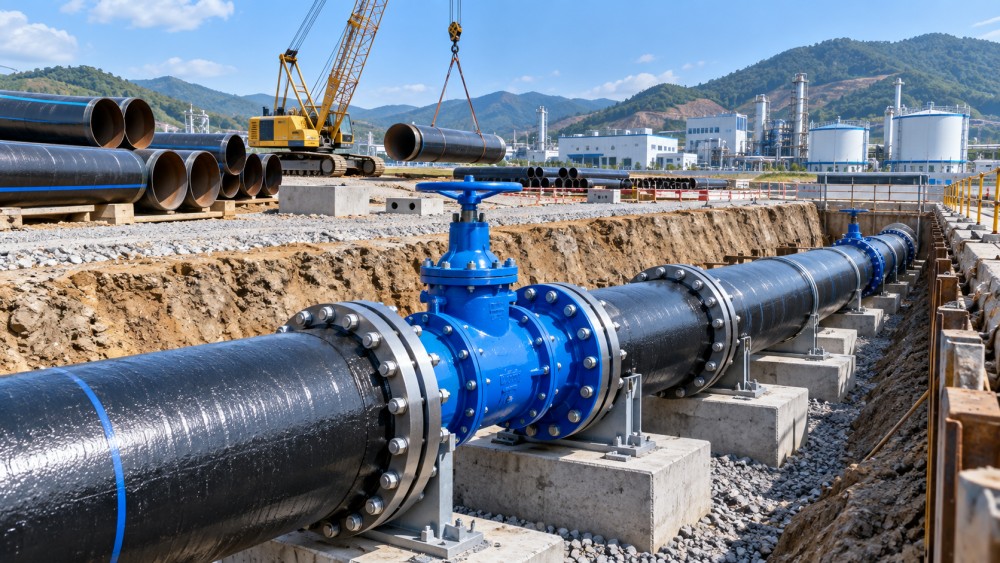
Long straight runs can make a pipe schedule look straightforward. The financial complexity usually appears at bends, tees, reducers, branches, air-release locations, washouts, chambers, river crossings, pump stations, and tie-ins to existing networks. These are not marginal items. Large-diameter fittings, special fabricated pieces, flange adaptors, dismantling joints, isolation valves, and restrained connections can account for a meaningful share of the package cost, particularly when the alignment is constrained.
A capital review should ask whether the bill of quantities is supported by an alignment and profile that are mature enough to identify these interfaces. If the design is still conceptual, a contingency may be more defensible than presenting an artificially precise fitting allowance. This is especially relevant where the transmission main must connect to older infrastructure with uncertain dimensions, nonstandard connections, or limited shutdown windows.
Thrust restraint is another area where material and civil costs meet. Changes in direction and pressure-related forces may require thrust blocks, restrained joints, anchors, or other designed measures. The appropriate solution depends on pipe material, joint system, soil bearing capacity, pressure conditions, and route constraints. Leaving this outside the initial estimate may make the pipe package seem cheaper while shifting a known requirement into later construction cost.
Installation Conditions Can Change the Investment More Than Material Selection
For many transmission projects, installation conditions are the largest source of cost uncertainty. Open-cut trenching in accessible ground is fundamentally different from work in congested streets, rock, high groundwater, contaminated soil, steep terrain, railway corridors, or environmentally sensitive areas. The pipe itself may be unchanged, but excavation support, dewatering, traffic management, disposal, restoration, and working-hour restrictions can substantially alter the installed cost.
Crossings require separate scrutiny. A road, watercourse, utility corridor, or rail crossing may involve casing pipes, trenchless methods, permits, monitoring, specialist contractors, or additional design reviews. These costs should not be hidden within a broad metres-of-pipe figure. They should appear as defined work packages or as transparent risk allowances tied to unresolved conditions.
Logistics should be evaluated with the same discipline. Pipe length, diameter, weight, coating vulnerability, storage time, delivery sequencing, and site access all affect the real delivered cost. Imported supply may be commercially attractive under some circumstances, but approval teams should confirm the delivery basis, lead-time assumptions, inspection points, packaging responsibilities, and who bears the cost of disruption or damage before the material reaches the trench.
Quality Documentation Is Part of the Capital Cost
A reliable transmission main depends on more than the physical pipe. Project documentation commonly includes material traceability, dimensional records, coating or lining inspection information, pressure-test requirements, manufacturing certificates, and evidence that the supplied system meets the stated project specification. The precise documentation package depends on the contract, applicable standards, and owner requirements, but it should be priced and reviewed rather than assumed.
Inspection requirements can influence supplier selection, lead time, and commercial terms. Third-party witnessing, factory visits, sample testing, hydrostatic tests, non-destructive examination for fabricated components, and pre-shipment checks may be justified on critical projects. Their cost is usually small compared with the impact of discovering a compliance issue after shipment or installation, yet they should be visible in the budget.
This is one reason structured technical review is valuable before financial approval. Global Industrial Machining & Piping Equipment Network (IMPE) organizes information on ductile iron piping, steel pressure pipe, fittings, valves, coatings, corrosion protection, manufacturing controls, and inspection practices so procurement and project stakeholders can connect technical requirements with commercial implications. The useful outcome is not a generic supplier comparison; it is a clearer understanding of what must be verified before a quoted price can be considered comparable.
Move from Purchase Price to Lifecycle Exposure
A capital budget is often constrained by the initial funding envelope, but transmission assets are expected to operate for decades. The financial review should therefore distinguish between a low acquisition cost and a low lifecycle risk. Relevant considerations include expected corrosion performance, joint integrity, ease of repair, access to compatible fittings, availability of replacement components, leakage consequences, energy implications of hydraulic roughness, and the disruption associated with taking a major main out of service.
Not every factor can be converted into a precise forecast at an early stage. That does not mean it should be ignored. A sensible approval document can identify qualitative risks, state the assumptions behind the chosen material and coating system, and require confirmation at the next design gate. This is more credible than assigning unsupported savings figures to one pipe option or another.
Lifecycle thinking also changes how alternatives are compared. A proposal with a higher supply cost may reduce construction complexity, improve tolerance to ground movement, or simplify future connection work. Another option may be justified because local contractors have stronger installation familiarity, established tooling, and ready access to spare components. The value of either approach depends on the project context, not on a universal ranking of pipe materials.
A Practical Approval Checklist
Before approving a water transmission pipe budget, decision-makers should be able to obtain clear answers to the following questions:
- What pipe material, diameter range, pressure class, lining, coating, and joint system form the basis of the estimate?
- Does the price include fittings, valves, restrained sections, flanges, couplings, and special fabricated components?
- Is the quoted amount factory-gate, delivered, or fully installed, and which party carries freight and unloading risk?
- Which route conditions have been confirmed, and which remain assumptions related to ground, groundwater, crossings, utilities, and reinstatement?
- What testing, inspection, traceability, and documentation are required before acceptance?
- What allowance has been made for commissioning, pressure testing, disinfection, tie-ins, and operational handover?
- Which risks are included in contingency, and who owns them contractually?
A concise answer set is more valuable to a capital committee than an oversized quotation pack. It exposes whether the estimate rests on a coordinated technical basis or merely on a material rate multiplied by route length.
Approve the System, Not a Fragmented Number
The water transmission pipe price should be treated as the starting point of a capital decision, not the decision itself. Pipe diameter, pressure duty, material, protection system, fittings, logistics, installation method, documentation, and lifecycle exposure all contribute to the final investment requirement. The most defensible budget is one that makes these dependencies visible and distinguishes confirmed scope from unresolved risk.
Before funds are committed, confirm the design basis, route assumptions, supply boundary, required quality records, and installation responsibilities. If those elements cannot yet be confirmed, record them as approval conditions or budget contingencies. That approach gives finance teams a clearer basis for approval while giving engineering and procurement teams a practical path to refine the project without losing sight of long-term network performance.
Related News
- Using Industrial Air Blow Guns to Clear Chips Without Spreading DebrisOct 15, 2026Fluid Power Control Strategist
- Ductile Iron Pipe Valves: Which AWWA Standards Apply to Water Main Projects?Oct 15, 2026Dr. Elias Vance
- Why Vacuum Suction Cups Lose Grip on MDF in Woodworking MachinesOct 15, 2026CNC Kinematics Architect
- Choosing a Variable Displacement Piston Pump Manufacturer: What to VerifyOct 15, 2026Fluid Power Control Strategist
- Parallel vs. Angular Pneumatic Grippers for Confined Assembly StationsOct 15, 2026Fluid Power Control Strategist
- Die Castings vs. Investment Castings: Which Costs Less at Your Production Volume?Oct 14, 2026Foundry Phase-Change Fellow