
Selecting Large-Diameter Water Transmission Pipes for Pressure, Surge, and Installation Risk
The decisive question in a large-diameter transmission main is not which pipe material has the highest nominal pressure class. It is whether the completed system can safely absorb its full operating envelope: normal pressure, transient pressure, external loads, joint movement, installation forces, and the consequences of a difficult repair.
For long water conveyance routes, an apparently small error in pressure assumptions, restraint design, trench preparation, or interface control can become a major programme and lifecycle risk. Large-diameter water transmission pipes must therefore be selected as a system rather than as individual pipe barrels. The pipe wall, lining, coating, joints, fittings, valves, anchors, thrust control, bedding, access arrangements, and construction method all contribute to the final risk profile.
Start with the pressure envelope, not the stated operating pressure
Static operating pressure is only one input. The design basis should distinguish between normal operating pressure, maximum sustained pressure, commissioning conditions, pump start and stop events, valve operations, emergency shutdown scenarios, and negative-pressure conditions. A pipeline that is adequate under steady-state flow can still be vulnerable when a pump trip, rapid valve closure, power failure, or air-release malfunction produces a transient event.
Surge analysis should be completed early enough to affect pipe class, joint selection, valve specification, pump controls, and pipeline profile. Treating surge as a late hydraulic check often forces expensive revisions: heavier wall sections, additional surge vessels, altered valve timing, larger air valves, or local redesign at high-pressure points.
The highest transient pressure does not automatically govern every segment of the route. Pressure varies with elevation, hydraulic grade line, pump duty, and transient wave behaviour. A practical design may divide the main into pressure zones or use different pressure classes along the alignment. This can reduce unnecessary material cost, but only where the transition locations, fitting compatibility, construction sequencing, and documentation are tightly controlled. A mixed-class pipeline with weak identification or poor site control creates its own installation risk.
Vacuum conditions deserve equal attention. Pipeline draining, column separation, pump failure, or inadequate air admission can impose external-pressure loading that differs fundamentally from internal-pressure design. Large-diameter pipes with thin walls may require specific verification for buckling resistance, especially at high points, river crossings, long downhill reaches, or sections subject to dewatering. Air and vacuum valve selection is therefore part of the pipeline’s structural protection, not merely an operational accessory.
Material choice changes the risk distribution
Ductile iron, steel, prestressed concrete cylinder pipe, reinforced concrete pressure pipe, and, in some projects, large-diameter thermoplastic or composite systems can all be technically viable. The relevant comparison is not a generic list of advantages and disadvantages. It is how each system behaves under the route’s pressure, ground, corrosion, jointing, logistics, and repair constraints.
Ductile iron pipe offers high inherent strength, robust handling characteristics, and widely used push-on or restrained joint arrangements. It is often well suited to buried pressure applications where construction teams need a tolerant system that can accommodate modest alignment adjustment. Its mass, however, affects lifting plans, transport loads, and placement productivity. External corrosion protection must be matched to soil aggressiveness, stray-current exposure, and local coating requirements rather than assumed from pipe material alone.
Steel pipe provides flexibility in diameter, wall thickness, fabricated fittings, special bends, and non-standard connections. It is frequently considered where high pressures, large spans, complex valve chambers, tunnels, crossings, or custom geometry make fabricated solutions attractive. Its performance is highly dependent on weld quality, field-joint coating restoration, corrosion protection, and control of ovality and alignment. The construction plan must allow for welding productivity, non-destructive examination where specified, coating cure time, and weather-related disruption.
Concrete pressure pipe systems can be appropriate for large trunk mains where their structural capacity and economics suit the route. Their selection requires careful review of joint performance, handling limits, transport geometry, bedding, and repair procedures. The project team should not assume that a pipe type suitable for open rural installation will carry the same programme risk in constrained urban corridors, deep excavations, or locations with frequent utility crossings.
Thermoplastic and composite options may offer corrosion resistance and lower handling weight in certain duty ranges, but their feasibility at large diameters depends strongly on pressure rating, stiffness, temperature, surge response, joining method, and local supply capability. Their lower modulus compared with metallic systems may change deflection, anchoring, and transient behaviour. A material that performs well in a corrosion-driven application may still be unsuitable where high surge pressure or severe external loading governs.
Material selection should therefore identify which risk is being transferred rather than eliminated. A heavier, more rigid pipe may reduce deformation concerns but increase lifting and transport demands. A fabricated steel solution may simplify a difficult connection but introduce field-welding and coating-control exposure. A corrosion-resistant pipe body does not remove the need to assess joints, fittings, bolts, valves, and appurtenant structures.
Joint behaviour is often more important than pipe barrel strength
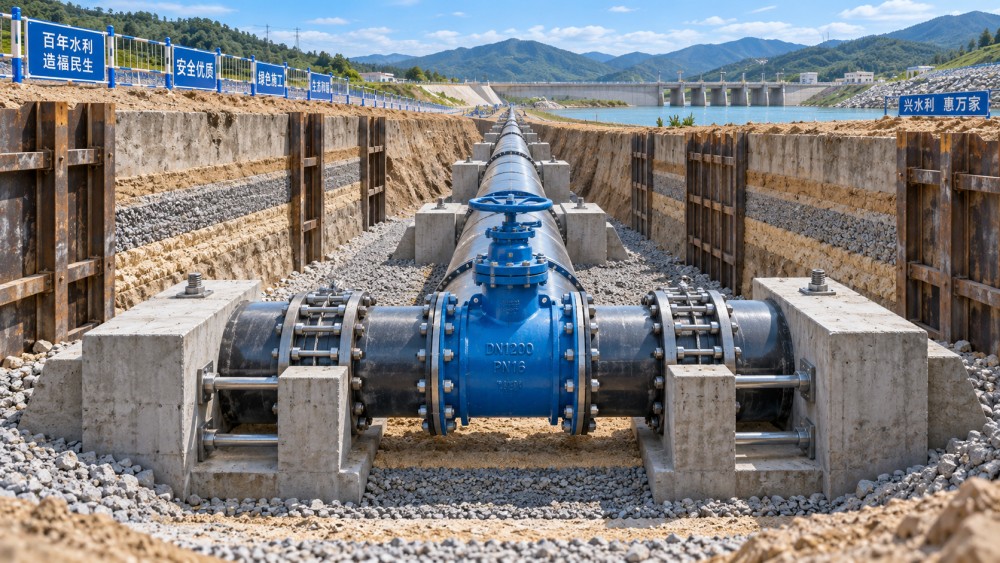
Large mains fail at interfaces more often than design discussions suggest. Changes in direction, diameter, material, pressure class, lining, or installation method concentrate risk at joints and fittings. The pipe schedule should make clear which joints are intended to be flexible, restrained, welded, flanged, mechanically coupled, or anchored in concrete structures.
Push-on flexible joints can accommodate limited angular deflection and settlement, but they do not automatically resist axial thrust. At bends, tees, reducers, dead ends, valves, and other changes in hydraulic force, the design must establish how thrust is transferred. Depending on the system and ground conditions, this may involve thrust blocks, restrained joints over a calculated length, welded or flanged connections, anchor blocks, or a combination of methods.
Thrust blocks are not a default solution. Their effectiveness depends on undisturbed bearing soil, correct orientation, adequate contact area, and separation from joints where movement is required. In soft, variable, saturated, or made ground, relying on thrust blocks without a verified soil basis can be unsafe. Restrained joint systems may offer a more predictable load path in these locations, but their installation quality, insertion depth, locking elements, and allowable deflection must be controlled.
Flanged joints need special scrutiny in chambers and above-ground installations. They offer accessibility and disassembly, yet are relatively rigid and sensitive to alignment, bolt tightening sequence, gasket selection, and support arrangement. A large valve or dismantling joint can impose substantial loads if the pipework is not independently supported. Flanges should not be used as a convenient remedy for poor dimensional coordination.
Installation conditions can overturn a technically sound pipe choice
The route should be divided by installation environment before procurement is finalized. Open-cut rural trench, congested urban street, deep excavation, rock trench, expansive clay, high groundwater, soft alluvium, slope, bridge attachment, jacked crossing, and tunnel installation place different demands on the pipeline system.
For buried pipes, the interaction between pipe stiffness and soil support is central. Bedding material, trench width, compaction method, sidefill quality, groundwater control, and backfill sequence affect line and level, deflection, coating damage, and joint performance. Specifications that state only a generic bedding requirement leave too much to interpretation. The project needs defined material gradation where relevant, compaction expectations, inspection hold points, and a clear approach for unsuitable foundation conditions.
Deep trenches introduce risks beyond the pipe itself. Shoring, dewatering, haul-road access, lifting radius, trench occupancy, and emergency access can determine daily output. A pipe system with longer individual lengths may reduce the number of joints, but it may also demand heavier cranes, wider work zones, and more restrictive delivery windows. Conversely, shorter lengths can be easier to handle in constrained corridors while increasing jointing time and inspection workload.
At trenchless crossings, the question is not simply whether the pipe can fit within the bore. Pulling loads, bending radius, external coating abrasion, weld configuration, buoyancy, annular grouting, and access-pit geometry need to be treated as a separate design package. Carrier pipe selection for horizontal directional drilling, microtunnelling, sliplining, or pipe jacking should be based on installation loads as well as final hydraulic duty. A pipe that meets service pressure requirements may not survive installation-induced stresses without modification.
Internal lining and external protection must reflect water and soil chemistry
Internal linings affect hydraulic roughness, water quality protection, abrasion resistance, and long-term maintenance. Cement mortar linings, epoxy systems, polyurethane coatings, and other protective approaches have different preparation, curing, repair, and service limitations. The decision should consider raw-water characteristics, treatment process, disinfectant regime, flow velocity, sediment load, temperature, and the expected duration of stagnation during commissioning.
External protection should be based on a route-specific corrosion assessment. Soil resistivity, moisture, pH, chlorides, sulfates, redox conditions, contamination, and stray-current exposure can vary substantially over one transmission corridor. A single coating strategy may be adequate for much of the route but insufficient at isolated aggressive sections, railway interfaces, industrial land, or crossings near electrical infrastructure.
For metallic systems, coating continuity at field joints is a recurring quality issue. The most durable factory-applied coating cannot compensate for poorly prepared, incorrectly applied, or uninspected field repairs. The specification should define surface preparation, compatible repair materials, minimum overlap, curing conditions, holiday testing where applicable, and acceptance records. Where cathodic protection is included, electrical isolation, continuity requirements, test stations, and future monitoring access must be coordinated with civil and mechanical works.
Fittings, valves, and chambers should be procured as a pressure-system interface
Large-diameter projects frequently encounter delay when pipes, fittings, valves, and chamber pipework are purchased under separate packages without a single dimensional responsibility matrix. Nominal diameter does not guarantee interchangeable dimensions. Outside diameter, flange drilling, face-to-face length, lining thickness, coating build-up, joint insertion depth, and allowable tolerances can differ between systems and standards.
Before release for manufacture, the project should reconcile pipe schedules with general arrangement drawings, valve data sheets, thrust arrangements, dismantling joint travel, actuator clearances, support locations, and access requirements. This is particularly important at flow meters, air valves, pressure-reducing stations, pump stations, branch connections, and reservoir inlets where several disciplines converge.
Standards can provide a common technical language, but citing a standard number alone is not enough. Depending on the jurisdiction and pipe material, specifications may refer to AWWA, EN, ISO, national standards, or utility-specific requirements. The contract documents should identify the governing edition, pressure terminology, test requirements, allowable tolerances, coating and lining requirements, marking, traceability, and any hierarchy where documents conflict. Requirements for potable-water contact materials may also be regulated separately from structural pipe standards.
Factory quality records matter only when they support site decisions
Material certificates, hydrostatic test records, dimensional reports, coating records, and traceability marks are valuable when they can be linked to the delivered pipe and to the installed chainage. They are less useful when collected as disconnected turnover paperwork after installation has progressed.
A workable control plan connects factory release, delivery inspection, storage, installation, testing, and handover. It should address pipe identification, damage inspection on arrival, handling restrictions, gasket storage, joint cleanliness, weld procedure qualification where applicable, field-coating inspection, survey records, pressure-test sections, disinfection requirements, and reinstatement of test failures. The same plan should define who can accept a nonconformance, particularly when coating damage, ovality, lining defects, or missing documentation is identified in the trench.
Hydrostatic testing requires early operational planning. Test section lengths, temporary bulkheads, water source, filling rate, air removal, pressure instrumentation, discharge arrangements, environmental permits, and access to repair locations affect both programme and safety. A test failure on a long, inaccessible section can consume far more time than the original pipe installation. Designing test segmentation around isolation capability and realistic repair access is often more valuable than maximizing test length.
Evaluate cost through recoverability, not only installed price
The lowest delivered pipe price can be misleading where the route is difficult or the consequences of failure are high. Cost comparison should include excavation width and depth, bedding, lifting plant, transport restrictions, jointing productivity, special fittings, restraint, corrosion protection, testing, spare parts, commissioning duration, and likely repair complexity.
Recoverability is especially important for transmission mains beneath major roads, rail corridors, waterways, dense utilities, or developed land. A system that costs more initially but reduces the probability or duration of a future intervention may be justified without relying on broad lifecycle claims. The relevant question is specific: if a joint, coating, valve connection, or pipe section needs repair, can the work be isolated, excavated, accessed, and restored without disproportionate service or programme consequences?
Selection should end with a route-based decision record rather than a generic material preference. The record should show the pressure envelope, surge assumptions, vacuum checks, soil and corrosion conditions, installation zones, joint and restraint philosophy, interface dimensions, inspection requirements, and deviations requiring approval. That discipline makes large-diameter water transmission pipe selection more defensible because it ties the chosen system to the actual risks the project must manage, not to a catalogue comparison detached from the route.
Related News
- How to Assess a Rigid Coupling Supplier for Bore Accuracy and Traceable QualityOct 08, 2026Tribology & Kinematics Expert
- Titanium Alloys Compared: Balancing Strength, Corrosion Resistance, and MachinabilityOct 08, 2026CNC Kinematics Architect
- Where Ductile Iron Dismantling Joints Reduce Alignment Risk in Water PipelinesOct 08, 2026Pipeline Metallurgy Scientist
- Selecting a Precision Bearing Sleeve: Fits, Runout, and Material ChoicesOct 08, 2026Tribology & Kinematics Expert
- Face Milling Cutters: How Insert Geometry Affects Finish on Steel and AluminumOct 08, 2026CNC Kinematics Architect
- Single-Acting Cylinders for Clamping: Stroke, Force, and Return Spring ConsiderationsOct 07, 2026Fluid Power Control Strategist