
Nodular Ductile Iron: Which Properties Matter Most in Pressure Pipe Design?
For pressure pipe design, the most consequential properties of nodular ductile iron are not simply its ultimate tensile strength. The priority is the relationship between yield strength, elongation, wall thickness, internal pressure, external loading, corrosion allowance, and joint performance. A pipe can satisfy a nominal material grade and still be poorly specified for its service conditions if those factors are evaluated separately.
Technical evaluators should begin with a practical distinction: material properties determine how the pipe body behaves, while pressure class and pipe-wall design determine whether the complete pipe can safely resist the design load. Tensile strength matters, but yield behavior and ductility often provide more useful information about reserve capacity under transient events, installation loads, settlement, handling damage, and local stress concentrations. For buried water and industrial pipelines, that distinction affects both specification quality and lifecycle risk.
Pressure Capacity Starts With Strength, but Does Not End There
Nodular ductile iron, also called spheroidal graphite iron, derives its performance from graphite formed as rounded nodules rather than flakes. This graphite shape reduces the stress-raising effect associated with gray iron and gives the material a more useful combination of strength and deformability. In pipe design, the immediate benefit is that a ductile iron wall can carry substantial hoop stress while retaining some ability to accommodate localized strain.
Internal pressure creates circumferential, or hoop, stress in the pipe wall. A preliminary pressure calculation therefore needs the pipe outside diameter, effective wall thickness, design pressure, design factors required by the governing standard, and any allowances incorporated into the product design. The material strength used in that calculation must align with the applicable pipe standard and the manufacturer’s declared grade. It should not be substituted casually with a catalog tensile-strength figure.
Yield strength deserves particular attention because it marks the transition from predominantly elastic behavior to permanent deformation. A pipeline subjected to routine pressure must remain within the intended design range, but accidental overpressure, pump starts and stops, valve closure, or pressure surges can impose short-duration loads above normal operating pressure. Higher yield strength provides reserve against permanent distortion. It does not, however, make surge analysis unnecessary.
Ultimate tensile strength remains relevant because it establishes the material’s resistance before fracture under a tensile test. Yet specifying the highest available tensile grade is rarely the whole answer. A higher-strength grade may be beneficial where wall thickness, pressure duty, or external load calls for it, but the selected grade must retain adequate elongation and must be compatible with the pipe manufacturing route, joint design, machining requirements, and project standard.
Why nominal pressure rating should not replace design review
Pressure ratings are useful procurement tools, but they are not a complete service description. They may be linked to a standard wall class, a particular safety basis, defined water service conditions, and assumptions about installation. The evaluation should identify whether the stated rating addresses continuous operating pressure, allowable working pressure, surge pressure, test pressure, or some combination of these. These terms are not interchangeable.
For a municipal transmission main, pressure cycling and surge events may drive the design more than the average operating pressure. For an industrial line, temperature, chemical exposure, pump duty, or non-water media can change both the pressure envelope and the suitability of linings, gaskets, and coatings. The pipe body cannot be evaluated in isolation from those conditions.
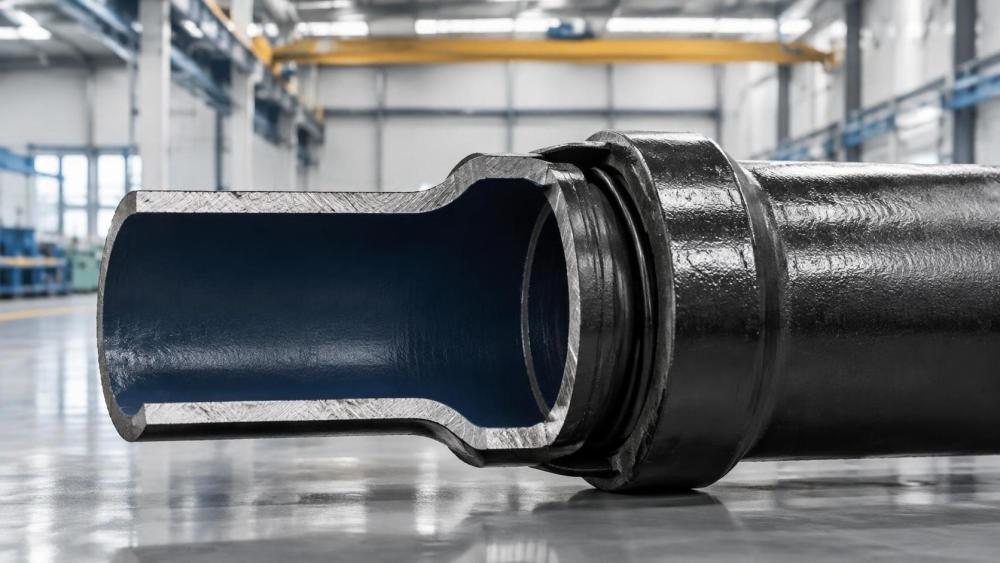
Elongation Is the Property That Makes “Ductile” Operationally Meaningful
Elongation is often treated as a secondary line on a material certificate after tensile strength and yield strength. In pressure pipe systems, it is a central reliability indicator. It reflects the material’s capacity to strain before fracture under the conditions of the tensile test. That capacity helps the pipe tolerate localized stresses that are difficult to model perfectly, including minor ground movement, handling impacts, support irregularities, restrained joint forces, and stresses around fabricated or cut sections.
This does not mean that ductile iron pipe should be expected to bend freely in service. Pipe deformation remains limited by wall stiffness, burial support, joint geometry, and the nature of the loading. The practical point is narrower: a ductile material gives a more forgiving failure margin than a brittle material when conditions depart from the ideal assumptions used in a design calculation.
Elongation should be read together with the test method, specimen location, material grade, and acceptance requirements. A reported value is only meaningful when it comes from representative production testing under the governing standard. Technical reviewers should be cautious when certificates provide broad material claims without clear traceability to the pipe lot, heat, production run, or relevant test procedure.
For pressure piping, adequate elongation has several implications:
- It improves tolerance to localized tensile stress caused by settlement, point loading, or construction-related damage.
- It provides more warning and deformation capacity before fracture than a lower-ductility iron structure.
- It supports field operations such as cutting, drilling, tapping, and fitting installation when those operations follow approved procedures.
- It helps preserve system robustness where joint movement, restraint design, and trench conditions cannot be treated as perfectly uniform.
High tensile strength with poor elongation can be an unfavorable trade when the pipeline will face variable support conditions or pressure transients. Conversely, a ductile grade does not compensate for undersized wall thickness or an unreviewed surge condition. Strength and ductility are complementary inputs, not alternatives.
Fatigue and Pressure Transients Can Govern Long-Term Performance
A static pressure calculation gives only one view of pipe demand. Many systems experience repeated changes in pressure caused by pump cycling, valve operation, flow reversal, hydraulic control sequences, or intermittent process duty. Repeated stress may be more significant than a single steady-state load, particularly where the system operates close to its design envelope for long periods.
Fatigue performance in nodular ductile iron is influenced by stress range, number of cycles, surface condition, graphite nodule quality, matrix structure, casting soundness, wall thickness, and local geometric features. A pipeline does not behave like a polished laboratory specimen. Changes in section at fittings, connections, restrained areas, field modifications, or damaged protective systems can create local conditions that deserve separate consideration.
Water hammer assessment should therefore be treated as a system exercise. Pipe material properties contribute to wave behavior and stress capacity, but the pressure event itself depends on line length, flow velocity, fluid characteristics, pipe stiffness, pump inertia, valve closure time, air management, and control strategy. Selecting nodular ductile iron because of its strength does not remove the need to calculate credible transient scenarios.
For critical lines, evaluators should ask for the operating pressure profile rather than only a nominal pressure. Useful design inputs include normal pressure range, expected maximum operating pressure, hydrostatic test condition, pump trip scenario, rapid valve closure scenario, frequency of cycling, and the specified method for controlling surge. A pressure class selected solely from normal working pressure can leave too little margin for the event that actually governs pipe stress.
Corrosion Protection Often Determines Whether Mechanical Properties Remain Relevant
The mechanical advantages of nodular ductile iron only deliver long service if the wall section is protected against its operating environment. External corrosion can reduce effective wall thickness over time, while internal attack can damage the flow surface, compromise water quality requirements where applicable, or accelerate localized deterioration. In aggressive conditions, corrosion protection becomes part of structural design rather than a finishing detail.
External conditions require a review of soil resistivity, moisture, pH, chlorides, sulfates, stray-current exposure, drainage, and the likelihood of disturbed or mixed backfill. No single field indicator defines corrosivity on its own. A coating appropriate for ordinary buried service may need supplementary protection where soil conditions are severe or variable. The selected system also needs to account for transport damage, field repair procedures, and continuity at fittings and connections.
Internal lining selection should follow the conveyed medium, operating temperature, flow regime, water chemistry where relevant, abrasion potential, and any applicable drinking-water or process requirements. Cementitious linings are common in many water applications, but they are not automatically suitable for every fluid or every chemistry. Industrial effluent, slurry, aggressive process water, and elevated-temperature duty can require a different lining approach and closer coordination with gasket and valve materials.
There is a design trap here: increasing wall thickness may provide corrosion allowance in some specifications, but it should not be used as a substitute for understanding the corrosion mechanism. Uniform wall loss, localized pitting, coating disbondment, and electrically induced corrosion have different implications. A robust specification states the intended protection system, inspection expectations, repair rules, and interfaces with cathodic protection or other mitigation measures when they are part of the project.
The Joint Can Be the Limiting Part of a Pressure Pipe System
Pressure pipe performance is a system property. The pipe barrel may have substantial strength and ductility, but leakage, separation, or displacement risk can originate at the joint. Push-on, mechanical, flanged, restrained, and specialized joints all serve different installation and loading conditions. Their selection must reflect pressure, surge, thrust, alignment tolerance, anticipated movement, installation access, and maintenance strategy.
At changes in direction, tees, reducers, dead ends, valves, and connections, hydraulic thrust must be managed. Depending on the project, that may involve thrust blocks, restrained joints, anchor arrangements, or a combination of measures. The required approach is affected by soil bearing capacity, trench geometry, joint restraint length, test pressure, and possible transient pressure. A pipe material certificate cannot demonstrate that this system-level restraint requirement has been addressed.
Joint flexibility is valuable in buried networks because it can accommodate limited angular deflection and settlement. It also has boundaries. Excessive deflection, unsupported transitions, poor gasket placement, contamination of sealing surfaces, and incorrect assembly depth can undermine a well-designed pipe selection. The specification should define compatible pipes, fittings, gaskets, lubricants, restraint components, and installation procedures rather than treating them as independently interchangeable items.
How to Prioritize Technical Review
For a conventional buried pressure-water line in stable soil, the most useful first review is usually the combination of design pressure and surge pressure, applicable pipe standard, wall class, minimum yield and elongation requirements, joint type, and corrosion protection. Those factors establish whether the proposed pipe system has a credible structural and environmental basis.
Where service conditions are less conventional, the sequence changes. A line exposed to aggressive soil may be governed by external protection. A pumped industrial system may be governed by transients and fatigue. A pipeline crossing poor ground, unstable slopes, or areas of anticipated settlement may place greater emphasis on joint movement, restraint, bedding, and ductility. A fire protection application may impose a distinct combination of standby conditions, test requirements, and connection details.
A focused technical submittal review should therefore establish the following before comparing suppliers or prices:
- The governing design and product standards, including the defined material grade and acceptance tests.
- The pressure envelope: normal operation, surge, test pressure, and any vacuum or negative-pressure condition.
- The pipe dimensions, wall class, tolerances, and any required corrosion allowance.
- Verified mechanical test documentation, traceability, and the manufacturer’s quality-control scope.
- External coating and internal lining suitability for the actual soil and conveyed medium.
- Joint type, gasket material, restraint design, fitting compatibility, and field assembly requirements.
- Installation assumptions, particularly bedding, backfill, cover depth, external loads, and settlement risk.
The most defensible specification for nodular ductile iron does not chase one maximum property. It establishes a balanced material and system requirement: sufficient yield resistance for pressure loading, enough elongation for practical robustness, a wall design appropriate to static and transient conditions, and protection that preserves the wall over the intended service life. When those elements are aligned, nodular ductile iron becomes a reliable pressure-pipe material for demanding infrastructure duty.
Related News
- Using Industrial Air Blow Guns to Clear Chips Without Spreading DebrisOct 15, 2026Fluid Power Control Strategist
- Ductile Iron Pipe Valves: Which AWWA Standards Apply to Water Main Projects?Oct 15, 2026Dr. Elias Vance
- Why Vacuum Suction Cups Lose Grip on MDF in Woodworking MachinesOct 15, 2026CNC Kinematics Architect
- Choosing a Variable Displacement Piston Pump Manufacturer: What to VerifyOct 15, 2026Fluid Power Control Strategist
- Parallel vs. Angular Pneumatic Grippers for Confined Assembly StationsOct 15, 2026Fluid Power Control Strategist
- Die Castings vs. Investment Castings: Which Costs Less at Your Production Volume?Oct 14, 2026Foundry Phase-Change Fellow