
When Do Flexible Manufacturing Systems Pay Off for Unmanned Machining?
Flexible manufacturing systems for unmanned machining pay off when they produce additional saleable parts at a lower total cost, with predictable quality and manageable interruption risk. More available spindle hours create an opportunity; repeatable processes, suitable work and sufficient demand turn that opportunity into financial value.
The strongest candidates usually have recurring part families, frequent setup changes and proven machining cycles that can run without routine operator intervention. The weakest candidates depend on manual adjustments, unpredictable tool life or inspection decisions that remain unresolved until someone examines the finished part.
Before comparing automation proposals, establish which production constraint the investment will remove. A system that reduces setup losses can be valuable even without running all night. A system purchased mainly for overnight capacity needs enough prepared work, tooling and downstream capacity to make those hours productive.
Start with the production constraint and the available work
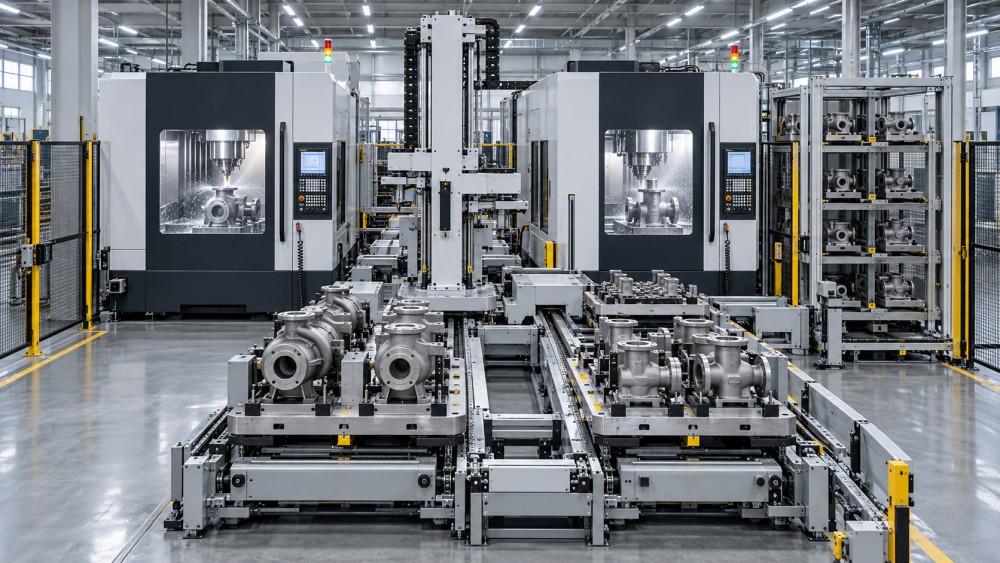
A flexible manufacturing system typically combines CNC machines, automated pallet or material handling, storage and scheduling controls. Its economic advantage comes from keeping suitable work available to the machines while preparation takes place outside the cutting cycle. The exact configuration varies, and machine compatibility must be established before assuming equipment can share work.
Consider a shop producing recurring pump housings and valve bodies in several variants. If fixtures can remain on pallets and approved programs can be recalled reliably, the system may reduce repeated setup work and allow different orders to run through the same cell. Its flexibility has value because the production mix changes while the underlying processes remain controlled.
However, a pallet store filled with work does not guarantee useful capacity. The queued jobs must have sufficient demand, available tools and compatible machine requirements. They must also reach inspection, deburring and assembly without creating a larger backlog elsewhere.
Review actual production records to distinguish cutting time from setup, waiting for operators, missing tools, inspection holds and maintenance. If the main losses come from unstable machining or unavailable material, automatic pallet movement will leave much of the original problem intact.
Which part families support a credible return?
Recurring work with different order quantities can suit an FMS well. Identical parts are not essential, but common production requirements make the system easier to operate economically. Group candidate parts by workholding, machine envelope, spindle requirements, tooling, material behavior and inspection method.
Batch size alone is a poor selection rule. Small batches can work when setups are repeatable and pallets can be prepared in advance. Large batches can still perform badly if chip accumulation, tool wear or part distortion repeatedly stops production.
Also examine how much of each part's route the proposed system covers. Automating one milling operation may deliver limited benefit if every component then waits for a manual second setup on another machine.
Unattended machining must work as a complete process
The practical question is how long the entire process can run before it needs human attention. That interval may be limited by tool life, chip storage, coolant condition, fixture capacity or the inspection plan. The shortest dependable interval determines the realistic unattended window.
Tooling and workholding need predictable limits
Tool life should be established under representative production conditions, including material variation and demanding features. Average life alone is insufficient when an early failure could damage several parts. Replacement rules, sister tools and suitable breakage detection can help control this risk, but detection capability must match the failure modes.
Workholding must locate and clamp each part consistently. Chips on locating surfaces, variable casting stock or incomplete seating can cause errors even when the CNC program is correct. Depending on the process, seating checks, clamping confirmation and probing may be necessary before cutting begins.
Tool capacity also affects the commercial value of flexibility. A broad product mix may require more tool positions, duplicate cutters and longer tools than the proposed machine can accommodate. Frequent manual tool changes can then consume the unattended hours used to justify the investment.
Inspection and recovery determine usable output
In-machine probing can check selected features, establish offsets and identify some loading errors. It does not automatically replace independent inspection. The quality plan must define which characteristics can be monitored during production, which require separate measurement and what happens when a result falls outside its permitted range.
Thermal drift deserves particular attention when production extends into periods with different ambient conditions. A process that holds tolerance during a staffed shift may behave differently after prolonged running. Validation should cover the intended operating window.
Ask how the system responds to a broken tool, failed probe check, missing pallet or machine alarm. A useful response may be to isolate the affected job and continue approved work elsewhere, where the equipment and scheduling controls support that behavior. Remote notifications help only when someone can act on them and the recovery procedure is clear.
Chip evacuation, coolant management and fire protection must also suit the materials and cutting processes involved. These requirements belong in the initial specification because they can affect equipment selection, operating procedures and the cost of unattended production.
Build the business case around good parts and cash flow
Additional machine availability is not the same as additional revenue. If the order book cannot absorb the extra output, the return must come from other measurable benefits, such as reduced overtime, lower setup effort, less subcontracting or deferred capacity purchases.
A practical annual model is:
Net annual cash benefit = contribution from additional saleable output + avoidable operating costs − additional recurring costs.
Use contribution after the variable costs of making and selling the extra parts, rather than their full sales value. Count only costs that will actually disappear. Redeploying an operator may increase capacity elsewhere, but it does not create a payroll saving unless staffing expenditure changes.
Keep each benefit distinct. For example, extra output and avoided subcontracting may describe the same production volume. Counting both in full would overstate the return. Similarly, lower work in progress can release working capital, but that release should be treated separately from recurring annual savings.
The installed investment should include more than machines and pallet handling:
- Fixtures, pallets, toolholders, duplicate tools and initial tool inventory.
- Software, control integration, program preparation and production-data connections.
- Machine modifications, foundations, utilities, guarding and installation.
- Inspection equipment, process development, training and commissioning.
- Production disruption during installation and the cash needed during ramp-up.
Recurring costs can include maintenance, software support, replacement components, energy, consumables and additional programming or planning effort. An FMS changes the work required to keep production moving; it rarely removes that work entirely.
Simple payback—installed investment divided by net annual cash benefit—provides an initial comparison when annual benefits are reasonably stable. For the investment decision, account for ramp-up, financing or the cost of capital, equipment life and major future expenditure through a discounted cash-flow assessment.
Test a conservative case with lower demand, fewer productive unattended hours and more intervention than planned. If the return depends on nearly perfect overnight running from the start, the proposal has little room for normal production variation.
Compare the FMS with the least expensive workable alternative
The relevant comparison is often an FMS versus several smaller improvements. Better fixtures, offline tool preparation, probing, standardized programs or improved scheduling may release enough capacity to address the immediate constraint.
A single-machine pallet pool can suit a narrower requirement where one machining center needs a queue of prepared jobs. Robotic machine tending may fit work that transfers predictably between loading, machining and unloading. A broader FMS becomes more attractive when coordinating multiple machines and changing part families produces additional value.
Machine redundancy requires careful examination. Two machining centers in one system do not necessarily provide interchangeable capacity. Spindle capability, axis travel, accuracy, tooling and approved programs must allow jobs to move between them. Otherwise, a machine failure can still stop every order assigned to that machine.
Expansion should also be priced as a defined project. Ask what adding a machine, pallet storage or new part family would require in controls, floor space, commissioning and production downtime. An expandable layout has value only if the future expansion is technically and financially practical.
Make supplier proposals prove the operating assumptions
Give potential suppliers the same representative production package: drawings, materials, tolerances, demand patterns, batch ranges, current cycle information, setup requirements and inspection expectations. Include difficult jobs and realistic product variation, rather than selecting only parts that are easy to automate.
Require proposals to distinguish cutting time, pallet transfer, tool changes, probing and other machine-occupied time. Scheduling assumptions should show how the system handles different cycle lengths, urgent orders, unavailable tools and equipment downtime. A simulation is useful when its inputs reflect the proposed production mix and its limitations are visible.
Acceptance criteria should cover production behavior as well as mechanical installation. Define the representative parts, dimensional requirements, operating duration, permitted interventions and recovery scenarios. Also establish who is responsible for fixtures, programs, interfaces and process performance when several suppliers contribute equipment.
Service capability affects the economics throughout the system's life. Review access to technical support, spare parts, control backups and software maintenance. A cell that depends on one integrator needs clear arrangements for fault diagnosis and restoring production.
Commit when the production evidence supports the financial case
Before placing an order, prove representative processes over the intended unattended window, including tool changes, inspection checks and controlled recovery from likely interruptions. Use those results to replace optimistic assumptions in the investment model.
Proceed when recurring demand supports the added output, the process can maintain quality without routine intervention, and a conservative cash-flow case meets the investment requirement. If those conditions are incomplete, target the missing capability first—whether it is tool-life control, repeatable workholding, inspection capacity or production planning.
The strongest purchase specification connects every major automation feature to a measurable production need. It shows which losses will fall, which good parts will increase and what resources will keep the system running. That is the point at which unattended capacity becomes a defensible investment.
Related News
- Why Is Your Heavy-Duty Piston Pump Losing Pressure Under Load?Nov 09, 2026Fluid Power Control Strategist
- Cartridge Valves for Manifold Blocks: Avoiding Cavity Fit ProblemsNov 09, 2026Fluid Power Control Strategist
- Large-Diameter Forged Rings: How Seamless Rolling Affects Grain FlowNov 09, 2026Foundry Phase-Change Fellow
- Sealed Heavy-Duty Roller Bearings: Choosing Seals for Dust and WaterNov 09, 2026Tribology & Kinematics Expert
- Sprockets and Chain Drives: What Determines Replacement Cost?Nov 08, 2026CNC Kinematics Architect
- Monoblock Hydraulic Control Valves: Flow Rating and Spool SelectionNov 08, 2026Fluid Power Control Strategist