
Tool Steel for Cutting Tools: D2 vs. A2 for Industrial Shear Blades
Tool Steel for Cutting Tools: D2 vs. A2 for Industrial Shear Blades
Choosing tool steel for cutting tools requires more than comparing hardness values. Industrial shear blades must resist wear without losing pieces of their cutting edge, often while processing material that varies in thickness, strength, surface condition, and flatness. D2 generally offers greater abrasive wear resistance; A2 typically provides higher toughness. The better choice depends on which failure mechanism actually limits production.
That distinction matters commercially. A blade that stays sharp longer but chips unexpectedly may cost more to operate than one requiring predictable regrinding. Conversely, selecting a tougher steel brings little benefit if the existing blades simply wear round during stable, repetitive cutting. Start with the used blade and the machine conditions—not the supplier’s hardness headline.
Read the worn edge before choosing the grade
Remove a blade at its normal maintenance point and inspect the working edge under suitable magnification. A broadly rounded edge, a consistent wear land, and gradually increasing burrs suggest progressive wear. Localized missing fragments, cracks, or isolated deep notches point toward a different problem. Record where damage occurs: near a mounting point, at the start of engagement, or repeatedly in one machine position.
Neither observation proves that the steel grade is wrong. Chipping can originate from excessive hardness, grinding damage, insufficient edge support, incorrect clearance, loose seating, or machine deflection. Uneven wear may reflect alignment rather than inadequate abrasion resistance. Changing from D2 to A2 can reduce sensitivity to some mechanical shocks, but it cannot compensate for blades contacting each other.
Also distinguish edge rounding from plastic deformation. If the edge rolls or mushrooms, lowering hardness to gain toughness may make matters worse. The investigation should separate abrasive wear, fracture, and deformation before anyone approves a material substitution.
What D2 and A2 actually change
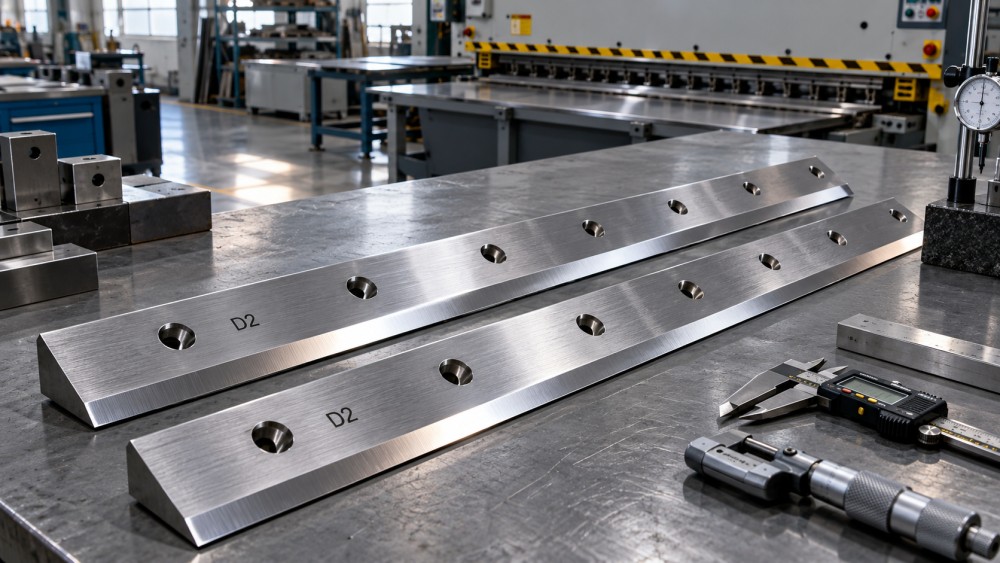
D2 and A2 are air-hardening cold-work tool steels, but their carbide populations differ. D2’s higher carbon and chromium content produces a substantial population of hard carbides that supports abrasive wear resistance. The trade-off is lower toughness than A2 under comparable, appropriate heat-treatment conditions. Carbide size, distribution, steel cleanliness, and processing route also influence performance.
A2 generally offers a more forgiving balance where edge fracture is the limiting concern. Its lower carbide content typically improves toughness and makes grinding easier, although it normally gives up abrasive wear resistance to D2. These are relative tendencies, not promises that every A2 blade will outlast every D2 blade.
D2’s chromium content does not make it a maintenance-free stainless blade. Both grades need appropriate protection during storage and service, particularly around water-based fluids or humid conditions.
Match the steel to the actual shearing conditions
Stable production with progressive wear: investigate D2
D2 is a strong candidate when a rigid, correctly adjusted shear processes consistent stock and blades are retired because their edges gradually lose sharpness. Repetitive sheet cutting with controlled feed, dependable blade support, and predictable material properties gives its wear resistance a useful operating window.
Abrasive surface contamination or scale may strengthen the case for D2, but inspect how that surface enters the cut. Hard scale can contribute both abrasion and localized loading. If damage consists of discrete chips rather than smooth wear, “more wear-resistant steel” is not yet a complete answer.
Variable engagement and recurring chips: investigate A2
A2 deserves consideration where approved work varies frequently, engagement is interrupted, or edge chipping ends blade life before abrasion does. A job shop changing between thicknesses and grades may value predictable edge survival more than the longest possible interval on one uniform material.
However, A2 is not automatically suitable for severe scrap processing, unknown hardened inclusions, or loads beyond the shear’s rating. Those conditions may require a different blade family, revised geometry, or a process change. Workpiece tensile strength, ductility, thickness, and cutting temperature all matter; the label “steel plate” is insufficient for selection.
Stainless sheet also warrants care. Work hardening, adhesion, and high cutting forces can complicate the wear pattern. Do not select D2 simply because the workpiece is stainless, or A2 simply because it is tough. Inspect the actual edge damage and verify machine capacity for the specific material.
Hardness, clearance, and geometry must be specified together
A hardness certificate is useful, but it is not an application specification. The target hardness should come from the blade supplier’s grade-specific heat-treatment guidance, the blade section, and the operating conditions. Increasing hardness may improve resistance to deformation while reducing the margin against fracture. Different microstructures can also produce similar hardness readings.
Clearance deserves equal attention. Too little can increase cutting forces and secondary shearing; too much can worsen rollover, burr formation, and cut quality. The correct setting depends on material and thickness as well as machine design. Use the equipment manufacturer’s guidance rather than treating one clearance percentage as universal.
Keep edge geometry distinct from machine rake. Edge geometry controls local support at the cutting edge, while rake affects how the cut progresses along the blade and the load pattern. If a D2 blade chips, reviewing edge support may be more productive than immediately changing grade. Any modification must preserve the intended cutting function and mounting compatibility.
Heat treatment and finish grinding can decide the outcome
Long shear blades need dimensional control as well as metallurgical quality. Both grades can change shape during heat treatment, despite their air-hardening classification. Section size, furnace loading, quench conditions, and straightening practice affect the finished result. “Air hardening” does not mean distortion-free.
Ask the manufacturer how it controls decarburization, achieves through-section properties, and verifies final straightness. Tempering practice and any subzero treatment should follow a validated route for the selected steel and dimensions. Subzero processing is not a universal upgrade; its purpose and place in the heat-treatment sequence need explanation.
Finish grinding is another failure point. Excessive heat can damage the edge through local softening, residual stresses, or cracking. A blade may meet dimensional requirements and still perform poorly. Require a suitable grinding procedure, adequate coolant delivery, and inspection appropriate to the consequence of failure. Regrinding shops need the same discipline as the original manufacturer.
What to put in the supplier enquiry
A useful enquiry gives suppliers enough information to challenge the proposed material. Include the workpiece grades and thickness range, machine model, blade drawing, normal clearance settings, current blade specification, and photographs of the failure pattern. State whether the purchasing objective is longer wear life, fewer chipped edges, shorter maintenance stops, or more consistent cut quality.
For procurement review, request:
- Material identification, the applicable specification and edition, and heat or batch traceability. Confirm claimed cross-standard equivalents rather than accepting “D2 equivalent” without qualification.
- The agreed hardness range, test method, measurement locations, and confirmation that the readings represent the finished condition.
- Drawing-based acceptance limits for straightness, parallelism, mounting features, surface finish, and edge geometry.
- Heat-treatment documentation and any agreed crack inspection, with acceptance criteria defined before production.
- Regrinding limits, minimum usable blade dimensions, packaging protection, and replacement lead time.
This links material selection with the machining, inspection, and supplier-evaluation topics covered by Global Industrial Machining & Piping Equipment Network (IMPE). For a replacement blade, traceable steel and controlled processing are part of the performance specification—not merely paperwork accompanying it.
Approve the grade through a controlled production trial
Where uncertainty remains, compare blades under documented conditions. Keep workpiece material, thickness, clearance, geometry, and the cut-quality rejection limit consistent. Record production mix rather than counting operating hours alone: an hour on thin mild steel is not comparable with an hour on thicker, higher-strength stock.
Measure acceptable output between services, unplanned stops, grinding stock removed, and whether the blade remains reusable. If both grade and hardness change, treat the trial as a comparison of complete blade specifications; it will not isolate the effect of alloy selection. Include regrinding, setup time, rejected work, and replacement inventory in the cost review.
Choose D2 when controlled shearing is mainly limited by abrasive wear. Choose A2 when fracture resistance deserves more weight and the expected wear rate remains acceptable. If blades repeatedly fail in the same location, investigate support, alignment, and grinding quality before ordering either grade again. The right tool steel for cutting tools is the one that addresses the observed failure mechanism within a verified blade-and-machine setup.
Related News
- Why Is Your Heavy-Duty Piston Pump Losing Pressure Under Load?Nov 09, 2026Fluid Power Control Strategist
- Cartridge Valves for Manifold Blocks: Avoiding Cavity Fit ProblemsNov 09, 2026Fluid Power Control Strategist
- Large-Diameter Forged Rings: How Seamless Rolling Affects Grain FlowNov 09, 2026Foundry Phase-Change Fellow
- Sealed Heavy-Duty Roller Bearings: Choosing Seals for Dust and WaterNov 09, 2026Tribology & Kinematics Expert
- Sprockets and Chain Drives: What Determines Replacement Cost?Nov 08, 2026CNC Kinematics Architect
- Monoblock Hydraulic Control Valves: Flow Rating and Spool SelectionNov 08, 2026Fluid Power Control Strategist