
Titanium Alloys Compared: Balancing Strength, Corrosion Resistance, and Machinability
Titanium Alloys Compared: Balancing Strength, Corrosion Resistance, and Machinability
Titanium alloys are widely evaluated where high strength-to-weight performance, corrosion resistance, and long-term reliability are critical. For technical evaluators, however, selecting the right grade requires more than comparing tensile strength. Machinability, heat response, surface requirements, joining methods, section thickness, and operating environment can all change the practical value of a material choice.
A titanium component may look well specified on a drawing and still create avoidable cost or delivery risk if the selected alloy is difficult to machine, poorly suited to the intended forming route, or unnecessarily resistant for the actual service environment. The most useful comparison is therefore not “which titanium alloy is best?” but “which alloy creates the right balance of mechanical performance, corrosion margin, manufacturability, and verification requirements for this part?”
This question appears across aerospace structures, marine equipment, chemical-processing hardware, energy systems, medical devices, high-performance automation, pumps, valves, forged shafts, and custom-machined industrial parts. In each case, the alloy is only one part of the decision. Geometry, tolerances, machining access, inspection methods, and the capability of the production route deserve equal attention.
Start with the alloy family, not the grade number
Titanium is commonly discussed through three broad metallurgical families: alpha alloys, near-alpha alloys, and alpha-beta alloys. Beta and metastable-beta alloys form a further group where very high strength, hardenability, or forming flexibility is required. These labels describe the material’s microstructural behavior and provide a more useful starting point than a grade number alone.
Commercially pure titanium grades are generally associated with strong corrosion resistance, good formability, and comparatively simpler fabrication. They are often considered for corrosion-driven applications in chemical handling, marine service, heat exchangers, and process equipment where extreme structural strength is not the main requirement. Their lower strength relative to many alloyed grades can limit their usefulness in compact, highly loaded parts, but that same characteristic may simplify forming and reduce machining difficulty.
Alpha and near-alpha alloys are often selected where elevated-temperature stability, weldability, or resistance to certain aggressive environments matters. Alpha-beta alloys, particularly Ti-6Al-4V and related variants, are widely used when designers need a more balanced package of strength, weight efficiency, fatigue capability, and availability in multiple product forms. Beta alloys can offer high strength potential and may support specific cold-forming or heat-treatment strategies, but they also demand closer control of processing history and final properties.
Strength is valuable only when the design can use it
High strength is often the first reason a titanium alloy enters a material shortlist. It can reduce section thickness, lower moving mass, and support demanding fatigue or load-cycle requirements. In rotating equipment, robotic assemblies, actuators, precision fixtures, and transportation components, lower mass can improve response, reduce inertia, or lessen support loads elsewhere in the system.
Yet strength alone does not define component reliability. A highly strengthened alloy may be less forgiving during machining, more sensitive to local thermal effects, or less appropriate for a part with a complex thin-wall geometry. If the final part includes deep pockets, interrupted cuts, narrow ribs, internal channels, or long unsupported features, the machining process can be more influential than the nominal strength listed on a material certificate.
Technical teams should also distinguish between static strength and service performance. A component exposed to vibration, cyclic loading, fretting, fluid pressure variation, or misalignment should be reviewed for fatigue behavior, notch sensitivity, surface condition, and residual stress. A material with high tensile strength does not automatically provide the best fatigue outcome if the production route leaves poor surface integrity or inconsistent geometry at critical transitions.
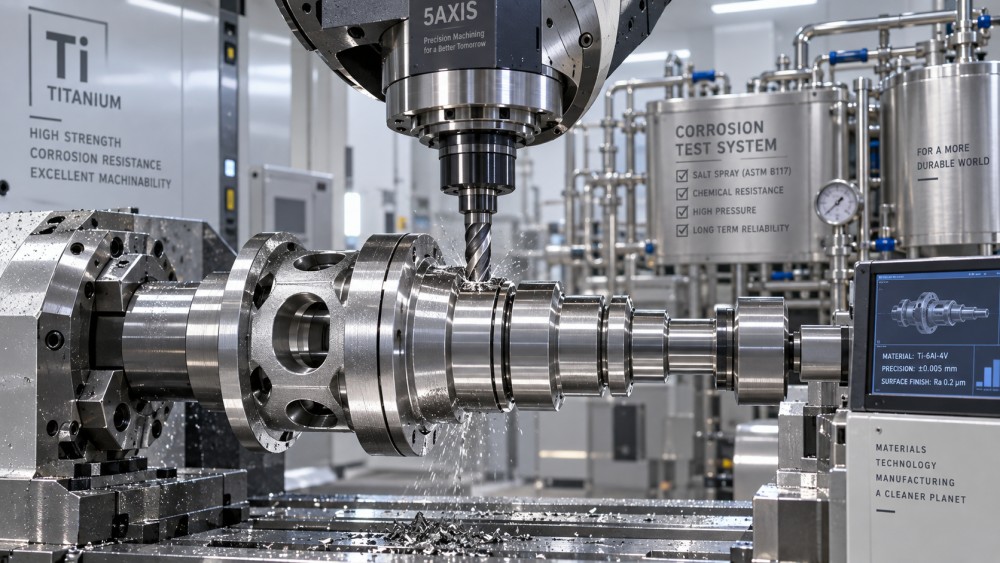
For forged or machined shafts, couplings, valve stems, bearing-adjacent parts, and hydraulic components, the question is often whether the alloy can maintain predictable performance after all downstream operations. Heat treatment, straightening, grinding, coating, or surface finishing may matter as much as the original bar, billet, plate, or forging specification.
Corrosion resistance depends on the medium, not the word “corrosive”
Titanium is valued for the stable oxide film that forms naturally on its surface. In many oxidizing and chloride-containing environments, this film can provide excellent protection. That does not mean every titanium alloy behaves identically in every fluid system, nor does it remove the need to consider crevices, deposits, temperature, velocity, contamination, galvanic couples, and chemical concentration.
For piping equipment, pumps, valve bodies, fittings, heat-transfer assemblies, and seawater-adjacent machinery, evaluators should define the actual service condition before choosing a grade. Is the component continuously immersed, intermittently wetted, exposed to stagnant fluid, cleaned with chemicals, or subjected to pressure cycling? Is the concern general corrosion, crevice corrosion, erosion-corrosion, galvanic interaction, or contamination from the process stream? These conditions can lead to different material decisions.
Galvanic compatibility is frequently underestimated. When titanium contacts less noble metals in the presence of an electrolyte, the adjacent material may be placed at greater risk. Fasteners, flanges, sealing faces, brackets, and mixed-metal pipe connections should be evaluated as an assembly rather than as isolated titanium parts. Electrical isolation, coating strategy, drainage, and access for inspection may be more practical solutions than changing the titanium grade.
Surface condition also affects corrosion decisions. Scale, embedded foreign material, machining residues, and poorly controlled thermal processing can compromise the intended surface behavior. Where corrosion performance is central to the design, requirements for cleaning, pickling, passivation where applicable, surface roughness, and post-process handling should be stated clearly rather than left as assumed workshop practice.
Why titanium machining needs to be part of material selection
Titanium alloys are not impossible to machine, but they are less forgiving than many common engineering steels and aluminum alloys. Their relatively low thermal conductivity tends to keep heat concentrated near the cutting edge. Their tendency to work harden under unfavorable cutting conditions, combined with elastic recovery and a tendency for material to adhere to tools, can accelerate tool wear and create surface-quality issues.
The production consequence is straightforward: an alloy selected solely for mechanical strength can become expensive if it requires long cycle times, frequent tool changes, conservative metal-removal rates, or multiple finishing operations. This is especially relevant for low-volume complex parts machined from solid stock, where a high buy-to-fly ratio turns material cost into a major part of the finished-component cost.
A capable machining plan normally addresses rigidity, stable workholding, correct cutter geometry, controlled engagement, coolant delivery, chip evacuation, and in-process inspection. Five-axis machining can reduce refixturing for complex geometries and may help preserve datum relationships, but it does not solve poor material or design choices by itself. Thin walls, inaccessible internal corners, sharp transitions, and unnecessarily restrictive tolerances still create process risk.
Part designers can often make titanium more manufacturable without weakening the functional design. Useful reviews include replacing sharp internal corners with suitable radii, avoiding deep narrow cavities where possible, ensuring sufficient tool access, and identifying surfaces that genuinely require fine finish or tight geometric control. These decisions should be made before the grade is frozen, not after a supplier has quoted an impractical process.
Heat treatment, welding, and finishing change the comparison
Titanium alloys can respond very differently to thermal processing. Certain alpha-beta and beta alloys are chosen partly because their properties can be tailored through controlled solution treatment, aging, annealing, or stress-relief practices. The resulting benefit depends on the required final condition, the product form, the section size, and the approved processing route. It should not be assumed that two parts made from the same nominal grade will perform identically after different thermal histories.
Welding introduces another decision point. Titanium welding requires clean surfaces and effective shielding from atmospheric contamination at elevated temperature. Where fabrication includes welded tube assemblies, pressure-containing structures, or repairable equipment, weld procedure capability and post-weld requirements should be reviewed early. A grade that looks attractive in a machined billet may be less attractive in a welded fabrication.
Finishing cannot be treated as cosmetic. Grinding, blasting, polishing, coating preparation, and thread rolling can influence residual stress, surface roughness, and fatigue-sensitive features. For precision fluid-power components, sealing surfaces and bore finishes may need particular review. For mechanical transmission components, the interaction between titanium, mating materials, lubrication, contact pressure, and wear mode may be more limiting than bulk corrosion resistance.
A practical decision path for technical evaluation
A robust titanium alloy decision usually begins with the failure mode rather than with a preferred grade. If the principal risk is corrosion, define the fluid, temperature range, exposure pattern, deposits, and mixed-metal interfaces. If the principal risk is structural failure, identify static load, fatigue spectrum, stiffness requirements, and critical stress raisers. If the component is expensive to machine, map the geometry, starting form, tolerance zones, and expected production volume before assigning an alloy with demanding cutting behavior.
The next step is to examine the complete supply chain. Material traceability, chemistry limits, mechanical-property condition, ultrasonic or other inspection requirements, forging reduction where relevant, heat-treatment records, and dimensional inspection should correspond to the actual application risk. Requiring every available document can increase cost without improving the part; requiring too little can make later investigation difficult. The goal is proportionate control.
This is where a cross-functional review is useful. Design engineers may focus on loads and envelopes, manufacturing engineers on cutting stability and tooling, quality teams on inspection and documentation, while procurement teams need to understand product-form availability and lead-time exposure. A material decision made by only one of these functions often returns later as a quotation discrepancy, a late design change, or an avoidable qualification task.
Selecting for the complete component, not the material datasheet
The right titanium alloy is rarely the one with the highest strength, the broadest corrosion claim, or the most familiar grade name. It is the one that meets the governing service requirement while remaining practical to source, machine, inspect, assemble, and maintain. In many industrial projects, a slightly less aggressive material choice paired with better geometry, surface control, and corrosion-aware assembly design delivers a more predictable result than an over-specified alloy.
For evaluators comparing precision-machined components, forged parts, fluid-handling equipment, or heavy-duty mechanical assemblies, IMPE organizes material behavior alongside machining capability, tolerance control, inspection, and long-term operating conditions. That wider view is useful because titanium alloy selection is not a catalog exercise. Before releasing a drawing or purchase requirement, confirm the alloy condition, applicable material specification, component geometry, corrosion environment, required test evidence, and the supplier’s realistic manufacturing route. Those details determine whether the chosen material performs as intended after it becomes a finished part.
Related News
- Why Is Your Heavy-Duty Piston Pump Losing Pressure Under Load?Nov 09, 2026Fluid Power Control Strategist
- Cartridge Valves for Manifold Blocks: Avoiding Cavity Fit ProblemsNov 09, 2026Fluid Power Control Strategist
- Large-Diameter Forged Rings: How Seamless Rolling Affects Grain FlowNov 09, 2026Foundry Phase-Change Fellow
- Sealed Heavy-Duty Roller Bearings: Choosing Seals for Dust and WaterNov 09, 2026Tribology & Kinematics Expert
- Sprockets and Chain Drives: What Determines Replacement Cost?Nov 08, 2026CNC Kinematics Architect
- Monoblock Hydraulic Control Valves: Flow Rating and Spool SelectionNov 08, 2026Fluid Power Control Strategist