
An inline hydraulic filter price means little unless competing quotes cover the same operating duty. Lower upfront costs can reflect significant differences in specification.
For procurement teams, fair comparison starts with pressure, flow, filtration efficiency, fluid compatibility, and quotation scope. Even the supplied element may be excluded.
The best purchasing decision combines technical compliance with installed cost, replacement-element expense, delivery reliability, and documentation. Port size and nominal micron ratings alone cannot establish equivalence.
This guide explains how to align supplier offers, identify costly omissions, and evaluate operating expenses before approving a hydraulic filter purchase for your application.
What Should an Inline Hydraulic Filter Price Actually Include?
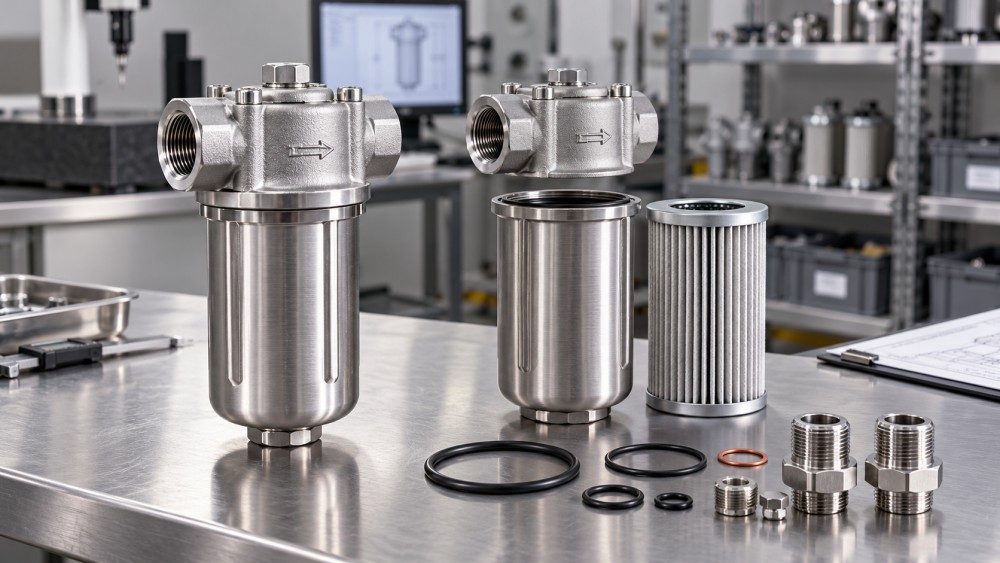
Start by establishing whether each offer covers a complete filter assembly, a housing without an element, or a replacement element for an existing installation.
A complete assembly may include the housing, element, bypass valve, seals, and clogging indicator. However, suppliers package these components differently, so written confirmation matters.
There is no universal price that applies across inline hydraulic filters. Small low-pressure assemblies and high-pressure units protecting sensitive components have substantially different requirements.
Public listing prices can also exclude freight, taxes, indicators, or required adapters. Treat them as initial references until the configuration and commercial terms are confirmed.
Request an itemized quotation showing the exact assembly code, element code, accessories, quantity, currency, and delivery basis. This makes hidden differences easier to identify.
If one offer is materially cheaper, ask the supplier to identify every deviation from your specification. A clearly documented alternative can still provide good value.
Define the Same Operating Duty Before Comparing Quotes
Give every bidder the same duty sheet, approved by the responsible engineer. Include operating conditions rather than asking suppliers to select equipment from connection size alone.
Do not assume maximum flow equals pump nameplate flow. Cylinder return flow, simultaneous functions, or transient events can produce different conditions at the filter.
Likewise, warm operating viscosity does not represent cold startup. Ask suppliers to assess restriction at the highest expected viscosity and relevant flow condition together.
A filter selected for a return line should not be treated as interchangeable with a pressure-line unit. Their housing and element requirements can differ substantially.
When operating information is incomplete, record the supplier’s assumptions explicitly. Otherwise, apparently comparable prices may describe products selected for entirely different conditions and service expectations.
Which Technical Differences Justify a Higher Price?
Several specifications can justify a higher purchase price, but each should connect to an application requirement. Additional capability has value when the system actually needs it.
Pressure ratings and element strength answer different questions
Housing working pressure describes allowable service pressure under stated conditions. Burst pressure is a separate characteristic and must not substitute for the working-pressure rating.
Element collapse resistance concerns differential pressure across the element. It becomes especially important when evaluating bypass arrangements, blocked elements, and applications requiring filtration without bypass.
Request ratings for the exact quoted configuration, including temperature limitations. A strong housing does not automatically establish that the element can withstand the required differential pressure.
Compare measured efficiency, not just micron labels
A “10-micron” description is incomplete without an efficiency statement and test basis. Nominal ratings may use different definitions, making direct price comparisons unreliable between suppliers.
Ask for the beta ratio at the specified particle size, preferably supported by ISO 16889 testing. For example, β10(c) = 200 corresponds to 99.5% efficiency.
This percentage describes performance at the stated particle size under test conditions. It does not guarantee that the installed system will achieve its cleanliness target.
Required cleanliness also depends on contamination ingress, system layout, maintenance, and operating conditions. Have engineering confirm the filtration specification before accepting a lower-cost substitute element.
Pressure drop, bypass settings, and capacity affect service
Ask for clean pressure-drop data covering the housing and element together at your flow and viscosity. An element-only curve can understate total assembly restriction.
Compare bypass cracking pressure, tolerance, and indicator setting. The warning arrangement should provide useful maintenance notice before bypass operation under the agreed operating conditions.
Dirt-holding capacity can influence replacement frequency, but compare results only when test conditions and terminal differential pressures are comparable. A larger number alone proves little.
Also confirm fluid compatibility for media, adhesives, seals, and housing materials. A general statement about oil compatibility may not cover your specified hydraulic fluid.
Normalize the Quotation Before Ranking Suppliers
Create a technical compliance gate before calculating savings. Offers with unresolved pressure, compatibility, or filtration deviations should remain conditional until engineering accepts the proposed configuration.
Next, convert technically acceptable offers to the same purchase scope. Add required accessories, installation hardware, freight, and other applicable charges using a consistent delivery destination.
Keep recoverable taxes separate from actual procurement expense where appropriate. Confirm named delivery locations and Incoterms rules instead of assuming all delivered prices include identical obligations.
These figures are illustrative, not market quotations. They show how a lower advertised assembly price can become a higher initial cost once required items are included.
Record quotation validity, minimum order quantity, payment terms, warranty scope, and confirmed dispatch timing. These conditions can change the commercial ranking even after technical alignment.
For replacement projects, include installation labor and necessary pipework changes. A compatible assembly may justify a higher purchase price if it avoids substantial installation expense.
How Much Will Replacement Elements Cost Over Time?
Request replacement-element pricing with every assembly quote. Include the exact part number, availability, minimum order quantity, and whether pricing depends on an annual purchasing commitment.
A low housing price can be offset by expensive consumables. Conversely, a higher-priced assembly may reduce total spending if its element costs and service requirements are lower.
Use a stated planning period and calculate initial installed cost plus replacement elements, changeout labor, disposal, and other measurable operating expenses relevant to the application.
For example, assume technically compliant Assembly A costs $560 installed, uses $95 elements, and requires four annual changes. Each change costs $30 in labor.
Assembly B costs $650 installed, uses $120 elements, and requires two annual changes. Over three years, the respective totals would be $2,060 and $1,550.
This example assumes those replacement frequencies are supported by operating experience or a validated trial. Do not derive service intervals directly from marketing claims about capacity.
If reliable interval data are unavailable, calculate multiple scenarios. Compare equal replacement frequency first, then test how longer or shorter service life changes the result.
Energy losses may also matter in continuously operating equipment. Estimate them using representative pressure drop, actual flow, operating hours, and efficiency assumptions reviewed by engineering.
What Evidence Should You Request Before Issuing the Purchase Order?
Ask for a datasheet and drawing tied to the quoted part number. Family brochures may contain ratings or options that do not apply to your configuration.
Request supporting filtration and pressure-performance information appropriate to the application. Clarify whether documents are published type-test results, certificates of conformity, or unit-specific inspection records.
Relevant references may include ISO 16889 for filtration performance, ISO 3968 for pressure-drop characteristics, and ISO 2941 for element collapse or burst resistance verification.
Do not request every available certificate automatically. Specify documentation that supports engineering approval, contractual obligations, or maintenance needs, and confirm any additional cost before ordering.
Verify replacement support through stock information, realistic replenishment lead times, and part-number continuity. Claims of interchangeability should include dimensions, sealing details, and performance evidence.
For uncertain substitutions, arrange a controlled evaluation with engineering oversight. Track differential pressure, fluid cleanliness, leakage, and service interval against predefined acceptance criteria before wider adoption.
Choose the Best Price Among Filters That Meet the Duty
The most useful inline hydraulic filter price is the normalized cost of a technically suitable assembly, supported by affordable replacement elements and dependable supply arrangements.
Approve the duty specification first, resolve deviations second, and compare installed and operating costs third. This sequence makes supplier selection clearer and easier to defend.
Choose the lowest evaluated cost that meets the agreed requirements. Paying more is justified when documented performance, service life, installation savings, or availability supports the difference.