
Inconel 625 Alloy Properties for Corrosion, Heat, and Offshore Service
Why Inconel 625 Is Selected for Severe Service
Inconel 625 alloy is usually considered when a component must survive more than one demanding condition at the same time: chloride-bearing fluids, seawater exposure, elevated temperatures, pressure cycling, difficult welding requirements, or long intervals between maintenance opportunities. It is not the automatic choice for every corrosive or hot-duty application. Its value becomes clearer when failure of a lower-alloy material would create substantial downtime, safety exposure, repair cost, or access difficulty.
For technical evaluation teams, the central question is rarely whether the alloy has high corrosion resistance in general. The more useful question is whether its resistance, strength, fabrication behavior, and inspection requirements match the actual failure mechanism of the component. A valve body exposed to warm chlorides, a subsea control line fitting, a heat exchanger transition piece, and a high-temperature exhaust component may all be described as “severe service,” yet they place very different demands on the material.
Inconel 625 is a nickel-chromium-molybdenum alloy with niobium additions. This chemistry gives it a combination that many engineering alloys do not provide easily: strong resistance to localized corrosion in chloride-containing environments, good mechanical strength without relying solely on precipitation hardening, useful elevated-temperature performance, and generally favorable weldability for a high-alloy nickel material. Those traits explain its use in offshore equipment, chemical process systems, marine hardware, aerospace-related components, pollution-control equipment, and selected energy applications.
Composition Matters Because Corrosion Is Local
The alloy’s nickel-rich matrix supports resistance to reducing environments and chloride-related attack. Chromium improves resistance to oxidizing media and high-temperature oxidation. Molybdenum is particularly important where pitting and crevice corrosion are concerns, while niobium contributes to solid-solution strengthening and helps stabilize the alloy during thermal exposure. The result is a material that can retain useful properties where common stainless steels may be vulnerable to localized corrosion or chloride stress corrosion cracking.
This distinction matters because many material selection errors begin with a broad corrosion label. “Seawater resistant” or “chemical resistant” does not describe fluid temperature, oxygen content, velocity, deposits, crevices, galvanic connections, cleaning chemistry, or concentration changes during upset conditions. Inconel 625 can be highly effective in chloride service, but its performance should still be evaluated against the geometry and operating envelope of the part.
A smooth, continuously flushed component in cool seawater presents a different corrosion problem from a bolted connection that traps stagnant seawater beneath a gasket. The latter may create an oxygen-depleted crevice with concentrated salts and altered local chemistry. Similarly, a piping component designed for nominal process conditions may face a harsher environment during shutdown, hydrotesting, chemical cleaning, or temporary storage. Material review should therefore include all credible exposure states, not just the process fluid listed on the line diagram.
Resistance to Chloride Pitting and Crevice Attack
One of the strongest reasons to specify Inconel 625 alloy is its resistance to chloride-induced localized corrosion. Stainless steels can offer good general corrosion performance while still developing pits or crevice damage in warm, concentrated, or stagnant chloride environments. Such attacks are dangerous because they may remain highly localized until wall loss, leakage, or cracking becomes significant.
The alloy’s molybdenum and nickel content give it a wider margin against these mechanisms than many conventional stainless grades. That margin is particularly relevant for offshore topside equipment, seawater handling systems, marine fasteners, subsea assemblies, and process equipment exposed to halide-bearing media. It does not remove the need for good design practice. Crevice-prone details, damaged protective surfaces, retained deposits, poorly drained cavities, and dissimilar-metal joints can still undermine long-term performance.
For an offshore assembly, the material decision should be linked to the component’s actual exposure category:
- Fully immersed parts may face seawater, marine growth, sediment, and galvanic interactions.
- Splash-zone components experience wet-dry cycling, oxygen access, salt deposits, and mechanical damage risk.
- Enclosed process parts may see higher temperature, pressure, chemical concentration, or stagnant conditions.
- Fasteners, clamps, and small-bore fittings can be especially sensitive to crevice geometry and installation quality.
Where Inconel 625 is used alongside carbon steel, stainless steel, titanium, or other nickel alloys, galvanic compatibility must be reviewed as a system issue. The corrosion behavior of the more active material may change when it is electrically coupled to a noble alloy in an electrolyte. Coatings, insulation kits, joint design, area ratio, and electrical continuity can be as important as the alloy selection itself.
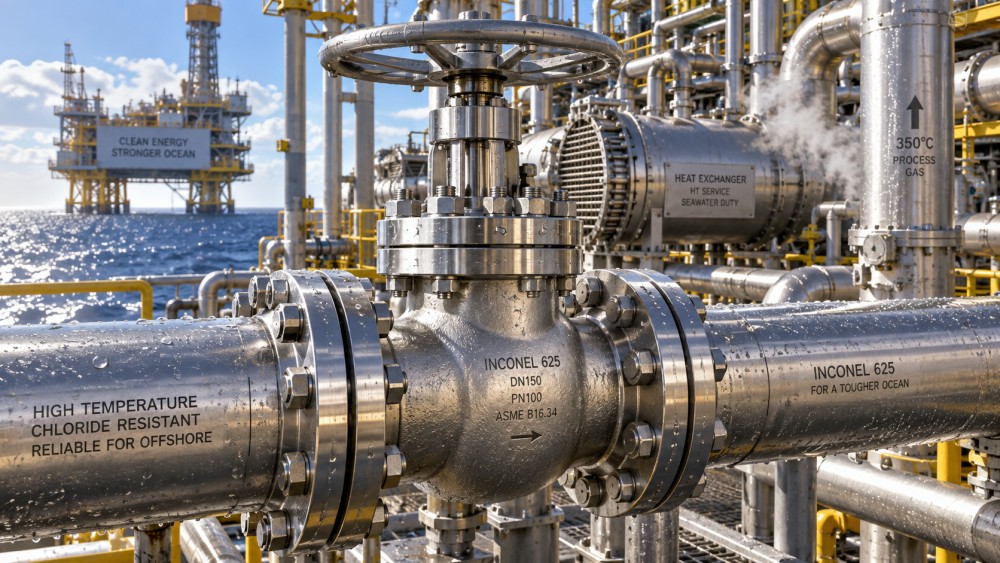
High-Temperature Strength Is Useful, but Temperature Alone Does Not Define Suitability
Inconel 625 retains strength over a broad temperature range and resists oxidation more effectively than many lower-alloy engineering materials. This makes it attractive for components exposed to heat, thermal cycling, exhaust streams, hot gas systems, furnace-related equipment, and process hardware where corrosion and temperature occur together.
Its strength comes largely from solid-solution strengthening rather than from a heat-treatment route that depends on producing a specific precipitation-hardened structure. For buyers and fabricators, this can simplify some processing decisions, but it should not be interpreted as immunity to service degradation. Long periods at elevated temperature can alter microstructure, affect ductility, and change the relevance of room-temperature property data. The longer the expected exposure and the closer the component operates to the upper end of its intended range, the more important it becomes to assess time-dependent behavior rather than relying on a single tensile value.
Thermal expansion, restraint, cyclic stress, and temperature gradients often govern component life before uniform oxidation does. A welded transition spool, for example, may experience repeated differential movement between a nickel alloy section and a lower-expansion adjoining material. A well-selected alloy can still crack if the design locks in thermal strain or concentrates stress at a weld toe, attachment, or section change.
Technical teams should separate three questions that are often combined under “heat resistance”:
- Can the alloy resist oxidation or chemical attack at the expected metal temperature?
- Can it carry the required load for the full operating duration, including transient conditions?
- Can the component design accommodate thermal movement without excessive cyclic stress?
Inconel 625 may answer the first two questions favorably in many severe environments, but the third depends on geometry, supports, weld configuration, insulation, temperature distribution, and operating sequence.
Offshore Service Depends on More Than Seawater Chemistry
Offshore equipment often justifies Inconel 625 because replacement and repair can be disproportionately expensive. The alloy is used where seawater, produced fluids, chlorides, pressure, vibration, and difficult access overlap. Typical examples include subsea connectors, valve trim, control components, hydraulic fittings, well intervention equipment, riser-related hardware, seawater system components, and corrosion-critical fasteners or machined parts.
Still, “offshore grade” should not become a shortcut in a materials specification. An alloy selected for a non-pressure external fitting may not satisfy the requirements for a pressure-retaining forged body. A machined component may need different acceptance criteria from a welded fabricated assembly. Product form matters because plate, bar, pipe, forged fittings, castings, weld consumables, and overlay materials are produced and controlled differently.
For pressure-containing or safety-critical offshore parts, the material review commonly needs to connect the following items:
- Specified alloy designation and applicable product-form standard.
- Chemical composition limits and traceability from melt source to finished component.
- Mechanical properties in the relevant condition, orientation, and section thickness.
- Required non-destructive examination method, coverage, and acceptance criteria.
- Welding procedure qualification, filler-metal selection, heat input control, and post-weld inspection.
- Environmental qualification for the expected chloride, sour, or seawater exposure.
- Dimensional tolerances and surface condition at sealing, threaded, fatigue-sensitive, or crevice-prone features.
This level of review is not bureaucracy around a premium material. It is how a project confirms that the delivered component has the same metallurgical and mechanical basis assumed by the design calculation. A material certificate alone may establish chemistry and mechanical test results for a lot, but it does not demonstrate correct machining, weld quality, surface finish, fit-up, or cleanliness.
Weldability Is an Advantage, Not a Reason to Relax Process Control
Inconel 625 is widely regarded as weldable compared with many high-strength nickel alloys. It is commonly used in fabricated equipment and as a welding or overlay material where a corrosion-resistant surface is needed over a lower-cost structural substrate. That practicality is a major reason it appears in complex industrial equipment rather than only in solid wrought components.
However, weldability does not mean every fabrication route produces equivalent corrosion performance. The weld metal, heat-affected zone, dilution from a base material, heat input, interpass temperature, shielding practice, and cleaning discipline all influence the finished assembly. In overlay applications, insufficient deposited thickness after machining or excessive dilution can reduce the intended alloying level at the exposed surface. In piping and pressure equipment, incomplete fusion, slag inclusions, porosity, undercut, or poorly blended weld profiles can become more consequential under fatigue and corrosive service.
Fabrication specifications should state the required final condition, rather than simply calling for “Inconel 625 weld overlay” or “625-clad construction.” A useful specification identifies minimum finished overlay thickness, examination requirements, corrosion-side chemistry where relevant, repair limits, and the location of any machining allowance. For welds joining solid 625 components, qualification should address the joint configuration and thickness range actually used in production.
Surface preparation also deserves attention. Carbon steel contamination, embedded grinding debris, heat tint, and rough machined surfaces may create local corrosion initiation sites or complicate inspection. Controlled tooling, cleaning procedures, and appropriate finishing methods help preserve the material advantage that justified the alloy selection.
Machining and Component Design Affect Delivered Performance
Inconel 625 has a reputation for being more difficult to machine than carbon steel or standard stainless grades. Its strength, work-hardening tendency, and low thermal conductivity can increase cutting forces and direct heat toward the cutting edge. This has practical consequences for procurement: dimensional complexity, tight tolerances, deep internal features, thin sections, and surface finish requirements can materially affect lead time, cost, and supplier capability.
A drawing for a 625 part should avoid treating material and geometry as separate decisions. Deep threads in corrosion-critical zones, sharp internal corners, narrow grooves, poorly accessible sealing faces, and difficult inspection surfaces can turn an otherwise sound alloy choice into a manufacturing or reliability problem. Where feasible, designs should allow stable machining access, adequate radii, clear inspection datums, and surface requirements tied to function rather than arbitrary cosmetic expectations.
The risk is especially high when a component combines pressure containment with fatigue loading. A surface discontinuity, machining mark, or local geometry transition may have more influence on fatigue life than a modest difference in nominal tensile strength. The material certificate cannot compensate for an unsuitable surface condition at a highly stressed feature.
Where the Alloy May Be More Than the Service Requires
Inconel 625 is a high-value alloy, and it should be applied where its performance margin solves a defined problem. For low-temperature, low-chloride, non-critical service, lower-cost stainless steels, duplex grades, coated carbon steel, or other materials may meet the design requirement. Conversely, highly reducing acids, unusual halide chemistries, aggressive sour environments, or very high-temperature duty may require evaluation of other nickel alloys or a different corrosion-control strategy.
The practical decision is not whether 625 is “better” in absolute terms. It is whether it reduces the dominant failure risk enough to justify the cost, fabrication complexity, and documentation burden. A material upgrade is most defensible when the operating envelope is well defined, the consequence of failure is high, and alternative materials show a credible vulnerability to the actual corrosion or thermal mechanism.
A Focused Evaluation Path
Before releasing an Inconel 625 alloy specification, technical teams should define the exposed media, chloride level, temperature profile, pressure, flow condition, stagnant zones, cyclic loads, expected design life, fabrication route, and inspection access. They should then match those conditions to the required product form and governing project standard. This sequence avoids a common mistake: approving a premium alloy based on general reputation while leaving the delivered form, weld details, and acceptance criteria open to interpretation.
For offshore and corrosive high-temperature service, Inconel 625 remains a strong candidate because it combines attributes that are difficult to obtain in a single material. Its best results come from treating alloy selection, component geometry, fabrication control, and service environment as one engineering decision.
Related News
- How to Assess a Rigid Coupling Supplier for Bore Accuracy and Traceable QualityOct 08, 2026Tribology & Kinematics Expert
- Titanium Alloys Compared: Balancing Strength, Corrosion Resistance, and MachinabilityOct 08, 2026CNC Kinematics Architect
- Where Ductile Iron Dismantling Joints Reduce Alignment Risk in Water PipelinesOct 08, 2026Pipeline Metallurgy Scientist
- Selecting a Precision Bearing Sleeve: Fits, Runout, and Material ChoicesOct 08, 2026Tribology & Kinematics Expert
- Face Milling Cutters: How Insert Geometry Affects Finish on Steel and AluminumOct 08, 2026CNC Kinematics Architect
- Single-Acting Cylinders for Clamping: Stroke, Force, and Return Spring ConsiderationsOct 07, 2026Fluid Power Control Strategist