
Hydraulic Accumulator Certification: What Buyers Should Request
Request a documentation package that identifies the exact hydraulic accumulator being supplied, establishes the pressure equipment requirements applicable at its destination, and records the inspections and tests performed on that unit. A catalog rating or a generic certificate does not establish that a particular vessel meets the agreed requirements.
Before requesting certificates, define the destination, intended service, maximum allowable pressure, operating temperature range, fluid, gas and installation arrangement. These details determine which conformity route and technical evidence are relevant. Ask the hydraulic accumulator supplier to identify any requirements that remain unresolved in its quotation, rather than leaving them to be settled after manufacture.
Establish the Applicable Pressure Equipment Route
An accumulator contains stored energy and may fall under pressure equipment rules in the jurisdiction where it is placed on the market or put into service. The applicable route can change with factors such as pressure, volume, fluid classification and intended use. Equipment incorporated into a larger machine may also be subject to requirements for the completed assembly. Determine the applicable rules for the vessel and the installation separately.
For equipment destined for the European Union, ask the supplier to state whether the Pressure Equipment Directive applies and, if so, which conformity assessment route is used. The classification and resulting obligations depend on the equipment characteristics and service. Where applicable, request the EU declaration of conformity, the relevant notified body details and evidence of the required marking. Some equipment falls under sound engineering practice provisions rather than requiring a CE mark under that directive; obtain the supplier’s written basis for the classification.
For equipment destined for the United States or Canada, establish the requirements of the applicable state, provincial or territorial jurisdiction and the project specification. An ASME code designation or stamp is relevant only when the specified construction and jurisdiction require or accept it. A statement that a vessel is “built to ASME” does not by itself establish that it carries an authorized code stamp or meets local registration requirements. Where registration is required, clarify responsibility, scope and timing before production begins.
Other destinations can impose different approval, registration or inspection requirements. State the final installation location, not merely the shipping address. A vessel dispatched to a distributor in one country and installed in another may need a different documentation package.
Match Every Record to the Vessel
The most useful certificate is one that can be linked unambiguously to the delivered item. Request a document index listing the model, serial number or other unique identifier, design pressure, permitted temperature range, capacity and applicable construction standard. The same identifier should appear on the nameplate and on unit-specific inspection and test reports.
Review the scope of each document. A supplier’s quality management certificate describes a management system within a stated scope; it does not certify the pressure integrity of an individual accumulator. Similarly, a certificate covering a vessel family does not necessarily confirm that the ordered configuration was produced under that approval. Compare the model designation, pressure rating, port arrangement and any certified options with the purchase order and drawing.
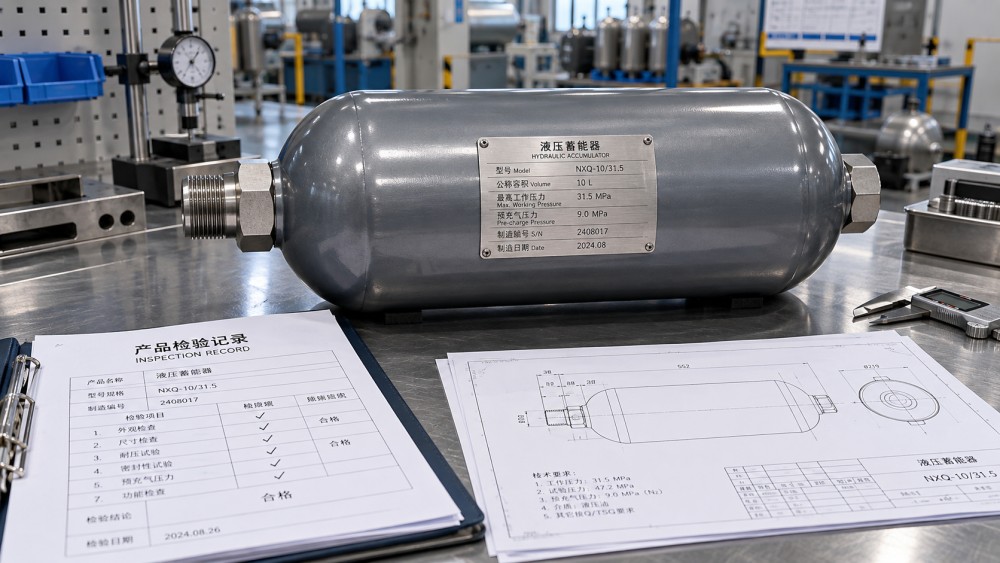
Substitution creates a traceability problem when the order references one approved design but the delivered unit has a different shell, gas valve or connection. Require written approval for changes that affect the pressure boundary, conformity assessment or agreed materials. The revised drawing and certification references should be issued before shipment, not reconstructed from email after receipt.
Material Traceability and Inspection Records
Ask which pressure-retaining parts are covered by material certificates and how their material identification is maintained through manufacture. Relevant parts can include the shell, end closures, pressure ports and other components within the defined pressure boundary. The exact scope should be agreed in the specification: a certificate for a piece of incoming steel does not automatically identify the finished shell unless the production records connect them.
Where material inspection documents are specified under EN 10204, state the required document type and the components it covers. A type 3.1 document carries a different validation basis from a type 2.2 document; a type 3.2 document adds independent inspection validation as defined by the standard. Selecting a document type does not replace agreement on the material grade, heat treatment, test results or traceability to the finished vessel.
For welded construction, request the records required by the applicable code and project specification. These can include weld procedure and personnel qualification evidence, weld identification and non-destructive examination reports. A report should state the examination method, area examined, acceptance criteria and result. A clean report for selected welds should not be read as evidence that every weld was examined.
Cast or forged pressure-retaining components raise a similar scope question. Material certificates and examination reports should identify the component and the extent of inspection. If heat treatment is required by the design or material specification, clarify whether the final documentation includes the relevant treatment record or a documented confirmation of compliance.
Pressure Tests: Read the Report Alongside the Design
Request the pressure test report for each accumulator, or a traceable report for the units covered by an accepted batch procedure. It should identify the item, test medium, applied pressure, result, date and responsible inspection authority or signatory. Include any required hold time and acceptance criteria in the purchase specification so the report can be assessed against an agreed basis.
Do not equate the test pressure with the allowable operating pressure. A pressure test is performed under specified conditions to demonstrate conformity with the applicable construction requirements; the nameplate pressure and design temperature define the permitted service envelope. A high test figure on a report does not authorize operation above the marked maximum allowable pressure.
Also distinguish a strength or proof test of the pressure boundary from a leakage or functional test of the assembled accumulator. A shell test may be completed before the bladder, piston seals or gas valve are installed. Ask which assembly was tested, whether the gas side and hydraulic side were included, and what evidence covers leakage at the completed connections. The applicable code and design determine the test method; a preferred test medium should not be assumed acceptable without confirmation.
If third-party witnessing is specified, agree on the witness point and notice period in the purchase order. A report signed by the manufacturer alone does not demonstrate that an independent inspector witnessed the test. Conversely, a third-party certificate should identify the activity actually witnessed rather than imply approval of the entire production process.
Verify the Operating Envelope and Gas-Charge Evidence
The technical data sheet should identify rated volume, maximum allowable pressure, minimum and maximum allowable temperatures, hydraulic connection and permissible fluids. These values must agree with the drawing, nameplate and conformity documents. Rated volume describes the vessel’s nominal capacity; it does not by itself establish usable fluid delivery at the system’s minimum and maximum pressures.
For a bladder or piston accumulator, request the approved gas type, precharge instructions and the conditions under which the precharge is stated. Temperature affects gas pressure, so a reported charge without a reference temperature can be difficult to compare with the required setting. Clarify whether the unit will ship charged, partially charged or uncharged, and whether the recorded value is a factory reading or the required setting at commissioning.
Fluid and temperature compatibility also reach beyond the steel shell. Identify the bladder or seal material and confirm that it is suitable for the specified hydraulic fluid and temperature range. A pressure-vessel certificate does not establish elastomer compatibility, resistance to the site environment or acceptable cycling performance. Where service involves frequent cycling or unusual pressure fluctuations, communicate the operating profile and obtain confirmation of the design’s suitability.
Precharge and service instructions should identify the correct charging equipment and safe isolation and depressurization procedures. Compressed gas and pressurized hydraulic fluid remain hazardous after a pump is stopped. Any shipping restrictions, protective caps and preservation requirements should be agreed alongside the delivery condition.
Resolve Gaps Before Release
Attach the required document list to the purchase order and identify which records are due with the quotation, before manufacture, before dispatch and with the final delivery. Early review is especially useful for the design classification, drawing and inspection plan: a missing test witness or an unapproved construction change may be impossible to correct after the vessel has been completed.
At receipt, compare the nameplate and serial number with the final document index. Treat discrepancies in pressure, temperature, material identification or certification scope as holds for technical resolution. A replacement page should identify the affected vessel and explain the correction; an unrelated generic certificate does not close a gap in unit-specific evidence.
Related News
- Why Is Your Heavy-Duty Piston Pump Losing Pressure Under Load?Nov 09, 2026Fluid Power Control Strategist
- Cartridge Valves for Manifold Blocks: Avoiding Cavity Fit ProblemsNov 09, 2026Fluid Power Control Strategist
- Large-Diameter Forged Rings: How Seamless Rolling Affects Grain FlowNov 09, 2026Foundry Phase-Change Fellow
- Sealed Heavy-Duty Roller Bearings: Choosing Seals for Dust and WaterNov 09, 2026Tribology & Kinematics Expert
- Sprockets and Chain Drives: What Determines Replacement Cost?Nov 08, 2026CNC Kinematics Architect
- Monoblock Hydraulic Control Valves: Flow Rating and Spool SelectionNov 08, 2026Fluid Power Control Strategist