
Powder Metallurgy Tool Steel: When Is It Worth the Higher Cost for Cutting Tools?
The higher cost of powder metallurgy tool steel is justified when a cutting tool is limited by a combination of wear, edge chipping, heat damage, or unstable life rather than by simple purchase price. It earns its premium where a conventional tool steel must be replaced before its geometry is fully used, where an unexpected edge failure interrupts a valuable operation, or where the tool material prevents a practical increase in cutting parameters. In low-stress work with short runs, broad tolerances, and easy tool changes, the benefit can be too small to recover the added material cost.
The decision should begin with the failure mode of the existing tool. A tool that wears uniformly and predictably at a modest rate presents a different opportunity from one that develops micro-chips, cracks at sharp internal corners, loses its edge near a coating breakdown zone, or varies substantially from one production batch to the next. Powder metallurgy grades are often selected because their carbide population is finer and more evenly distributed than that of conventionally cast high-alloy tool steels. That structure can improve the balance between hardness, compressive strength, abrasion resistance, and toughness. The balance matters because cutting tools rarely fail from one property alone.
Where the Material Difference Changes Tool Performance
In conventional production of high-alloy tool steel, alloying elements form carbides during solidification. Large carbide clusters can remain after later processing, particularly in grades designed for high wear resistance. Those particles contribute hardness and abrasion resistance, but they can also become local stress concentrators. A fine cutting edge, a thin punch land, or a sharp transition in a die cavity is more vulnerable when the microstructure contains coarse, unevenly spaced carbides.
Powder metallurgy routes atomize molten steel into powder, consolidate the powder under controlled conditions, and then process it into usable stock. The result is typically a more uniform carbide distribution. This does not automatically make every PM grade harder than every conventional grade. Its practical advantage is that it often allows useful hardness and wear resistance without sacrificing as much resistance to chipping or fracture. That distinction becomes visible in tools exposed to interrupted cuts, fluctuating chip loads, narrow edge radii, or localized contact pressure.
A higher alloy content alone is therefore an incomplete selection criterion. Two materials may reach similar hardness after heat treatment yet behave very differently in service. One may resist abrasive wear but crack when a heavy chip strikes a weak edge. Another may tolerate shock loading but round over too quickly in abrasive material. Powder metallurgy expands the workable range between those opposing demands; it does not eliminate the need to define which demand controls the application.
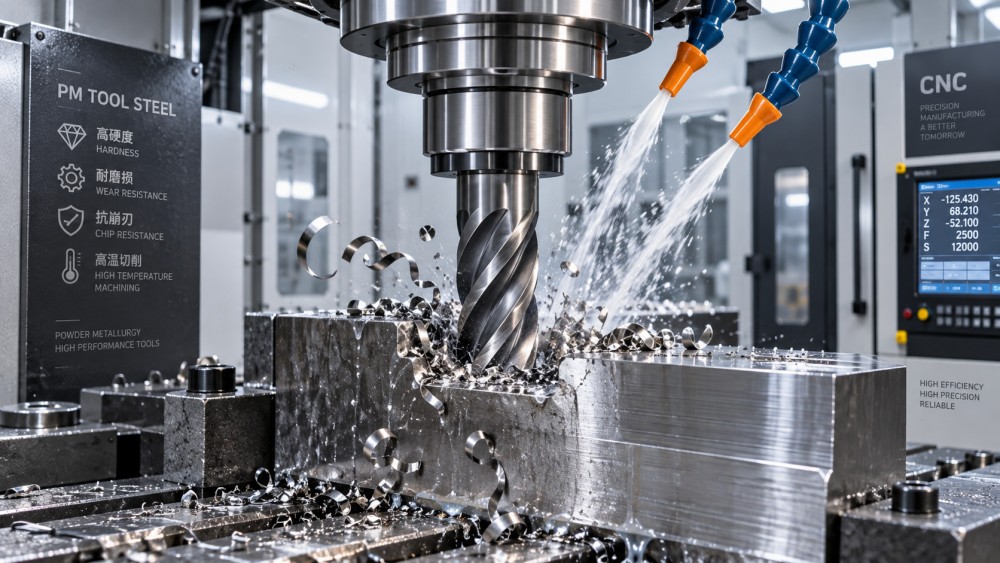
Situations That Usually Support the Premium
PM tool steel is most persuasive in cutting tools that are expensive to make, difficult to set, or disruptive to replace. Complex form tools, broaches, reamers, thread-forming tools, cold-forming dies with cutting features, and custom punches are common examples. Their value is not only in the steel blank. Grinding, EDM, polishing, coating, inspection, setup, and qualification may represent a much larger share of the finished tool cost. Extending the useful life of such a tool can be valuable even when the material price difference is substantial.
It also becomes attractive when the workpiece promotes abrasive wear. High-strength steels, materials containing hard carbides or inclusions, scale-bearing stock, sintered metals, and certain filled polymers can degrade an edge rapidly. The exact mechanism matters: abrasive wear along the flank face calls for a different response than adhesive pickup at the cutting edge. A PM grade with strong wear resistance is a credible option for the first condition, but it will not solve adhesion caused by an unsuitable coating, poor lubrication, or excessive heat at the chip interface.
Interrupted cutting is another strong case. Milling operations with varying engagement, keyway interruptions, cross holes, cast surfaces, or uneven stock allowance repeatedly shock the cutting edge. A conventional high-wear-resistance grade can fail through small edge fractures even though its average hardness appears adequate. The more uniform PM microstructure can provide a wider operating margin against this type of damage. That margin is particularly useful when a small chip changes surface finish, creates burrs, or causes a tool to reject parts before the edge seems visibly worn.
High-volume operations deserve a broader economic view. A small gain in tool life may not matter when the tool can be changed during a planned pause. The same gain matters when replacement stops an automated cell, requires re-establishing a datum, consumes a qualified offset, or creates a first-piece inspection requirement. In these settings, tool life consistency can be as valuable as average life. A material that produces a narrower spread between early failures and long-running tools makes scheduling and process control easier.
When Conventional Tool Steel Remains the Better Choice
Premium steel is a weak investment when the cutting edge is not the limiting element. If tool bodies bend because of insufficient section thickness, if the spindle or fixture lacks rigidity, or if runout overloads one flute, a change in steel grade will not correct the root cause. A tougher PM grade can survive longer than a brittle alternative, but no tool material compensates for severe mechanical instability.
Short-run work with uncomplicated tools often favors conventional grades. A simple blank that can be reground quickly, runs at moderate speed, and experiences little shock loading may deliver adequate service from a properly heat-treated conventional steel. This is especially true where the tool is discarded after a limited task or where the machining time per part is low enough that a tool change has little operational consequence.
Some failures also originate in heat treatment rather than steel selection. Excess retained austenite, insufficient tempering, excessive decarburization, poor quench support, or distortion that forces heavy corrective grinding can undermine either material family. PM steel is not a substitute for a validated thermal cycle. Its performance potential depends on reaching the intended hardness range while preserving toughness and dimensional stability. Comparing a carefully processed PM tool with a poorly heat-treated conventional tool gives a misleading conclusion about the steel itself.
Likewise, a coating mismatch can obscure the material comparison. Coatings affect friction, thermal transfer, oxidation resistance, and wear behavior, but they depend on a sound substrate and appropriate surface preparation. Edge preparation, polishing quality, coating thickness, and post-coating treatment can change the result as much as a modest difference between base steel grades. A trial should hold these variables as constant as possible.
Read the Failure Pattern Before Changing Grades
Flank wear, crater wear, chipping, plastic deformation, built-up edge, and fracture are often grouped together as “tool wear,” although they call for different remedies. A microscope examination of used edges is more useful than a replacement count alone. Wear bands that broaden evenly across the flank indicate gradual abrasion or diffusion-related loss. Repeated chips at the same portion of an edge suggest impact, runout, poor support, or an unfavorable edge geometry. A smeared, torn edge may point toward adhesion and temperature rather than insufficient bulk hardness.
Fracture surfaces deserve close attention. A break that begins at an EDM recast layer, a grinding burn, a sharp corner, or an inclusion cannot be diagnosed solely from nominal steel grade. PM material may reduce sensitivity to coarse carbide-related initiation sites, yet residual tensile stress and surface damage remain capable of starting cracks. The tool design, finishing route, and thermal history must be considered alongside the microstructure.
Cost Should Be Measured at the Operation Level
Material cost is only one line in the tool's cost. The more relevant comparison includes the finished tool price, expected regrinds, changeover time, scrap exposure during a deteriorating edge, machine idle time, inspection burden, and the consequences of an in-process breakage. A PM tool does not need to last dramatically longer to be justified where changing it requires dismantling a fixture, resetting a toolpath reference, or repeating qualification cuts.
At the same time, faster cutting parameters should not be entered as an assumed financial benefit. A stronger substrate may permit an increase in speed or feed, but the limiting factor can shift to spindle power, workholding, coolant reach, chip evacuation, part distortion, or surface integrity. Increasing parameters without observing tool temperature and part quality can merely exchange one problem for another. The better question is whether the new material enables a stable operating window that was previously unavailable.
A useful evaluation compares matched tools under a controlled production condition. Keep geometry, coating, heat treatment target, edge preparation, coolant strategy, workpiece lot, and inspection criteria consistent. Record cutting time or completed parts until a defined end-of-life condition occurs, rather than waiting for catastrophic failure. The end condition could be a dimensional limit, surface-finish deterioration, burr formation, maximum flank wear, or a specified amount of edge chipping. The chosen limit must reflect the actual process requirement.
Do not judge the result from one unusually good or poor tool. Material lots, grinding condition, coating variation, and workpiece variability can all influence a short trial. A small number of comparable runs often reveals whether the premium changes the failure pattern, but a broader release decision should rely on repeatable evidence. If PM steel mainly delays a predictable wear mode, the value calculation is straightforward. If it converts breakage into controllable wear, its operational value can be larger than the increase in average life suggests.
Heat Treatment, Grinding, and Edge Geometry Still Set the Ceiling
Powder metallurgy steel is frequently selected for its microstructural potential, then restricted by downstream processing. Heat treatment must follow the grade-specific guidance for austenitizing, quenching, cryogenic treatment where applicable, and tempering. Substituting a cycle developed for a different steel can produce an attractive hardness reading while leaving inadequate toughness or unstable dimensions. Hardness alone should be treated as a confirmation point, not as a complete release criterion.
Grinding requires equal care. Aggressive grinding can introduce thermal damage, tensile stress, or microcracks at the very edge that the premium material was intended to protect. Fine-grit finishing, controlled stock removal, suitable coolant delivery, and inspection for burn are especially important for sharp profiles. A deliberately honed edge may outperform a razor-sharp edge in interrupted cutting because it reduces local stress concentration. On the other hand, too large a hone raises cutting forces and can worsen heat generation in light finishing operations.
Tool geometry and steel choice must therefore be paired. A high-wear PM grade with a fragile included angle may still chip. A tougher grade used with an overly blunt edge may rub rather than cut. Relief angles, rake, edge radius, flute form, land width, and support behind the cutting edge determine how the substrate experiences load. Material selection is strongest when it follows this geometry review rather than replacing it.
A Practical Threshold for Selection
The premium is most defensible when at least two conditions are present: the operation is abrasive or thermally demanding; edge chipping or random breakage causes instability; the tool is complex or costly to remake; or replacement creates meaningful disruption beyond the price of the tool itself. When none of these conditions applies, a conventional steel with disciplined heat treatment and grinding is often the sounder choice.
Powder metallurgy tool steel should be specified as part of a defined process change, with a clear baseline and an agreed end-of-life criterion. That approach prevents a costly material upgrade from being judged by anecdote and reveals whether the gain comes from longer life, improved resistance to failure, a broader cutting window, or more consistent output. Those are the outcomes that determine whether the higher initial cost has real value in a cutting operation.
Related News
- Using Industrial Air Blow Guns to Clear Chips Without Spreading DebrisOct 15, 2026Fluid Power Control Strategist
- Ductile Iron Pipe Valves: Which AWWA Standards Apply to Water Main Projects?Oct 15, 2026Dr. Elias Vance
- Why Vacuum Suction Cups Lose Grip on MDF in Woodworking MachinesOct 15, 2026CNC Kinematics Architect
- Choosing a Variable Displacement Piston Pump Manufacturer: What to VerifyOct 15, 2026Fluid Power Control Strategist
- Parallel vs. Angular Pneumatic Grippers for Confined Assembly StationsOct 15, 2026Fluid Power Control Strategist
- Die Castings vs. Investment Castings: Which Costs Less at Your Production Volume?Oct 14, 2026Foundry Phase-Change Fellow