
Multi-Axis Machining Centers: When Does 5-Axis Machining Pay Off?
Five-axis machining pays off when the savings from fewer setups, better access and more reliable production exceed the added cost of the machine, programming, tooling and support. The strongest business case usually involves parts with features on several faces, demanding relationships between those features, or complex surfaces that are difficult to machine efficiently on existing equipment.
The decision is less straightforward when a shop mainly produces flat parts in long runs or has unused three-axis capacity. A five-axis machine may still shorten individual jobs, but a faster process does not automatically justify an investment if there is not enough suitable work to keep it productive. The comparison should cover the complete production route, not spindle time alone.
Start with the parts that create the cost
Review a representative group of jobs rather than selecting the most complicated component in the factory. The useful candidates are parts that repeatedly require several fixtures, manual reorientation, long tool reach, awkward inspection or subcontracted operations. Record the actual route for each part: setup and machining time at every operation, movement between machines, inspection, rework and waiting time.
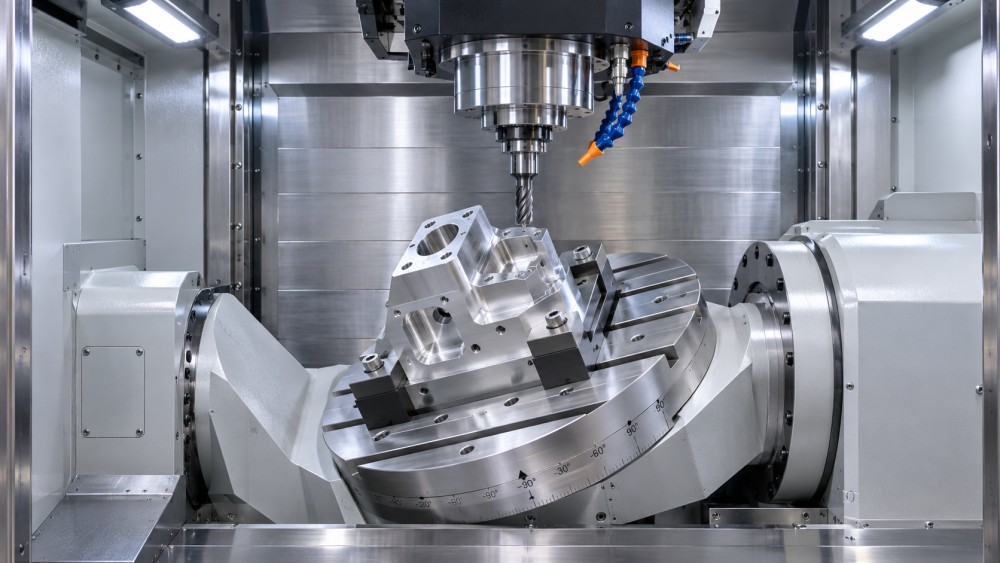
A component with holes and milled features on multiple faces is a common candidate. On a three-axis machine, each face may need a separate setup and a new datum alignment. A five-axis configuration can position the part to present several faces to the spindle in one clamping. That can remove handling and reduce the opportunity for errors introduced during repositioning. It does not eliminate the need to establish datums accurately, nor does it guarantee that every face is accessible.
Complex contoured parts present a different opportunity. Tilting the tool or workpiece can improve access to a surface, permit shorter tools and help maintain a more favorable cutting orientation. The actual gain depends on the material, cutting strategy, machine rigidity and finish requirement. Some surfaces will still need finishing passes, manual work or a separate process.
By contrast, a part with features on one face, generous tolerances and a stable fixture may run economically on a three-axis machine. Replacing an effective process simply because a newer machine has more axes can raise the hourly cost without removing enough work from the route.
Distinguish positioning from simultaneous cutting
Not every part described as five-axis needs all five axes moving during a cut. In 3+2 machining, the rotary axes position the workpiece or tool at an angle and remain fixed while the linear axes cut. This can be sufficient for angled holes, pockets and features on multiple faces. It can also simplify programming and process validation compared with continuously moving all axes.
Simultaneous five-axis machining coordinates the rotary and linear axes during cutting. It is useful when a tool must follow a changing surface orientation or maintain access through a complex passage. It also places greater demands on the control, postprocessor, simulation, operator training and machine accuracy. Buyers should establish which of these capabilities the target parts actually need before specifying software and machine options.
Check access against the real fixture and stock, not just a model of the finished part. Rotary travel limits, table size, spindle orientation and interference between the holder, fixture and machine enclosure can prevent a proposed setup. A machine may reach the necessary angles on paper while lacking the clearance to cut safely with the required tool.
Build the comparison around annual cash flow
A useful business case compares the proposed process with the best practical existing alternative. That might be a three-axis machine with improved fixtures, a fourth-axis rotary table, a mill-turn machine or an outside supplier—not necessarily the current method unchanged. Use the same expected part mix, quality requirements and planning period for each option.
For each representative part, estimate annual demand and compare the full cost of producing an acceptable part. Include the following where they change between alternatives:
- Machine and labor time: setup, cutting, tool changes, operator attention and handling between operations. Distinguish attended time from machine-running time.
- Quality and flow: inspection, rework, scrap, work-in-process and external processing. Use observed costs where available; treat uncertain improvements as scenarios rather than guaranteed savings.
- Process preparation: programming, simulation, prove-out, fixtures, tooling and first-article inspection. Spread recurring and one-time costs appropriately across the expected production life.
- Ownership and support: purchase and installation, software and maintenance agreements, training, utilities, service, calibration and financing costs where applicable.
A simple screening calculation is: annual net benefit = annual avoidable operating cost under the alternative − annual operating cost of the five-axis route − additional annual ownership and support costs. If this figure is positive, a rough payback period can be estimated by dividing the incremental upfront investment by the annual net benefit, provided the annual calculation has not already included depreciation or another charge for that same upfront investment. This is a screening measure, not a substitute for a discounted cash-flow analysis when timing, financing and residual value matter.
Keep the comparison consistent. For example, counting a reduction in machine hours as a cash saving is only valid if those hours reduce an actual cost or support additional profitable work. Freed capacity on an otherwise idle machine has a different value from capacity that removes an overtime shift or avoids subcontracting.
Test utilization rather than assuming a full schedule
A machine can be technically suitable and still fail the investment test if too few jobs reach it. Build a realistic loading plan from confirmed demand and a separate pipeline of plausible work. Allow for setup, programming, maintenance, tool changes and nonproductive time; scheduled cutting hours are not the same as available calendar hours.
Run at least a conservative and an expected scenario. Vary demand, actual cycle time, setup reduction and scrap improvement independently where possible. This shows which assumption drives the decision. If the investment only works when every forecast part arrives and every setup saving is achieved, the exposure is materially different from a case that remains viable with lower loading.
Where the economics tend to change
High setup content. Low- and medium-volume jobs can justify five-axis capability when repeated clamping consumes substantial labor or delays the next operation. The relevant measure is total setup effort across the batch, including fixture preparation and verification. A single setup on the new machine can still require a sophisticated fixture and a careful prove-out.
Tolerances between faces. Features machined in one clamping may be less exposed to errors caused by transferring the part between fixtures. That can reduce adjustment and inspection effort when relationships between faces are critical. Machine geometry, thermal behavior, probing, tool wear and measurement uncertainty still affect the result, so confirm capability against the actual drawing and inspection method.
Shorter lead time. Consolidating operations can reduce queues and work-in-process even if cutting time changes little. This matters when delivery commitments or constrained machines limit output. Quantify a financial effect only when the shorter route avoids a cost or creates usable capacity; do not add an arbitrary value for speed and count the same capacity saving twice.
Expensive material or rework. A more stable process may be valuable when a defective part represents substantial accumulated material and machining cost. However, a new process can initially increase risk during programming and prove-out. The comparison should include that learning period rather than assuming immediate yield improvement.
Costs that can erode the projected return
The machine quotation is only the beginning. Five-axis production may require a different CAM package or module, a suitable postprocessor, collision simulation, probing routines, additional toolholders and workholding that raises the part above the rotary table. Large or heavy fixtures also consume payload and can restrict tilt. Ask for these items to be priced against the intended part family, including implementation and continuing support.
Programming and prove-out deserve particular attention for frequent part changes. An operation saved on the shop floor may be offset by additional preparation if each job is unique and the programming team is already constrained. Conversely, repeat orders can spread proven programs and fixtures across multiple batches. Compare the total engineering hours over the expected order life, not only the first run.
Machine availability also matters. Consolidating several operations onto one center can remove transfers, but it can put more of the route on a single asset. Consider the consequences of a spindle failure, rotary-axis service or control fault, including service response, spare-parts access and whether critical work has a qualified fallback route.
Specify and validate the purchase against real work
Before requesting final quotations, prepare a small set of representative drawings, material specifications and expected batch sizes. Include a difficult but realistic part, not only an ideal demonstration component. Identify required datums, tolerances, surface finishes, inspection requirements and the operations that must be included in the proposed cycle.
Ask each supplier to explain the proposed setup, fixture concept, tools, programming approach and any operations left outside the machine. Request cycle-time and setup estimates with their assumptions stated: stock condition, tooling, cutting parameters, operator involvement and whether prove-out is included. A comparison is meaningful only when each proposal covers the same scope.
Machine selection should then address the physical and operational limits of that process:
- Confirm usable travels and rotary angles with the actual part, fixture and tool envelope; nominal travel alone does not establish access.
- Check table payload, workpiece size, spindle characteristics and rigidity against the material and cutting loads, including the weight and height of workholding.
- Define the required accuracy and inspection approach at the operating conditions relevant to the parts. A general machine specification is not proof that a particular tolerance can be held in production.
- Verify compatibility between the control, CAM system, postprocessor, simulation and probing routines, including responsibility for resolving integration problems.
- Agree on installation requirements, operator and programmer training, acceptance criteria, service arrangements and the availability of a qualified fallback for critical orders.
An acceptance test should reflect the purchased capability. Agree in advance on the test part, material, tooling, measurement method and environmental conditions, as well as which results constitute acceptance. A demonstration cut can reveal access or process issues, but a single successful part does not establish long-term production stability.
When another route is the better investment
A fourth-axis fixture may provide enough access for indexed features at lower incremental cost. Additional three-axis capacity can be more attractive when simple work is already constrained by machine availability. For parts that also need extensive turning, a suitable mill-turn process may reduce transfers more effectively than a machining center alone. Each alternative still needs its own fixture, programming and capacity assessment.
Outsourcing is a practical comparison when demand is intermittent or the organization cannot yet support programming and maintenance in-house. Evaluate quoted part cost alongside transport, lead time, quality documentation, intellectual-property controls and the risk of relying on an external schedule. The buy decision becomes stronger when a repeatable workload and a supported process can justify the committed capital; it is weaker when the projected return depends mainly on work that has not been won.
Related News
- Sprockets and Chain Drives: What Determines Replacement Cost?Nov 08, 2026CNC Kinematics Architect
- Monoblock Hydraulic Control Valves: Flow Rating and Spool SelectionNov 08, 2026Fluid Power Control Strategist
- Cement Mortar Linings for Ductile Iron Pipes: Inspection and StandardsNov 08, 2026Pipeline Metallurgy Scientist
- Why Needle Roller Thrust Bearings Fail: Loads, Lubrication and WearNov 08, 2026Tribology & Kinematics Expert
- Selecting Machine Tool Bearings for Machining Center SpindlesNov 08, 2026CNC Kinematics Architect
- Industrial Gearbox Drive Shafts: Torque, Alignment and Fatigue LifeNov 07, 2026Tribology & Kinematics Expert