
How to Qualify a Milling Cutters Supplier for Tight-Tolerance Production
For procurement teams sourcing tools for demanding CNC applications, selecting a qualified milling cutters supplier is essential to achieving consistent tight-tolerance production.
Beyond catalog specifications and unit price, buyers must assess tool geometry, coating quality, material consistency, batch traceability, technical support, and delivery reliability.
A low-priced cutter can become expensive when it causes unstable dimensions, short tool life, poor surface finish, unexpected machine downtime, or repeated inspection failures.
The right supplier should demonstrate repeatable manufacturing control, transparent technical documentation, and the ability to support actual machining conditions rather than generic applications.
This guide explains how procurement professionals can evaluate a milling cutters supplier, reduce tooling risk, and build a dependable supply chain for precision production.
Start With the Tolerance Risk of the Actual Part
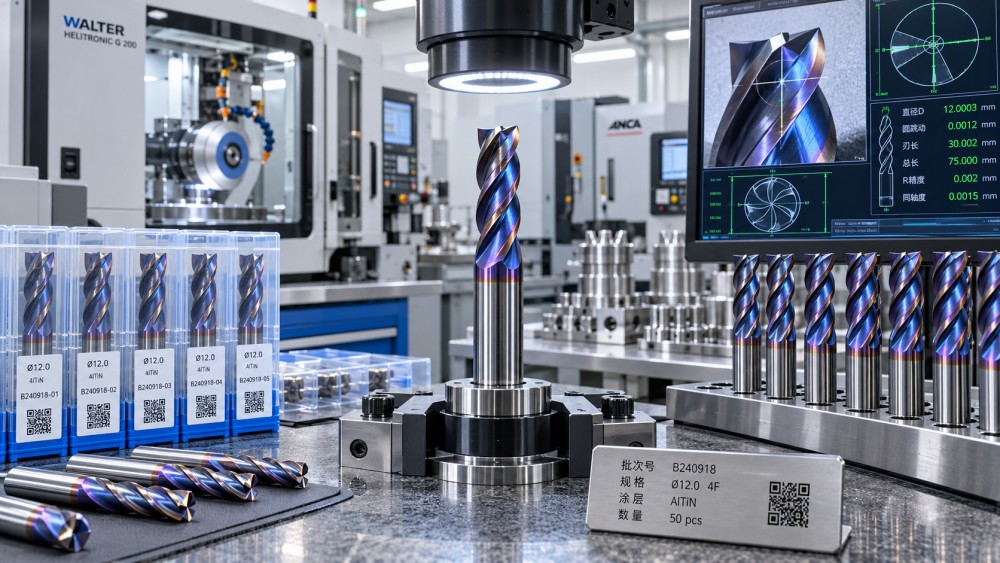
Supplier qualification should begin with the finished component, not with the cutter catalog. Procurement teams need a clear view of tolerance, material, geometry, volume, and process risk.
A milling cutter used for roughing structural steel does not face the same requirements as a tool finishing hardened mold inserts or aerospace aluminum pockets.
For tight-tolerance work, even small changes in runout, edge preparation, coating thickness, or carbide grade can affect dimensional accuracy and surface consistency.
Buyers should request the drawing features that are most sensitive to cutter performance, including bore diameters, slot widths, wall thicknesses, flatness, and profile tolerances.
It is also important to identify whether the cutter is used for roughing, semi-finishing, finishing, contour milling, high-speed machining, or long-reach machining.
Each application creates different demands for rigidity, chip evacuation, heat control, radial engagement, and edge sharpness. A supplier must understand these relationships before recommending a tool.
Procurement should involve manufacturing engineering early. Purchasing can compare commercial terms, but process engineers must confirm whether the proposed cutter supports the required capability level.
A practical qualification brief should include workpiece material, hardness range, machine spindle speed, toolholder type, coolant method, cutting parameters, and expected annual consumption.
Verify Carbide Quality and Tool Geometry Control
For solid carbide milling cutters, the quality of the carbide blank is a foundation for stable performance. Inconsistent grain structure can lead to uneven wear and edge chipping.
A credible milling cutters supplier should identify the carbide grade, grain size category, binder content range, and intended material group for each cutter series.
Micrograin and ultrafine carbide grades are often selected for finishing and difficult materials, but the correct choice depends on toughness requirements and cutting conditions.
Buyers should be cautious when suppliers provide only broad claims such as “premium carbide” without describing the material source, specification, or quality-control method.
Tool geometry requires equal attention. Helix angle, flute count, rake angle, relief angle, core diameter, corner design, and edge preparation directly influence milling behavior.
For example, a larger core can improve rigidity, while fewer flutes can provide better chip evacuation in deep aluminum slots or sticky stainless steel applications.
Corner radius and chamfer dimensions must be controlled carefully when the cutter is used to generate finished profiles. Tool variation can transfer directly to the part.
Ask the supplier what tolerances they hold on cutter diameter, flute geometry, shank diameter, overall length, and corner features. “Standard” should be defined numerically.
Assess Coating Consistency, Not Just Coating Names
Tool coatings are frequently presented as product labels, but procurement teams need to understand the functional purpose behind each coating recommendation.
TiAlN, AlTiN, TiSiN, DLC, and uncoated options each behave differently under heat, lubrication, workpiece chemistry, and cutting speed.
A suitable coating can reduce friction, protect the substrate, and extend tool life. An unsuitable coating may increase built-up edge, heat generation, or premature failure.
For tight-tolerance production, coating consistency matters because uncontrolled thickness can change effective cutter diameter and influence final feature size after tool replacement.
A milling cutters supplier should be able to explain coating thickness ranges, deposition methods, adhesion checks, and which substrates are paired with each coating.
For finishing operations, buyers should ask whether the supplier controls coating buildup around cutting edges, corner radii, and small-diameter tool features.
Coating selection should also match coolant strategy. Some coatings perform well in dry high-speed applications, while others require controlled coolant delivery to prevent thermal shock.
Request documented recommendations for the intended material groups, including aluminum alloys, stainless steels, alloy steels, cast iron, titanium, nickel alloys, and hardened steels.
Check Manufacturing Repeatability Across Tool Batches
A sample tool can perform well while later production batches vary. Procurement qualification should therefore focus on repeatability, not just initial approval.
Ask how the supplier controls grinding wheels, wheel dressing intervals, machine calibration, tool measurement, and inspection frequency during production.
Modern cutter manufacturing commonly uses CNC tool grinders and optical measurement systems, but equipment alone does not guarantee reliable geometry control.
The supplier should have defined acceptance criteria for critical dimensions and a documented process for isolating nonconforming tools before shipment.
Batch identification is particularly important for high-volume manufacturers. Each shipment should be traceable to a production date, lot number, and inspection record.
Traceability makes it easier to investigate sudden changes in tool life, surface finish, dimensional drift, or breakage rates across different manufacturing cells.
For custom milling cutters, request first article inspection reports before volume release. These reports should confirm the actual dimensions rather than simply restating drawing values.
When possible, compare several tools from the same lot and from separate lots. Measure diameter, runout, corner geometry, and coating condition before full approval.
Evaluate Runout, Toolholding Compatibility, and Dynamic Stability
Tight-tolerance milling depends on the complete system. A high-quality cutter cannot compensate for poor toolholding, spindle condition, fixture rigidity, or unsuitable cutting parameters.
However, the cutter supplier should understand these system interactions and help buyers identify conditions that could undermine otherwise acceptable tool performance.
Runout is a critical example. Excessive radial runout causes uneven chip load, faster wear on one flute, poor surface finish, and unpredictable size control.
Buyers should ask what cutter shank tolerance the supplier provides and whether the tool is compatible with collet chucks, hydraulic holders, shrink-fit holders, or milling chucks.
For demanding finishing operations, suppliers should recommend practical runout targets at the cutting edge, not only nominal shank tolerances listed on a catalog page.
Long-reach cutters deserve special scrutiny. Their performance depends on flute design, neck clearance, core strength, vibration behavior, and conservative process settings.
A capable milling cutters supplier can provide starting parameters and explain how axial depth, radial engagement, feed per tooth, and overhang affect stability.
This support reduces the risk that a purchasing team rejects a suitable tool because it was tested under unstable or poorly documented machining conditions.
Review Application Engineering and Problem-Solving Capability
Technical support is often where qualified suppliers separate themselves from traders or catalog-only vendors. Tight-tolerance production needs more than product availability.
When parts fail inspection, users need timely analysis of wear patterns, cutter damage, chip formation, machining marks, and dimensional deviation.
Ask whether the supplier has application engineers who can review machining videos, tool photographs, machine data, and process records remotely or on site.
The supplier should be able to distinguish between tool failure caused by geometry, incorrect feeds and speeds, workholding vibration, inadequate coolant, or machine spindle issues.
Useful technical support includes recommended cutting data, toolpath guidance, entry strategy, ramping advice, plunge limitations, and replacement criteria for worn tools.
For recurring production, request a documented process sheet. It should identify the approved cutter, holder, tool projection, parameters, material condition, and inspection checkpoints.
This document helps maintain production consistency when operators change, machines are reassigned, or a new batch of tools is introduced.
Suppliers that can propose optimized alternatives may also create measurable value by reducing cycle time, minimizing secondary finishing, or increasing tool life without sacrificing accuracy.
Confirm Quality Documentation and Compliance Requirements
Procurement teams should define documentation requirements before requesting quotations. Requirements vary significantly between general manufacturing and regulated or safety-critical industries.
Basic documents may include certificates of conformity, inspection records, packing lists, country-of-origin statements, and batch identification labels.
Higher-risk applications may require material declarations, coating information, calibration records, supplier quality manuals, or evidence of ISO 9001 quality-system certification.
For aerospace, medical, energy, or defense-related production, buyers may need additional controls for traceability, restricted substances, export requirements, and change notification.
A qualified milling cutters supplier should state clearly what documentation is standard, what is available on request, and what creates additional lead time or cost.
Change control deserves specific attention. The supplier should notify customers before changing carbide sources, coating systems, manufacturing sites, or critical tool geometry.
Undisclosed changes can disrupt validated machining processes. This risk is especially serious when a cutter is used on features with narrow tolerances or expensive raw materials.
Include documentation and change-control expectations in supplier agreements rather than relying on verbal commitments made during initial technical discussions.
Measure Delivery Reliability and Supply Chain Resilience
A qualified supplier must deliver consistent tools when production requires them. A technically strong cutter is of limited value if replacement stock arrives after the machine stops.
Review normal lead times, stock availability, minimum order quantities, expedited production options, and the supplier’s ability to maintain safety inventory for critical tools.
For high-consumption tools, consider a blanket order, vendor-managed inventory arrangement, or agreed stocking program with defined replenishment triggers.
Procurement should also understand where blanks are sourced, where tools are ground, where coatings are applied, and whether key processes depend on one location.
Single-site dependence can create avoidable risk during logistics disruption, power interruption, capacity shortages, or regional trade restrictions.
Ask for on-time delivery performance data, particularly for custom tools. General statements about fast delivery are less useful than measurable historical performance.
Packaging should protect cutting edges and preserve lot identification. Damaged tools, mixed batches, and unclear labels create unnecessary receiving and production risk.
For international sourcing, confirm Incoterms, customs documentation, transit variability, and the supplier’s ability to respond quickly to urgent technical or commercial issues.
Use a Structured Trial Before Approving Full Production
Supplier qualification should end with a controlled production trial. The objective is to verify repeatable results under actual operating conditions, not laboratory assumptions.
Define acceptance criteria in advance. These may include feature size, surface roughness, tool life, number of components per edge, cycle time, and breakage rate.
Run trials using representative material batches, approved fixtures, normal operators, and production-equivalent machine settings whenever possible.
Compare the candidate cutter against the current approved tool using the same toolholder, projection, coolant strategy, and inspection method.
Do not evaluate only the first component. Track performance through enough parts to identify wear progression, dimensional drift, and finish changes near end of life.
Record actual parameters, inspection data, operator comments, and tool condition photographs. This evidence makes future sourcing decisions easier to defend internally.
Commercial evaluation should include cost per accepted part, not simply purchase price per cutter. A more expensive tool can lower total cost through longer life and better consistency.
Once approved, establish periodic supplier reviews. Performance, quality issues, delivery results, engineering responsiveness, and cost trends should be reviewed against agreed targets.
Build a Supplier Scorecard That Procurement Can Use
A supplier scorecard turns technical evaluation into a repeatable purchasing process. It also helps procurement compare suppliers fairly across different product lines and regions.
Weight the criteria according to production risk. Tight-tolerance components should give greater importance to geometry control, batch consistency, engineering support, and traceability.
Typical scorecard categories include tool performance, dimensional consistency, documentation quality, delivery reliability, response time, commercial terms, and continuous improvement capability.
Use evidence wherever possible. A supplier should earn points through inspection records, trial data, corrective-action quality, and delivery history rather than marketing claims.
Separate mandatory requirements from preferred capabilities. For example, traceability may be mandatory, while local inventory support may be a scored commercial advantage.
Include feedback from machining engineers, quality teams, production supervisors, and receiving personnel. Each function sees supplier performance from a different operational perspective.
A well-maintained scorecard also supports supplier development. It identifies whether problems require technical collaboration, stronger incoming inspection, alternate sourcing, or formal corrective action.
This approach gives procurement teams a defensible basis for selecting a milling cutters supplier that supports long-term manufacturing performance.
Conclusion: Buy Process Capability, Not Just Cutting Tools
For tight-tolerance production, the best milling cutters supplier is not necessarily the company offering the lowest unit price or the largest product catalog.
Qualification should focus on whether the supplier can repeatedly deliver controlled geometry, reliable carbide and coating quality, usable documentation, technical support, and predictable supply.
Procurement teams gain the strongest results when they connect sourcing decisions with actual part requirements, machining conditions, inspection data, and total cost per accepted component.
A structured trial, documented acceptance criteria, and periodic supplier scorecards transform tooling procurement from a price comparison exercise into a production-risk management process.
By qualifying suppliers on measurable capability, buyers can protect part accuracy, reduce unplanned downtime, improve machining consistency, and create a more resilient precision tooling supply chain.
Related News
- How to Assess a Rigid Coupling Supplier for Bore Accuracy and Traceable QualityOct 08, 2026Tribology & Kinematics Expert
- Titanium Alloys Compared: Balancing Strength, Corrosion Resistance, and MachinabilityOct 08, 2026CNC Kinematics Architect
- Where Ductile Iron Dismantling Joints Reduce Alignment Risk in Water PipelinesOct 08, 2026Pipeline Metallurgy Scientist
- Selecting a Precision Bearing Sleeve: Fits, Runout, and Material ChoicesOct 08, 2026Tribology & Kinematics Expert
- Face Milling Cutters: How Insert Geometry Affects Finish on Steel and AluminumOct 08, 2026CNC Kinematics Architect
- Single-Acting Cylinders for Clamping: Stroke, Force, and Return Spring ConsiderationsOct 07, 2026Fluid Power Control Strategist