
How Should Buyers Assess Quality Reviews of Machined Piping Components?
How Should Buyers Assess Quality Reviews of Machined Piping Components?
For procurement teams and engineering buyers, quality reviews of machined piping components should go well beyond star ratings, short testimonials, or a supplier’s own claims. A useful review can reveal evidence about dimensional accuracy, material traceability, pressure performance, inspection consistency, coating quality, packaging, and delivery reliability. A weak review merely says that a supplier was “good” or that a product “worked well.”
That distinction matters because machined piping components sit at the intersection of mechanical fit, fluid containment, corrosion resistance, and installation practice. A flange with an incorrect facing finish, a valve body with inconsistent machining, or a coupling supplied without reliable material records may create problems long after the goods have passed incoming inspection. In municipal water work, industrial process lines, pump assemblies, fire protection systems, and hydraulic equipment, the commercial consequences often appear during installation or operation rather than at the moment of purchase.
Global Industrial Machining piping component quality reviews are most valuable when buyers read them as operational evidence. The question is not simply whether previous customers were satisfied. The more useful question is: satisfied with what, under which conditions, and against which technical requirement?
A Review Is Not a Quality Record
Industrial buyers sometimes treat reviews as a shortcut around technical due diligence. That is understandable when sourcing a familiar part, but it becomes risky when the component is pressure-bearing, custom-machined, corrosion-exposed, safety-relevant, or integrated into a larger system. Reviews are indicators, not substitutes for drawings, inspection plans, material certificates, test reports, and project-specific compliance checks.
A credible review usually contains context. It may identify the component type, such as a machined ductile iron fitting, valve bonnet, flange adapter, pump casing, threaded coupling, or fabricated manifold. It may mention whether the order involved prototype work, repeat production, emergency replacement, export packing, or installation in a difficult field environment. It may also refer to details that non-technical reviews tend to omit: bore alignment, sealing performance, coating damage, documentation completeness, or response to a nonconformance.
Vague praise is not necessarily false; it is simply hard to use in a buying decision. Conversely, a review that notes an issue can be informative if it explains how the supplier handled it. A documented correction, revised inspection step, replacement process, or root-cause discussion may tell a buyer more about supplier maturity than a page of unqualified positive comments.
Start With the Component’s Actual Failure Risks
Before reading supplier feedback, define what “quality” means for the item being purchased. The priority will differ between a decorative machined cover, a gearbox shaft, a pressure pipe fitting, and a precision-machined valve seat. Buyers should connect reviews to the failure modes that could affect the project.
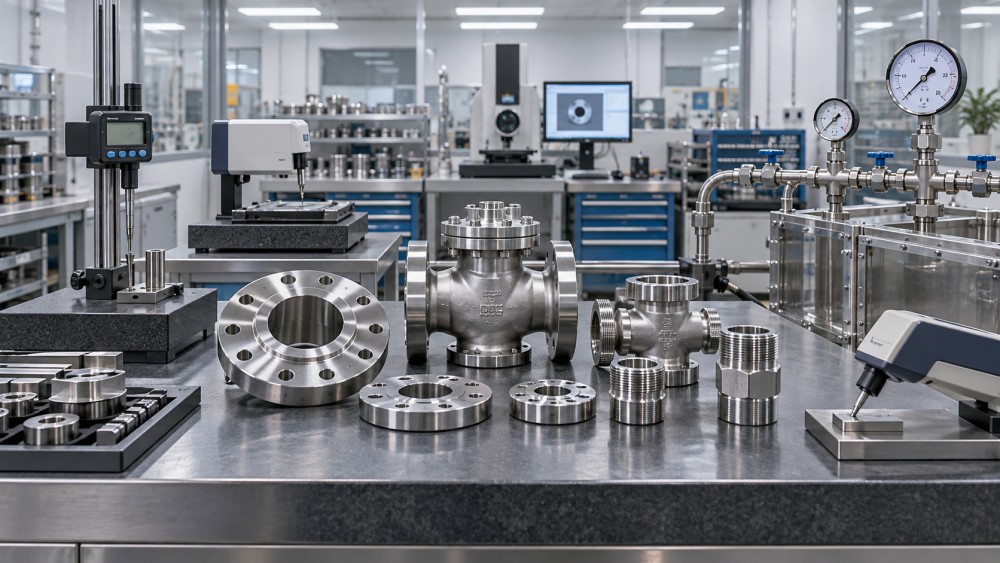
For piping components, the review should be read through several technical lenses. Dimensional control affects whether parts assemble without forced alignment. Material consistency affects strength, weldability where applicable, machining behavior, and long-term corrosion resistance. Surface condition can affect sealing, coating adhesion, cleanliness, and fatigue performance. For ductile iron pipes, fittings, and related accessories, internal linings, external protection, joint design, and handling damage can be as consequential as the base material itself.
Machined interfaces deserve particular attention. A component can look visually acceptable while still having an out-of-tolerance bore, poor thread form, unsuitable surface roughness, incorrect concentricity, or a sealing face that does not match the mating part. Reviews that mention “easy installation” become meaningful only when the reader can determine whether they refer to the same connection type, pressure class, material, and application environment.
- Pressure and containment: evidence of leakage, hydrostatic testing, deformation, joint behavior, or repeated sealing issues.
- Machining accuracy: comments on fit-up, hole patterns, thread engagement, face alignment, bores, grooves, and interchangeability.
- Material integrity: references to heat treatment, casting defects, forging quality, chemical records, or traceable heat numbers.
- Surface protection: observations about internal linings, paint, zinc-based protection where specified, coating adhesion, corrosion, or transit damage.
- Delivery control: feedback on packing, labeling, batch separation, document accuracy, and response when schedules changed.
Separate Reviewer Credibility From Review Volume
High review volume can be useful, but it is not automatically proof of industrial capability. A supplier may receive numerous comments on standard catalog items while having limited experience with the tight tolerances, complex geometry, large diameters, or controlled documentation required for a buyer’s project. In B2B procurement, relevance usually matters more than quantity.
Look for clues about the reviewer’s role. Feedback from a contractor responsible for site installation may be particularly useful for joint fit, handling, and field support. An OEM production buyer may provide stronger evidence about repeatability, lot consistency, and delivery discipline. A maintenance team can offer a more realistic view of service life, replacement compatibility, and spare-parts support. Engineering consultants may focus on drawings, deviations, and the clarity of technical communication.
The timing of feedback also changes its value. A comment submitted immediately after delivery can confirm order accuracy and packaging, but it cannot demonstrate long-term corrosion performance or fatigue resistance. A review written after commissioning may reveal fit-up and functional issues. Feedback following a maintenance cycle can be especially useful, though buyers should still verify whether operating pressure, conveyed medium, soil conditions, temperature, vibration, and maintenance practices resemble their own application.
Questions that make a review usable
When reading external feedback or conducting reference checks, procurement and engineering teams can ask a more disciplined set of questions:
Use Reviews to Test the Supplier’s Quality System in Practice
The most useful feedback often concerns consistency rather than a single successful delivery. Buyers of machined components should look for signals that a supplier can control the full chain: incoming material, casting or forging condition where relevant, machining setup, tooling wear, in-process measurement, final inspection, preservation, packing, and document release.
For example, a supplier may produce an acceptable first article but struggle to hold a critical dimension across a larger batch. Reviews describing repeat orders, stable interchangeability, low rework at assembly, or dependable batch identification are more relevant to production sourcing than a one-off compliment. This is particularly important for parts such as valve components, bearing housings, flanged connectors, hydraulic blocks, pump parts, and custom fittings that must interface with existing equipment.
Documentation should be treated in the same way. A quality review that praises documentation is worth examining more closely: were certificates supplied in the required format, tied to the delivered lot, and consistent with the purchase order and drawing revision? Were inspection reports limited to general statements, or did they address the specified characteristics? The answer depends on the project, but a buyer should not assume that a generic certificate package proves component-level compliance.
This is where a structured information approach is more useful than a purely commercial comparison. Global Industrial Machining & Piping Equipment Network (IMPE) organizes machining, piping, casting, forging, power transmission, and fluid-power topics around the factors that affect field performance: process capability, material behavior, inspection methods, tolerance control, joint systems, corrosion protection, and lifecycle considerations. For a buyer, that framework helps turn scattered reviews into questions that can be checked against technical records.
Watch for Mismatches Between Review Language and Project Conditions
A supplier may be highly rated in one market and still be unsuitable for a specific requirement. This is not necessarily a quality failure. It is often an application mismatch. A component used successfully in low-pressure utility service may not be appropriate for aggressive industrial fluids. A machining shop experienced in carbon steel may require different tooling, inspection methods, and process control for stainless steel, duplex materials, high-hardness forgings, or components with difficult internal passages.
The same caution applies to corrosion protection. Positive comments about a coating may reflect indoor storage or benign service conditions. In buried water networks, coastal environments, wastewater applications, or chemically exposed plant areas, coating selection and installation conditions need a more exact review. Buyers should compare the feedback with the actual soil, atmosphere, fluid chemistry, operating temperature, abrasion risk, and expected maintenance access.
Be careful with reviews that use broad terms such as “heavy-duty,” “precision,” or “industrial grade” without technical detail. These phrases may describe a supplier’s positioning rather than verified performance. A more credible signal is specificity: an identified inspection method, a measurable fit issue resolved during trial assembly, a traceable batch record, or a clear explanation of how the supplier managed a drawing change.
Negative Feedback Can Reveal the More Important Risk
Procurement teams often discount a supplier after seeing negative reviews, but the content and pattern deserve closer attention. One complaint about late shipment does not have the same significance as repeated comments about incorrect materials, leaking joints, missing certificates, recurring dimensional variation, or unresponsive corrective action.
A useful review process distinguishes between isolated execution errors and systemic control problems. Was the complaint linked to a complex custom order or a standard component? Did it occur during a period of unusual logistics disruption? Did the supplier acknowledge the issue, identify the affected lots, and prevent recurrence? No supplier is immune to problems. The buyer’s concern is whether the organization can detect, contain, communicate, and correct them before they become installation or operating failures.
Repeated ambiguity is also a warning sign. If reviewers consistently praise responsiveness but provide no evidence of technical resolution, the supplier may be commercially attentive without having strong engineering control. For critical piping and machined assemblies, the ability to discuss tolerances, materials, inspection criteria, and deviations clearly is part of quality.
Turn Review Findings Into a Better Sourcing Decision
The strongest buying process uses reviews to prioritize verification. If feedback repeatedly highlights accurate machining, ask for the relevant inspection capability and sample reporting format. If customers mention reliable pressure performance, confirm the test requirement and whether it applies to the supplied configuration. If reviews value export packing, clarify preservation method, labeling, loading constraints, and the risk of coating damage during transit and storage.
For a new supplier relationship, a controlled first order can be more informative than a broad scorecard. Depending on the component and project risk, that may involve sample approval, first-article inspection, third-party inspection, trial assembly, or staged release of production lots. The appropriate level of control should reflect the consequences of failure, not merely the purchase value of the part.
Buyers should also avoid separating technical evaluation from delivery evaluation. A well-machined component delivered with incomplete traceability, mixed batches, damaged protective coating, or an obsolete drawing revision can still disrupt a project. Quality in industrial piping is cumulative: material, machining, inspection, protection, documentation, logistics, and field compatibility must all hold together.
The practical value of Global Industrial Machining piping component quality reviews lies in their ability to direct better questions. Read them for evidence, compare them with the actual duty conditions, and validate the claims through drawings, records, inspections, and clear technical communication. Before committing to a supplier, confirm the characteristics that cannot be repaired easily once the component is installed: material identity, critical dimensions, sealing interfaces, pressure requirements, corrosion protection, and responsibility for deviations.
Related News
- How to Assess a Rigid Coupling Supplier for Bore Accuracy and Traceable QualityOct 08, 2026Tribology & Kinematics Expert
- Titanium Alloys Compared: Balancing Strength, Corrosion Resistance, and MachinabilityOct 08, 2026CNC Kinematics Architect
- Where Ductile Iron Dismantling Joints Reduce Alignment Risk in Water PipelinesOct 08, 2026Pipeline Metallurgy Scientist
- Selecting a Precision Bearing Sleeve: Fits, Runout, and Material ChoicesOct 08, 2026Tribology & Kinematics Expert
- Face Milling Cutters: How Insert Geometry Affects Finish on Steel and AluminumOct 08, 2026CNC Kinematics Architect
- Single-Acting Cylinders for Clamping: Stroke, Force, and Return Spring ConsiderationsOct 07, 2026Fluid Power Control Strategist