
End Mill Prices: How Grade, Coating, and Tool Life Change Total Cost
A low quote for a milling cutter can feel like an easy win—until the machine stops for a tool change halfway through a batch, surface finish begins to drift, or an operator has to slow the program to protect the cutting edge. For procurement teams, end mills price is not simply a line-item comparison. It is part of a wider calculation involving machining time, tool consumption, setup stability, scrap exposure, inventory complexity, and the relationship between the shop floor and the supplier.
Two end mills with the same diameter may look nearly identical in a catalog, yet behave very differently in hardened steel, stainless steel, aluminum, cast iron, titanium, or abrasive composite materials. The difference may come from carbide grade, coating chemistry, flute geometry, edge preparation, runout control, or manufacturing consistency. Understanding those variables helps buyers avoid the common mistake of purchasing the lowest-priced cutter while paying more through production.
Why the lowest end mills price rarely represents the lowest cost
Unit price matters, especially when a machining operation uses dozens or hundreds of tools each month. But the purchasing decision should start with a more practical question: What does this tool cost per acceptable part produced?
A cheaper end mill may be sensible for low-volume work, soft materials, prototype machining, or a non-critical feature. It may not be the right choice for an unattended production cell, a high-value aerospace component, a tight-tolerance hydraulic manifold, or a long-running mold cavity operation. In those environments, tool failure has consequences beyond replacement cost.
When a cutter wears too quickly or breaks unexpectedly, the actual cost can include:
- Machine downtime for tool replacement and offset adjustment;
- Lost spindle time caused by reduced feed rates or conservative cutting parameters;
- Increased operator intervention and inspection workload;
- Scrapped workpieces or expensive rework after dimensional drift;
- Interrupted production schedules and delayed deliveries;
- More safety stock because tool life is unpredictable.
This does not mean the most expensive option is automatically best. Premium tooling can also be overspecified. A high-performance coated carbide end mill designed for difficult alloys may offer limited benefit in short aluminum jobs where an uncoated polished tool is more appropriate. The goal is fit, not prestige.
Grade: the foundation behind cutting performance
Carbide grade is one of the least visible yet most influential reasons why end mill pricing varies. Cemented carbide consists primarily of hard tungsten carbide particles held together by a metallic binder, commonly cobalt or another binder system. The relationship between grain size, binder content, hardness, and toughness determines how the tool responds under load and heat.
Fine-grain and ultrafine-grain carbide grades are often selected for applications requiring sharp edges, wear resistance, and stable performance. They can support demanding finishing operations and difficult materials when the machine, toolholder, and process are controlled. Tougher grades, meanwhile, may be preferable where interrupted cuts, vibration, or heavy roughing raise the risk of chipping.
From a buyer’s perspective, it is useful to ask suppliers what the grade is intended to handle rather than requesting a generic “high-grade carbide” claim. A meaningful technical discussion should address the workpiece material, hardness range, cutting mode, coolant method, depth of cut, radial engagement, and machine rigidity.
For example, ductile iron machining can be abrasive and may accelerate flank wear. Stainless steel tends to work-harden and generate heat at the cutting edge. Titanium retains heat near the tool and demands careful thermal management. Aluminum often needs a sharp polished geometry that prevents built-up edge. One carbide grade cannot be optimal for every one of these conditions.
What procurement teams should verify about grade
- Whether the supplier identifies the target material group and intended operation;
- Whether the cutter is solid carbide, carbide-tipped, high-speed steel, or another construction;
- Whether grade selection is supported by application guidance rather than broad catalog language;
- Whether the supplier can provide batch consistency and traceability for recurring production programs;
- Whether tool performance is repeatable across replenishment orders.
In high-volume machining, repeatability may be more valuable than a single exceptional trial result. A tool that lasts slightly longer but varies widely from batch to batch can be harder to manage than a consistently performing alternative.
Coating changes more than the catalog price
Coatings are frequently presented as a simple upgrade, but they are a process-specific choice. A coating can reduce friction, improve heat resistance, resist abrasion, or protect the cutting edge from certain wear mechanisms. It can also be a poor match for the material, coolant strategy, or machining condition.
Common coating families include TiN, TiCN, TiAlN or AlTiN-type coatings, aluminum chromium nitride variants, diamond-like coatings, and specialized coatings for non-ferrous or abrasive materials. Names vary by tool manufacturer, so buyers should focus less on labels and more on the intended application.
For dry or high-temperature milling of steels, heat-resistant coatings may allow higher cutting speeds or extend usable tool life. In stainless steel, the right coating and edge treatment can reduce premature wear caused by heat and adhesion. For aluminum, a polished uncoated tool or a coating designed to resist material adhesion may outperform a general-purpose dark-coated cutter. In graphite, composites, or highly abrasive materials, wear-resistant specialized coatings can be essential.
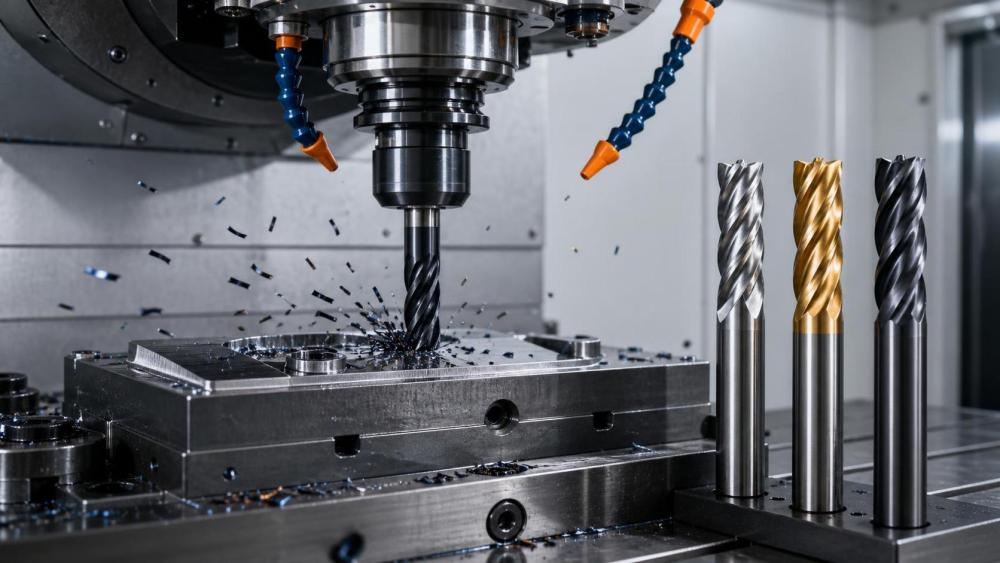
Coating also affects regrinding decisions. If a tool is reground, the original coating may be removed from the cutting edge. Recoating may restore performance, but only if the geometry remains suitable and the logistics cost makes sense. For a procurement program involving larger-diameter or custom end mills, it is worth evaluating whether a regrind-and-recoat route can lower lifecycle spending without compromising quality.
Tool life is where the cost comparison becomes real
A useful tool-life evaluation does not rely only on the number of minutes a cutter remains in the spindle. A more actionable measure is parts per tool, meters of cut, or total material removed before the tool reaches a defined wear limit. The right metric depends on the operation.
Consider two 10 mm carbide end mills. Tool A has a lower purchase price but produces 40 parts before finish quality falls outside the internal limit. Tool B costs more but reliably produces 100 parts at the same or faster cycle time. The more expensive tool may have a lower cost per part even before labor, downtime, and scrap are included.
Procurement should work with manufacturing engineering to establish a simple cost model:
Cost per acceptable part = tool cost per part + machine time per part + labor and tool-change cost + expected scrap/rework cost.
The formula does not need false precision. Even a basic comparison can reveal whether a lower end mills price is creating hidden losses. The key is to use comparable operating conditions. A supplier trial that runs a premium tool at aggressive parameters while the existing tool is tested under a different program does not provide a reliable commercial conclusion.
Define the end of tool life before testing
Tool life should end when a documented limit is reached, not only when the tool breaks. Depending on the part and operation, the limit may be flank wear, chipped edges, burr formation, declining surface finish, dimensional variation, increased spindle load, or unacceptable noise and vibration.
This matters particularly in precision machining of sealing faces, bearing bores, valve bodies, turbine components, molds, and fluid-power parts. Waiting until catastrophic failure can turn a controlled tooling expense into a scrap event.
Geometry and machine conditions can outweigh a price difference
Flute count, helix angle, corner geometry, chipbreaker design, neck relief, and edge preparation all influence cutting behavior. A variable-helix end mill may reduce chatter in an unstable setup. A corner-radius tool may survive better than a sharp-corner version in heavy milling. A high-feed roughing geometry can remove material efficiently under the right conditions, while a finishing cutter prioritizes surface quality and edge stability.
These details are not only an engineering concern. They affect what procurement teams should buy and stock. Ordering a generic four-flute cutter because it is inexpensive may create a problem when the actual operation needs long reach, deep cavity access, high chip evacuation, or a geometry that controls vibration.
Before comparing quotations, collect the information that gives suppliers a fair basis for recommendation:
- Workpiece material specification and approximate hardness;
- Part feature, depth, wall condition, and tolerance requirement;
- Roughing, semi-finishing, finishing, slotting, ramping, or profiling operation;
- Machine spindle speed, power, toolholder type, and coolant delivery;
- Expected production quantity and allowable cycle time;
- Known issues such as chatter, chip packing, burrs, tool breakage, or poor finish.
That information turns a quote request into an application review. It also makes it harder to compare tools only by diameter and list price when their intended capabilities are clearly different.
How to compare supplier quotations without losing the technical context
A purchase comparison sheet should separate commercial data from performance assumptions. The unit price, quantity break, lead time, payment terms, and freight conditions remain important. Yet each line should also identify the tool’s grade, coating, flute count, cutting length, overall length, shank tolerance, corner style, recommended material group, and any special geometry.
For repeat production, ask whether the supplier maintains standard inventory, produces tools in lots, or relies on third-party distribution. A very attractive price can become less attractive if replacement lead times are uncertain. This is especially relevant when a cutter is custom-made, uses a nonstandard radius, or is needed for a dedicated OEM component.
Buyers should also evaluate packaging and identification. Tool labeling that clearly shows diameter, flute configuration, coating, batch reference, and recommended application reduces receiving mistakes and tool crib confusion. Small administrative improvements can prevent costly shop-floor errors.
A practical quotation checklist
- Is the quoted tool technically equivalent to the approved or incumbent tool?
- What tool-life expectation is being proposed, and under what cutting conditions?
- Can the supplier support trial quantities before a full production conversion?
- Are replacement tools available on predictable lead times?
- Is regrinding or recoating feasible for this tool type and application?
- Does the supplier provide application support when wear patterns change?
- What is the risk if the specified tool is unavailable during a production run?
When a lower-priced end mill is the right procurement choice
Not every application requires a premium tool. Lower-cost end mills can be commercially sound for short runs, low-value workpieces, low-speed manual or conventional milling, non-critical features, educational settings, and jobs where the machining conditions are mild. They may also be appropriate when a tool is likely to be damaged by unpredictable setups or when a one-off part does not justify application-specific tooling.
The important point is to make that choice deliberately. Buying economical tools for economical work is different from applying them to a high-throughput production line because the purchase order looks favorable.
Build a tooling decision around total value, not catalog ranking
The best end mills price is the price attached to a tool that matches the operation, produces stable results, and supports the manufacturing plan. Grade determines the balance between hardness and toughness. Coating influences heat, friction, and wear behavior. Geometry controls chip flow and cutting stability. Tool life connects all of those factors to real production cost.
For procurement teams, the most productive conversation is not “Which cutter costs less?” It is “Which cutter gives us the lowest controlled cost per finished part with acceptable supply risk?” That question brings purchasing, production, quality, and suppliers into the same decision—and it is usually where better tooling economics begin.
Related News
- How to Assess a Rigid Coupling Supplier for Bore Accuracy and Traceable QualityOct 08, 2026Tribology & Kinematics Expert
- Titanium Alloys Compared: Balancing Strength, Corrosion Resistance, and MachinabilityOct 08, 2026CNC Kinematics Architect
- Where Ductile Iron Dismantling Joints Reduce Alignment Risk in Water PipelinesOct 08, 2026Pipeline Metallurgy Scientist
- Selecting a Precision Bearing Sleeve: Fits, Runout, and Material ChoicesOct 08, 2026Tribology & Kinematics Expert
- Face Milling Cutters: How Insert Geometry Affects Finish on Steel and AluminumOct 08, 2026CNC Kinematics Architect
- Single-Acting Cylinders for Clamping: Stroke, Force, and Return Spring ConsiderationsOct 07, 2026Fluid Power Control Strategist