
Choosing Collet Chucks for High-Speed CNC Machining: Runout, Grip, and Tool Access
A collet chuck can appear to be a straightforward choice: select the spindle interface, match the collet diameter to the tool shank, and use the holder within its published speed rating. In high-speed CNC machining, that approach is incomplete. The chuck becomes part of the rotating system that determines radial error, tool deflection, vibration behaviour, access around the workpiece, and the repeatability of every tool change.
The critical selection question is not whether a collet chuck can hold a given cutter. It is whether the complete assembly—spindle taper, holder body, collet, nut, cutting tool, and setup procedure—can maintain the required runout and gripping condition at the intended gauge length, cutting load, and speed. A holder with an impressive catalogue specification can still perform poorly if the collet is damaged, the shank is undersize, the nut is contaminated, or the tool is clamped at an impractical projection.
For high-speed roughing, finish milling, deep-pocket work, and multi-axis contouring, runout, grip, and tool access should be evaluated as connected variables rather than independent specifications.
Runout is a system condition, not only a holder specification
Runout is often treated as a single number, usually expressed as total indicator reading at a stated distance from the holder face. That figure matters, but it only becomes meaningful when the measurement location, tool diameter, collet condition, and measurement method are known. A low runout claim measured close to the nose does not automatically indicate low eccentricity at a long cutting length.
In practice, the radial error observed at the cutting edge is the accumulated result of several interfaces:
- spindle taper or spindle interface condition;
- holder taper seating and drawbar retention;
- holder bore geometry;
- collet concentricity and elastic deformation;
- nut alignment and thread condition;
- tool shank diameter, roundness, straightness, and cleanliness;
- tool projection beyond the collet face.
This explains why replacing only the holder does not necessarily correct a finish-quality problem. If a carbide end mill is held in a collet with debris on the taper surface, one flute may carry more chip load than the other even when the holder body itself is accurately manufactured. The resulting effect can include uneven flute wear, visible witness marks on finished walls, unstable cutting sound, and reduced tool life.
For finishing operations, the relevant question is usually the actual runout at the cutting zone, not the theoretical value at the chuck nose. This is especially important for small-diameter cutters. A modest eccentricity that may be tolerable with a larger roughing tool can create major chip-load imbalance on a small finishing end mill. In ball-nose finishing, the geometry of the active contact point changes continuously, making consistent radial behaviour more important than a simple static holder rating suggests.
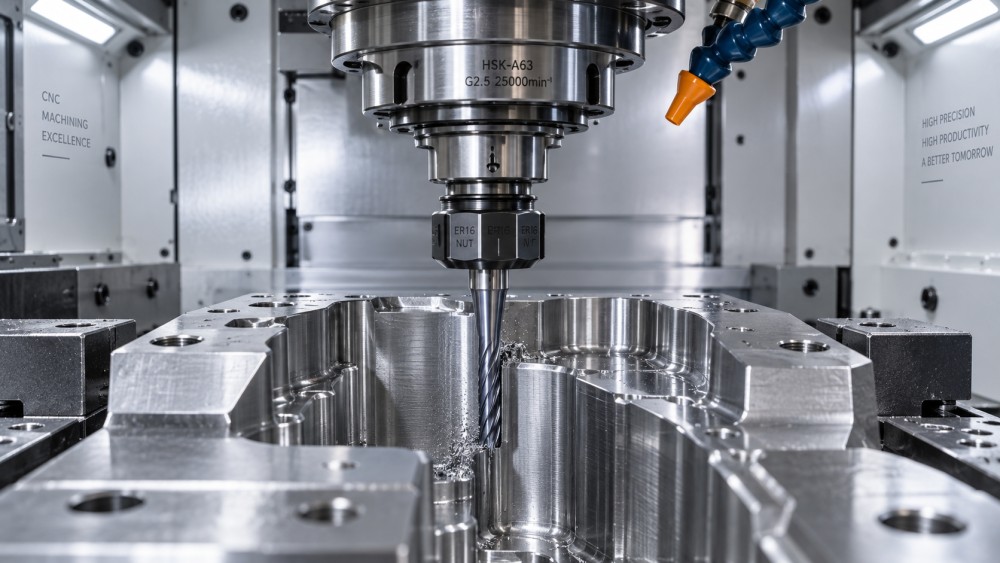
Measurement discipline should therefore be part of chuck evaluation. A meaningful qualification procedure uses a certified or known-good test pin, a clean assembled holder, a specified gauge length, and a repeatable indication method. The same assembly should then be checked with the intended production tool, because a tool shank can introduce error that is not visible during a test-pin inspection.
It is also useful to distinguish static runout from dynamic behaviour. A setup may indicate acceptably at rest but become unstable at speed because of imbalance, asymmetric nut geometry, contamination, or insufficient clamping stiffness. Static concentricity is necessary, but it is not a complete high-speed capability assessment.
The collet range affects concentricity and process control
Collet systems are valued because they cover a wide range of shank diameters with relatively compact tooling. That flexibility has a limit. A collet generally performs best when it clamps a tool close to its nominal diameter. Using the extreme end of a collet’s compression range can reduce contact uniformity and increase the risk of inconsistent repeatability.
This does not mean every tool requires a dedicated chuck. It means that a technical evaluation should identify which tools are process-critical. Small finishing cutters, reamers, drills requiring tight positional control, and tools used in long unattended cycles justify more restrictive collet selection than general-purpose roughing cutters.
Metric and inch shanks require particular care. A nominally similar size is not necessarily an acceptable substitute. A mismatch can produce incomplete contact, accelerated collet wear, inadequate retention, or radial displacement. The correct response is not to increase tightening torque beyond the supplier’s recommendation. Excessive torque can damage threads, distort components, and create a false sense of security while making future runout less predictable.
Collet condition matters as much as nominal size. Slots should be clean, free of packed coolant residue, and inspected for cracking or burrs. The internal bore should not show scoring caused by shank slippage. The external taper must seat fully in the chuck. A collet that has been dropped, overtightened, or repeatedly used with unsuitable shank sizes should not remain in service simply because it still closes around a tool.
Gripping force must be assessed against the cutting mechanism
High gripping force is not universally equivalent to better machining. The required retention depends on torque, axial cutting force, interrupted engagement, tool shank condition, thermal effects, and the direction in which the tool tends to move under load. The collet must prevent both rotational slip and axial pull-out while preserving enough concentricity and damping for the operation.
Conventional end milling can generate a torque-driven tendency to rotate the tool within the holder. Heavy axial engagement, difficult materials, peck drilling, and aggressive ramping can also create axial loading that works against retention. In these cases, a general-purpose collet configuration may be unsuitable even if the nominal tool diameter is within range.
Tool shank design changes the analysis. Smooth cylindrical shanks depend on friction and distributed clamping contact. Weldon flats, locking features, or purpose-designed anti-pull-out systems address retention differently, but may compromise concentricity, balance, or tool-change convenience. The best arrangement depends on the failure mode that must be controlled.
Where stable finishing is the priority, a high-precision collet chuck with a properly matched smooth shank may be preferable to a side-lock arrangement that introduces radial offset. Where large cutters, high torque, or severe interrupted cuts create a credible pull-out risk, retention may take priority over the lowest possible runout. The process should not be forced into a finishing-oriented chuck merely because it is rated for high rotational speed.
Clamping length also deserves attention. A tool held too shallowly has less effective contact area and lower bending support. It may be retained at low load yet deflect under cutting force, making the apparent runout problem partly a stiffness problem. Conversely, a tool inserted too deeply can interfere with internal chuck geometry or coolant delivery. The manufacturer’s minimum insertion guidance should be treated as an operating condition, not a suggestion.
Balance quality becomes more consequential as speed and overhang increase
At high rotational speed, even a small mass asymmetry produces centrifugal force that can affect spindle bearings, surface finish, and tool life. The risk increases when the tool projection is long, the cutting tool is asymmetrical, the nut has an uneven mass distribution, or coolant residue accumulates on the assembly.
A collet chuck should be evaluated as an assembled rotating unit. A balanced holder body fitted with an unsuitable nut, an improperly seated collet, or a tool with substantial asymmetry can no longer be assumed to meet the holder’s original balance condition. Published balance information is useful only when it identifies the assembly configuration and the speed at which the statement applies.
Balance grades are commonly communicated using the ISO 21940 balancing framework, but the grade alone is insufficient for comparison. Residual unbalance depends on rotational speed and rotor mass. A technical review should ask whether the stated grade applies to the holder alone or to a toolholder-collet-nut assembly, and whether the selected configuration remains suitable at the machine’s planned operating speed.
Nut selection is often underestimated. Standard external nuts can offer good usability, but their geometry may increase diameter near the tool nose and can be less favourable for high-speed balancing than slim, precision-ground, or sealed alternatives. Ball-bearing nuts may reduce tightening friction and improve the consistency of clamping torque, yet they add components that require clean handling and maintenance. The correct nut is the one that supports the required grip, clearance, and balance condition without creating an avoidable collision risk.
Tool access is a machining constraint, not a convenience feature
Many high-speed machining tasks involve complex workpiece geometry rather than open, easily accessible surfaces. Deep cavities, steep walls, ribs, impellers, mould inserts, and five-axis profiles often demand short, narrow holder noses. In these situations, a chuck with excellent runout but a large outside diameter may force excessive tool stick-out just to clear the workpiece. That longer projection can reduce stiffness enough to negate the original accuracy advantage.
The useful comparison is therefore not only holder diameter. It is the clearance envelope created by the entire assembly: nose diameter, nut profile, tool projection, approach angle, machine kinematics, fixture location, and programmed tool orientation. A compact nut can improve access, but it must still deliver adequate clamping load and withstand the required speed.
Five-axis machining makes this relationship particularly important. Tool access may vary substantially as the rotary axes move, and a holder that clears the model in one orientation may collide during lead-in, retract, or tilt transitions. Collision verification should use the actual selected holder model, not a generic cylindrical holder approximation. A few millimetres of unmodelled nut diameter can be decisive in close-clearance work.
Short-gauge collet chucks can be beneficial where spindle-to-cutting-edge distance must be minimized. However, a shorter holder does not automatically mean a better dynamic result. The reduced length must still accommodate sufficient clamping depth, coolant requirements, and the practical need to tighten and release the tool without damaging the nut or collet.
Coolant delivery and contamination control influence repeatability
Coolant-through capability is frequently included in a tooling specification but evaluated too late. Internal coolant can improve chip evacuation in deep features and drilling operations, yet the sealing arrangement must suit the actual tool shank and coolant pressure. A sealing disc or sealed collet used outside its intended diameter range can create leakage, pressure loss, or inconsistent chip evacuation.
External coolant also interacts with chuck geometry. A large nut or bulky nose can shadow coolant from the cutting zone, particularly in deep-wall milling. That can raise recutting risk and contribute to localized thermal loading. The holder should be considered with the machine’s coolant strategy and the chip flow expected from the material and operation.
Cleanliness is equally important. Collet systems contain multiple close-contact surfaces, so dried coolant, fine chips, corrosion residue, and lubricant buildup can alter seating. A practical maintenance routine should include cleaning the holder bore, collet taper, nut threads, and tool shank; inspecting for wear; and applying only the lubricant specified for the system. Lubricating the wrong surface can reduce friction where clamping depends on it, while leaving threads dry can make tightening torque inconsistent.
Interface compatibility should be reviewed beyond the taper designation
A CAT, BT, HSK, or similar interface designation does not resolve every compatibility issue. The holder must match the machine spindle interface, retention system, pull-stud or retention-knob specification where applicable, and available gauge length. For HSK systems, face and taper contact behaviour is central to the interface design, so cleanliness and correct handling are particularly important. For steep-taper systems, drawbar condition and taper contact quality can strongly influence repeatability.
Tool presetting capability should also be considered. If a process relies on offline measurement, the chuck design must allow repeatable assembly and a practical reference surface. A holder that is difficult to clean, inconsistent to tighten, or awkward to measure can add variation before it reaches the machine.
Where existing holders are being compared with a new collet chuck system, the technical review should avoid using spindle speed as the only decision criterion. The more relevant questions are whether the new system changes gauge length, clearance, tool protrusion, balancing procedure, or the method used to control pull-out. Any one of those changes can require revised cutting parameters or updated collision checks.
A defensible selection approach
The most reliable choice begins with the operation rather than the holder catalogue. Group tools by diameter, shank type, cutting load, projection, speed, finish requirement, and access constraint. This reveals where one flexible collet system is appropriate and where a more specialized solution is justified.
For each critical operation, define the allowable runout at the effective cutting length, the minimum required clamping depth, the maximum permissible holder envelope, and the intended rotational speed. Then assess the complete assembly rather than a bare chuck body. Confirm the collet size, nut type, coolant arrangement, balancing condition, and spindle interface as one configuration.
The best high-speed collet chuck is rarely the one with the lowest isolated runout figure, the highest stated gripping force, or the smallest nose diameter considered separately. It is the configuration that preserves stable tool retention and radial accuracy while allowing the shortest practical projection and safe access to the feature being machined. When those conditions are verified together, collet chucks become a controlled part of machining performance rather than an overlooked source of variation.
Related News
- How to Assess a Rigid Coupling Supplier for Bore Accuracy and Traceable QualityOct 08, 2026Tribology & Kinematics Expert
- Titanium Alloys Compared: Balancing Strength, Corrosion Resistance, and MachinabilityOct 08, 2026CNC Kinematics Architect
- Where Ductile Iron Dismantling Joints Reduce Alignment Risk in Water PipelinesOct 08, 2026Pipeline Metallurgy Scientist
- Selecting a Precision Bearing Sleeve: Fits, Runout, and Material ChoicesOct 08, 2026Tribology & Kinematics Expert
- Face Milling Cutters: How Insert Geometry Affects Finish on Steel and AluminumOct 08, 2026CNC Kinematics Architect
- Single-Acting Cylinders for Clamping: Stroke, Force, and Return Spring ConsiderationsOct 07, 2026Fluid Power Control Strategist