
5-Axis or 3-Axis Machining Centers: Which Fits Complex Parts and Throughput Goals?
When complex geometries, tight tolerances, and production speed all matter, choosing between 5-axis and 3-axis Machining Centers becomes a strategic decision. For project managers and engineering leaders, the right machine setup affects part quality, lead time, secondary operations, and overall manufacturing cost. This article explores how each option fits different complexity levels and throughput goals in real industrial production.
What Project Managers Really Need to Decide First
The core search intent behind this topic is practical comparison. Readers are not looking for a textbook definition of axes. They want to know which machine configuration better supports part complexity, delivery targets, and commercial performance.
For project managers and engineering leaders, the real question is not whether 5-axis machining is more advanced. It is whether that added capability creates enough production value to justify higher machine rates, programming effort, and process complexity.
In most cases, the answer depends on part geometry, tolerance stack-up, setup count, and production volume. If a component requires multiple faces, compound angles, and tight positional accuracy, 5-axis Machining Centers often create a stronger business case.
If the part is relatively open, prismatic, and accessible from standard orientations, 3-axis Machining Centers may deliver lower cost per part, simpler process control, and easier scheduling. The right choice is usually linked to the job mix, not the marketing label.
When 5-Axis Machining Centers Deliver Clear Value
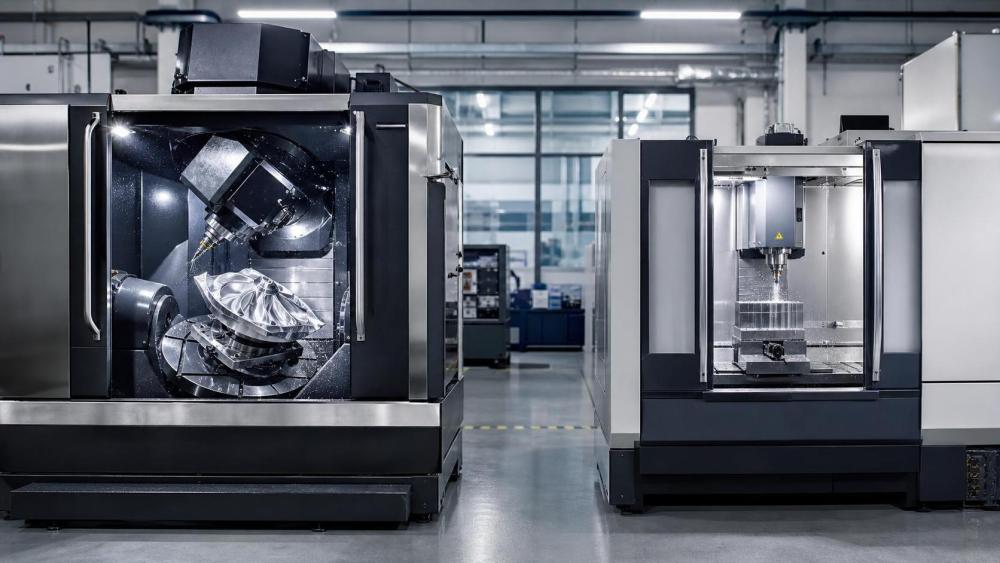
5-axis Machining Centers are built for parts that are difficult to finish efficiently with repeated repositioning. Their main advantage is the ability to approach complex surfaces and multiple features in a single clamping cycle.
This matters when the component includes deep cavities, angular features, sculpted profiles, or critical relationships between surfaces. Aerospace brackets, impellers, medical components, mold inserts, robotics parts, and energy equipment often fall into this category.
For project teams, the biggest gain is usually not speed alone. It is the reduction of setup transfers, fixture changes, manual reorientation, and tolerance variation introduced every time a part leaves its original reference condition.
When several operations can be consolidated into one machine cycle, dimensional consistency often improves. That can reduce scrap, rework, and inspection burden, especially on parts where datum relationships are more important than simple linear dimensions.
Another major benefit is surface access. With tool tilt and rotary movement, shorter cutting tools can often be used. That helps reduce chatter, improves surface finish, and supports better stability on hard materials or thin-wall geometries.
From a project delivery standpoint, 5-axis capability also shortens process routing. Fewer handoffs between machines means fewer queues, fewer transport delays, and less risk that an urgent job will stall between roughing, repositioning, and finishing stages.
Where 3-Axis Machining Centers Still Make Strong Business Sense
3-axis Machining Centers remain highly effective for a large share of industrial parts. They are often the better option when components are straightforward, features are accessible from one direction, and process repeatability matters more than geometric freedom.
Base plates, housings, covers, mounting blocks, frames, manifolds, and many fixture components can be produced very competitively on 3-axis equipment. For these jobs, adding 5-axis motion may not create enough value to offset machine cost and programming complexity.
3-axis platforms are also easier to staff and maintain in many shops. Programming is simpler, setup planning is more familiar, and training demands are lower. For manufacturers managing broad production schedules, that can be a meaningful operational advantage.
In medium to high volume work with standardized part families, a well-optimized 3-axis cell can deliver excellent throughput. Dedicated fixtures, pallet systems, and stable tool paths often produce predictable cycle times and straightforward quality control.
Cost control is another reason many buyers still prefer 3-axis production where possible. Machine hourly rates are generally lower, CAM programming time may be shorter, and replacement tooling strategies can be easier to standardize across multiple jobs.
For project leaders evaluating supplier capability, that means advanced equipment should not automatically be treated as better. The better process is the one that matches part geometry, quality targets, and delivery economics with the least unnecessary complexity.
Complex Parts: The Best Choice Depends on More Than Shape Alone
Many procurement and engineering teams make the mistake of classifying parts as complex based only on appearance. In reality, machining complexity comes from the combination of geometry, tolerance, material behavior, and process access.
A part may look simple but still be difficult to machine if it includes tight true-position requirements across several faces. Another part may have a curved form but still run efficiently on 3-axis equipment with the right fixture strategy.
To judge whether 5-axis Machining Centers are justified, teams should review several factors. These include the number of required setups, angular feature density, tool reach constraints, inspection risks, and how much tolerance drift setup changes may introduce.
Material also matters. Titanium, Inconel, hardened steels, and unstable forged or cast blanks often benefit from more efficient tool orientation and reduced reclamping. In these cases, process stability can be as important as raw cycle time.
Part origin should also be considered. Components machined from castings or forgings may have irregular stock conditions. A 5-axis machine can help adapt to variable access and preserve critical datums, especially when near-net shapes are involved.
For industrial buyers, the key takeaway is simple. Complex parts should be evaluated through manufacturing risk, not only design appearance. That is the level where machine selection starts influencing schedule confidence and total project cost.
Throughput Goals: Faster Production Is Not Just About Spindle Time
Throughput is one of the most misunderstood parts of the 3-axis versus 5-axis decision. Many teams assume the faster machine is the one with the shortest programmed cycle time. In practice, total throughput includes much more than spindle engagement.
Real production flow includes setup time, fixture loading, queue delays, in-process inspection, rework, and movement between operations. A machine that cuts faster but requires more part handling may still lose on weekly output and delivery reliability.
5-axis Machining Centers often improve throughput by reducing process steps. When one setup replaces three or four, the cumulative savings in labor, staging, and error correction can be larger than the pure machining time difference.
That advantage becomes especially important for low-volume, high-mix production. Shops serving aerospace, energy, robotics, medical, and custom OEM programs often gain more from process consolidation than from simple high-speed roughing capability.
On the other hand, if throughput depends on continuous production of repeatable prismatic parts, multiple 3-axis machines may outperform one 5-axis machine in total output. Parallel production can reduce bottlenecks and create more flexible scheduling options.
Project managers should therefore define throughput in business terms. The right metric may be shipped parts per week, approved parts per shift, or lead time from raw material release to inspection clearance, not just minutes per cycle.
How Setup Reduction Changes Cost, Quality, and Delivery Risk
Setup count is often the most decisive difference between 3-axis and 5-axis production. Every additional setup adds labor, fixture dependency, alignment risk, and the possibility of tolerance accumulation across separate operations.
For parts with critical relationships between bores, faces, and angled features, each reclamping event increases uncertainty. Even when individual operations remain within tolerance, cumulative variation can create final assembly issues or dimensional rejection.
By machining more features in one cycle, 5-axis Machining Centers can protect datum continuity. That directly supports better geometric accuracy, especially where flatness, perpendicularity, profile, and true position need to be maintained simultaneously.
There is also a scheduling advantage. Fewer setups mean fewer operator interventions and fewer opportunities for a job to wait for the next available machine. That can materially improve lead-time performance in busy contract manufacturing environments.
However, setup reduction only creates value when supported by capable fixtures, post-processing, and verification. A poorly planned 5-axis process can still lose time through long prove-outs, collision risk, or unstable tool engagement.
That is why project teams should ask suppliers not only whether they own 5-axis equipment, but how they use it. The maturity of the process often matters more than the machine specification itself.
Questions Buyers Should Ask Before Choosing a Machining Route
For OEM buyers, EPC teams, and industrial sourcing managers, the most useful comparison comes from supplier dialogue. The decision should be based on measurable process logic rather than assumptions about technology level.
Start with setup strategy. Ask how many setups are required on 3-axis versus 5-axis equipment, and which datums are maintained through the process. This reveals whether the supplier is managing tolerance risk or simply quoting machine access.
Next, ask about cycle time structure. Separate cutting time from loading, probing, inspection, deburring, and transfer time. A quote that looks attractive on machine hours may hide significant secondary handling that affects actual throughput.
It is also worth reviewing fixturing and workholding plans. Complex parts often succeed or fail based on how securely they are held and how consistently that holding method supports repeatability across batches.
Inspection planning is another important signal. Suppliers should explain how they verify multi-face features, angular geometry, and critical positional relationships. CMM capability, in-process probing, and documented control plans all reduce project risk.
Finally, ask whether the supplier recommends 5-axis because the part truly requires it, or because that is the machine they want to keep busy. The strongest suppliers can explain both options and justify the chosen route with engineering logic.
When a Hybrid Strategy Is the Smartest Option
In many industrial programs, the best solution is not an absolute choice between 3-axis and 5-axis Machining Centers. A hybrid strategy often creates the strongest balance of cost control and technical performance.
For example, roughing and simple reference features may be completed efficiently on 3-axis equipment, while final contouring and angular finishing move to a 5-axis platform. This can reduce premium machine time without sacrificing part quality.
Another common approach is segmentation by product family. Standard parts remain on 3-axis production lines, while complex variants or prototype runs are assigned to 5-axis machines. That keeps overall capacity aligned with order mix.
Hybrid planning can also support phased investment. Manufacturers that are not ready for full 5-axis production across all jobs may reserve that capability for critical projects, high-margin parts, or customer programs with demanding documentation requirements.
For project leaders, this approach is often the most realistic. It avoids oversimplified technology decisions and instead connects machine strategy to the actual economics of product complexity, volume profile, and customer expectations.
Conclusion: Match the Machine to the Production Objective
If your parts involve multi-face machining, compound angles, difficult tool access, and tight positional requirements, 5-axis Machining Centers usually provide stronger value through setup reduction, accuracy control, and shorter production routing.
If your production focuses on accessible prismatic parts, repeatable operations, and efficient high-volume flow, 3-axis Machining Centers often remain the more economical and operationally stable choice.
For project managers and engineering decision-makers, the right comparison is not advanced versus basic. It is whether the machining route reduces total manufacturing risk while meeting throughput, quality, and cost objectives.
The most effective sourcing and planning decisions come from looking beyond machine labels. Evaluate setup count, tolerance sensitivity, material behavior, fixturing, inspection strategy, and total workflow efficiency. That is how Machining Centers should be judged in real industrial production.
Related News
- Using Industrial Air Blow Guns to Clear Chips Without Spreading DebrisOct 15, 2026Fluid Power Control Strategist
- Ductile Iron Pipe Valves: Which AWWA Standards Apply to Water Main Projects?Oct 15, 2026Dr. Elias Vance
- Why Vacuum Suction Cups Lose Grip on MDF in Woodworking MachinesOct 15, 2026CNC Kinematics Architect
- Choosing a Variable Displacement Piston Pump Manufacturer: What to VerifyOct 15, 2026Fluid Power Control Strategist
- Parallel vs. Angular Pneumatic Grippers for Confined Assembly StationsOct 15, 2026Fluid Power Control Strategist
- Die Castings vs. Investment Castings: Which Costs Less at Your Production Volume?Oct 14, 2026Foundry Phase-Change Fellow